Vera-Estrada I L, Uribe-Godínez J, Jiménez-Sandoval O
Centro de Investigación y de Estudios Avanzados del Instituto Politécnico Nacional Unidad Querétaro, Libramiento Norponiente 2000, Fracc. Real de Juriquilla Querétaro, Qro. 76230 MEXICO
Centro Nacional de Metrología Km 4.5 Carretera a Los Cués El Marqués Qro. 76246 MEXICO.
RSC Adv. 2020 Jun 12;10(38):22586-22594. doi: 10.1039/d0ra02904a. eCollection 2020 Jun 10.
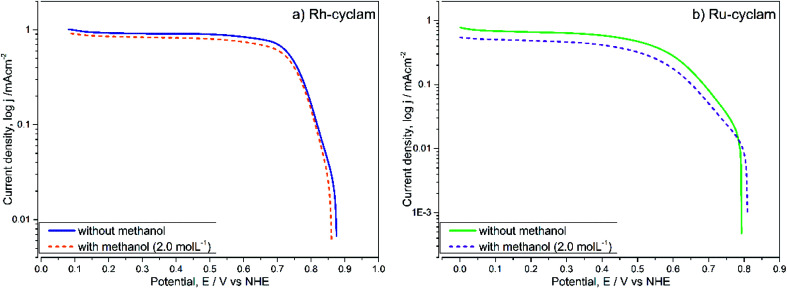
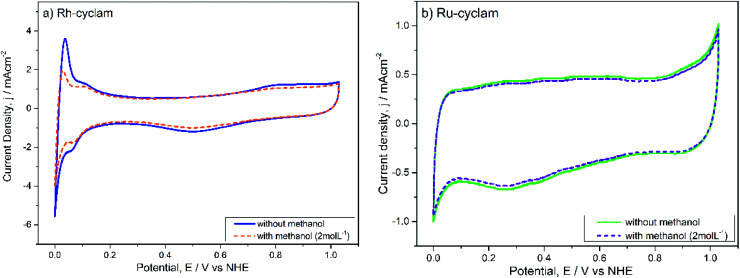
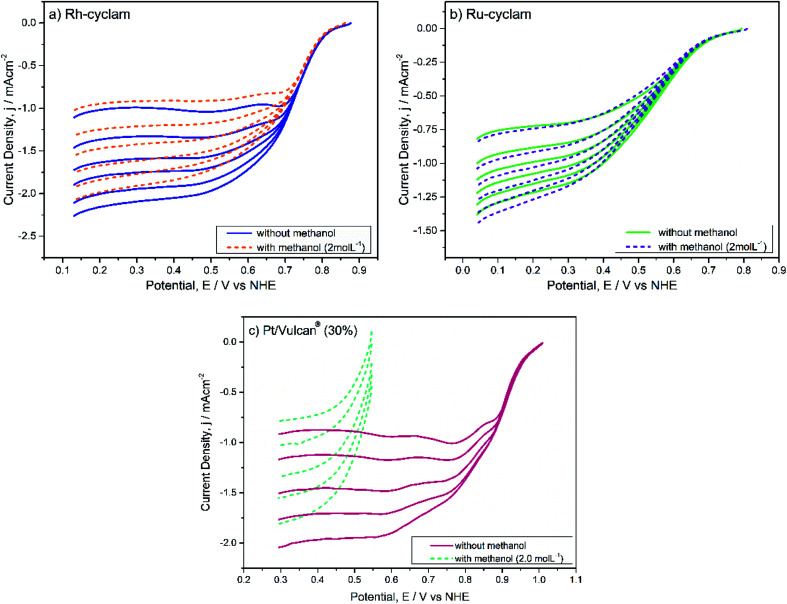
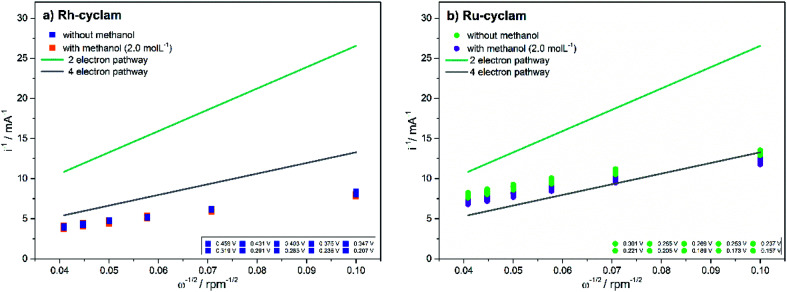
Transition metal macrocyclic complexes have acquired relevance as electrocatalysts to perform oxygen electroreduction in acid media as an alternative to platinum. This work presents two macrocyclic complexes using cyclam as ligand, which has a much simpler molecular structure (smaller size, no π-electrons, ) than the well studied porphyrins and phthalocyanines as transition metal complexes. Such compounds are usually subjected to thermal treatments at relatively high temperatures (800-900 °C) which result in ligand decomposition, leaving the so-called MN active sites. In contrast, the complexes reported in this work are efficient electrocatalysts for the oxygen reduction reaction (ORR) in their original molecular structure, with no thermal treatments of any kind applied. The electrocatalytic activity of the Rh(iii)-cyclam and Ru(iii)-cyclam complexes during the ORR in the absence and presence of methanol (2 mol L) was evaluated by voltammetry techniques. The kinetic parameters of the novel materials for the reaction were determined. The exchange current density ( ) values, directly related to the charge transfer velocity, are of the same order as or higher than those of platinum/Vulcan® nanoparticles. In addition, they are practically unaffected by methanol, therefore, becoming interesting candidates to be evaluated as cathodes in polymer electrolyte membrane and direct methanol fuel cells.
过渡金属大环配合物作为在酸性介质中进行氧电还原的电催化剂,已成为铂的替代物,具有重要意义。这项工作展示了两种以环胺为配体的大环配合物,与研究充分的卟啉和酞菁等过渡金属配合物相比,环胺具有更简单的分子结构(尺寸更小,无π电子)。这类化合物通常要在相对较高的温度(800 - 900℃)下进行热处理,这会导致配体分解,留下所谓的MN活性位点。相比之下,这项工作报道的配合物在其原始分子结构下就是氧还原反应(ORR)的高效电催化剂,无需进行任何热处理。通过伏安法技术评估了Rh(iii)-环胺和Ru(iii)-环胺配合物在不存在和存在甲醇(2 mol L)的情况下ORR过程中的电催化活性。测定了新型材料反应的动力学参数。与电荷转移速度直接相关的交换电流密度()值与铂/Vulcan®纳米颗粒的值处于同一量级或更高。此外,它们几乎不受甲醇影响,因此,有望成为聚合物电解质膜和直接甲醇燃料电池阴极的评估对象。