
评估原代人肝细胞在多孔丝绵海绵中的培养兼容性。
Assessing the compatibility of primary human hepatocyte culture within porous silk sponges.
作者信息
Kukla David A, Stoppel Whitney L, Kaplan David L, Khetani Salman R
机构信息
Department of Bioengineering, University of Illinois at Chicago 851 S Morgan St, 218 SEO Chicago IL 60607 USA
Department of Biomedical Engineering, Tufts University Medford MA USA.
出版信息
RSC Adv. 2020 Oct 12;10(62):37662-37674. doi: 10.1039/d0ra04954a.
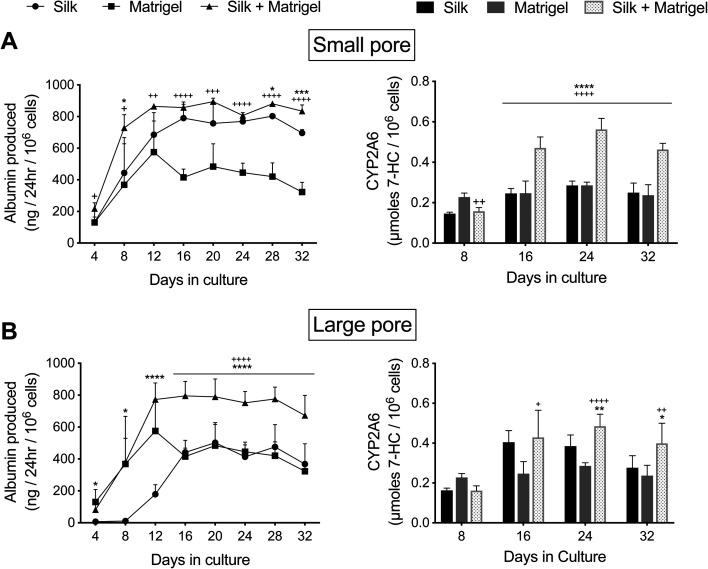
Donor organ shortages have prompted the development of alternative implantable human liver tissues for patients suffering from end-stage liver failure. Purified silk proteins provide desirable features for generating implantable tissues, including sustainable sourcing from insects/arachnids, biocompatibility, tunable mechanical properties and degradation rates, and low immunogenicity upon implantation. While different cell types were previously cultured for weeks within silk-based scaffolds, it remains unclear whether such scaffolds can be used to culture primary human hepatocytes (PHH) isolated from livers. Therefore, here we assessed the compatibility of PHH culture within porous silk scaffolds that enable diffusion of oxygen/nutrients through the pores. We found that incorporation of type I collagen during the fabrication and/or autoclaving of porous silk scaffolds, as opposed to simple adsorption of collagen onto pre-fabricated silk scaffolds, was necessary to enable robust PHH attachment/function. Scaffolds with small pores (73 ± 25 μm) promoted larger PHH spheroids and consequently higher PHH functions than large pores (235 ± 84 μm) for at least 1 month in culture. Further incorporation of supportive fibroblasts into scaffolds enhanced PHH functions up to 5-fold relative to scaffolds with PHHs alone and 2D co-cultures on plastic. Lastly, encapsulating PHHs within protein hydrogels while housed in the silk scaffold led to higher functions than protein hydrogel-only or silk-only controls. In conclusion, porous silk scaffolds containing extracellular matrix proteins can be used for the culture of PHHs ± supportive non-parenchymal cells, which can be further built on in the future to create optimized silk-based liver tissue surrogates for cell-based therapy.
供体器官短缺促使人们为终末期肝衰竭患者开发替代性可植入人体肝脏组织。纯化的丝蛋白为生成可植入组织提供了理想的特性,包括可从昆虫/蛛形纲动物可持续获取、生物相容性、可调节的机械性能和降解速率,以及植入时的低免疫原性。虽然此前不同细胞类型曾在基于丝的支架内培养数周,但尚不清楚此类支架是否可用于培养从肝脏分离的原代人肝细胞(PHH)。因此,我们在此评估了PHH在多孔丝支架内的培养相容性,这种支架能够使氧气/营养物质通过孔隙扩散。我们发现,在多孔丝支架的制造和/或高压灭菌过程中加入I型胶原蛋白,而不是简单地将胶原蛋白吸附到预制丝支架上,对于实现强大的PHH附着/功能是必要的。在培养至少1个月的时间里,小孔径(73±25μm)的支架比大孔径(235±84μm)的支架促进形成更大的PHH球体,从而具有更高的PHH功能。进一步将支持性成纤维细胞纳入支架,相对于仅含PHH的支架和在塑料上的二维共培养,可将PHH功能提高多达5倍。最后,将PHH封装在蛋白质水凝胶中并置于丝支架内,其功能高于仅含蛋白质水凝胶或仅含丝的对照组。总之,含有细胞外基质蛋白的多孔丝支架可用于培养PHH±支持性非实质细胞,未来可在此基础上进一步构建,以创建用于细胞治疗的优化丝基肝脏组织替代物。


 Zotero 插件