Cao Xiaoxue, Wu Chongming, Tian Yu, Guo Peng
Institute of Medicinal Plant Development, Chinese Academy of Medical Sciences, Peking Union Medical College Beijing 100193 China
RSC Adv. 2019 Apr 17;9(22):12247-12254. doi: 10.1039/c8ra09395d.
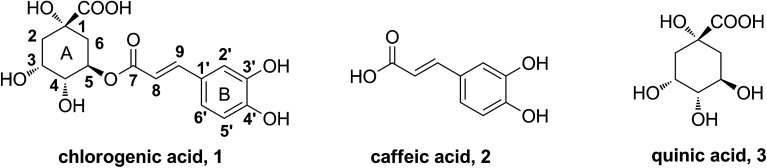
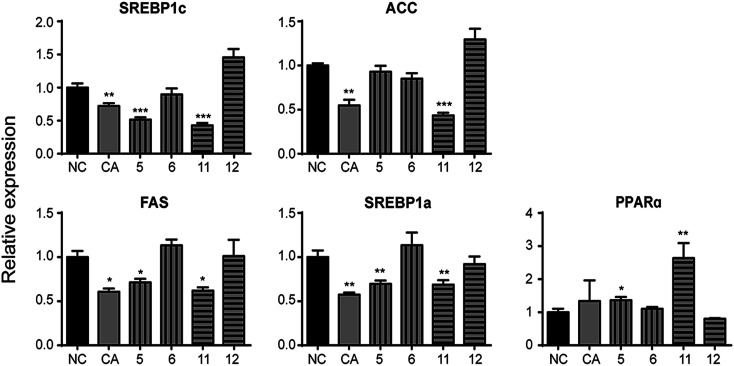
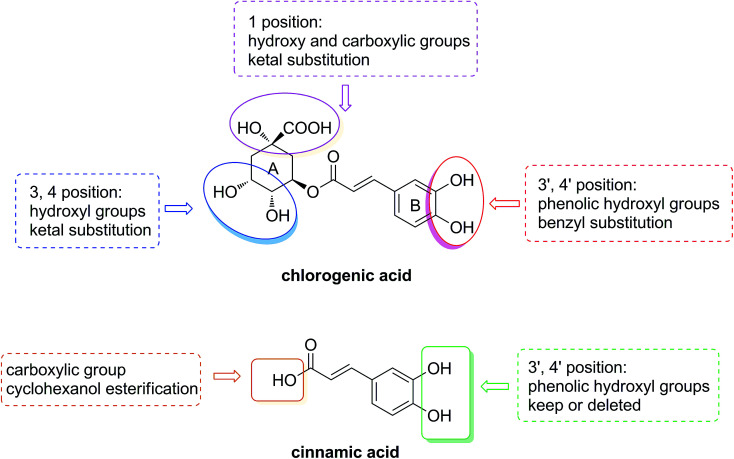
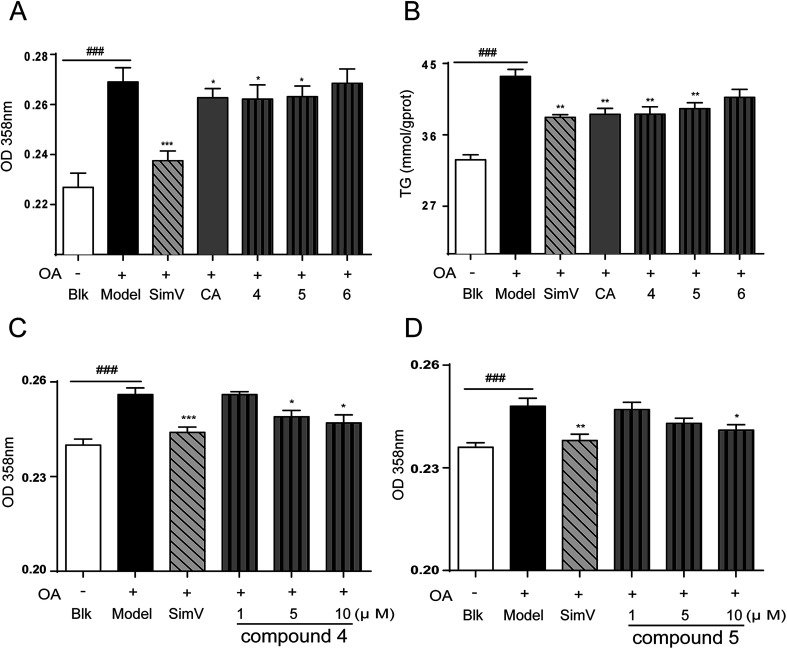
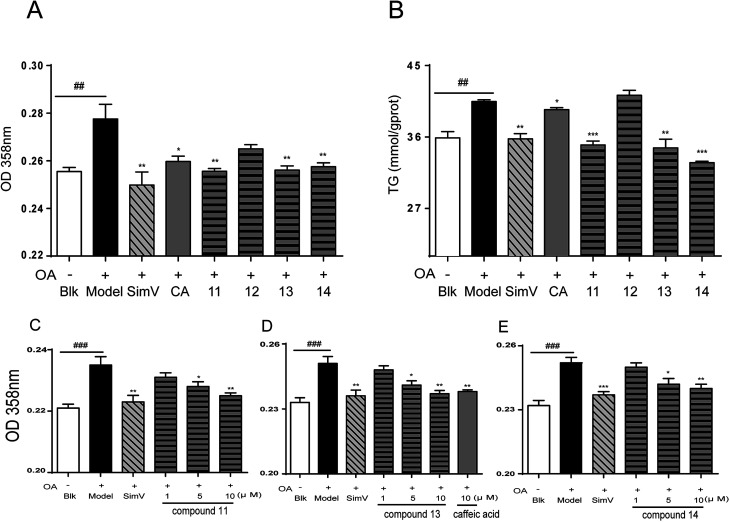
Chlorogenic acid (5-caffeoylquinic, CA) possesses distinct hypolipidemic properties and , yet the structure-activity relationship (SAR) of CA on lipid metabolism remains unknown. To achieve this aim, we designed and synthesized two sets of CA analogues and evaluated their efficacies to prevent oleic acid (OA)-elicited lipid accumulation in HepG2 cells. Blockage of all hydroxyl and carboxyl groups on the quinic acid moiety did not deteriorate the hypolipidemic effect of CA while blockage of all phenolic hydroxyl groups on the caffeic acid moiety abolished the activity of CA. Further replacement of the quinic acid moiety with cyclohexane and modification of individual phenolic hydroxyl groups on the caffeic acid moiety showed that the phenolic-hydroxyl-reserved analogues displayed a more potent hypolipidemic effect than CA, whereas the analogue with no phenolic hydroxyl displayed little effect on the OA-elicited lipid accumulation. In accordance, the modulating effects of CA on the transcription of the lipogenic gene sterol-regulatory element binding protein (SREBP)1c/1a, acetyl-CoA carboxylase (ACC), fatty acid synthase (FAS) and peroxisome proliferator-activated receptor α (PPARα) were also abolished when the phenolic hydroxyl groups on the caffeic acid moiety were blocked. Our results suggest that the phenolic hydroxyl on the caffeic acid moiety is vital for the lipid-lowering activity of CA.
绿原酸(5-咖啡酰奎尼酸,CA)具有明显的降血脂特性,然而CA在脂质代谢方面的构效关系(SAR)仍不清楚。为实现这一目标,我们设计并合成了两组CA类似物,并评估了它们预防油酸(OA)诱导的HepG2细胞脂质积累的效果。奎尼酸部分所有羟基和羧基的封闭并未削弱CA的降血脂作用,而咖啡酸部分所有酚羟基的封闭则消除了CA的活性。进一步用环己烷取代奎尼酸部分并对咖啡酸部分的单个酚羟基进行修饰表明,保留酚羟基的类似物比CA表现出更强的降血脂作用,而没有酚羟基的类似物对OA诱导的脂质积累几乎没有影响。相应地,当咖啡酸部分的酚羟基被封闭时,CA对脂肪生成基因固醇调节元件结合蛋白(SREBP)1c/1a、乙酰辅酶A羧化酶(ACC)、脂肪酸合酶(FAS)和过氧化物酶体增殖物激活受体α(PPARα)转录的调节作用也被消除。我们的结果表明,咖啡酸部分的酚羟基对CA的降脂活性至关重要。