Akbulut Tugba Ozkok, Suslu Hulya, Atci Tugba
Department of Dermatology, Haseki Training and Research Hospital, Istanbul, Turkey.
Sisli Etfal Hastan Tip Bul. 2022 Mar 28;56(1):91-95. doi: 10.14744/SEMB.2021.67503. eCollection 2022.
The aim of this study was to determine the frequency of seborrheic dermatitis (SD) by months and seasons in Istanbul, Turkey, and to examine the relationships between SD frequency and meteorological data, such as average temperature (°C), average humidity (%), average sunshine duration, and solar radiation per months.
The study was conducted at Dermatology Department of Haseki Training and Research Hospital. The data of all adult patients who applied to the dermatology outpatient clinic between June 2018 and May 2020 were obtained. Monthly average climate data values of Istanbul between the same period were requested from the Turkish Ministry of Agriculture and Forestry, General Directorate of Meteorology.
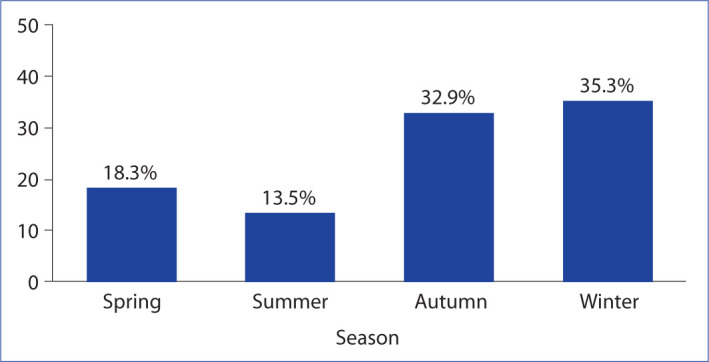
During the study period, SD was diagnosed in 5316 patients (5.9% of the outpatient clinic). Among these, 2721 (51.2%) were male, 2595 (48.8%) were female, and mean age was 35.9±15.1 years-old. With respect to monthly distributions, SD frequency was 7.3% in December, 7.1% in February, 6.7% in November, and 6.6% in January; whereas June (3.8%) and July (3.9%) represented the lowest proportion of patients. Frequency of SD was similar in the autumn and winter seasons, despite considerable difference in average temperature. The frequency of SD was found to be strongly and inversely correlated with temperature values (r=-0,646, p<0.001) and monthly maximum humidity value (r=-0.609, p=0.001), while it was also moderately correlated with solar radiation levels (r=-0.442, p=0.027). Minimum or average humidity values and sunshine durations (daily and monthly) were not associated with frequency of SD. Spearman's Rho correlation was calculated to assess the directional relationships between continuous variables.
Our study shows that environmental factors such as low temperature, low ultraviolet index, and low humidity are critical factors that increase the likelihood of SD development. These data support previous studies in terms of indicating that SD frequency might be increased in climate conditions favoring the growth of Malassezia species.
本研究旨在确定土耳其伊斯坦布尔脂溢性皮炎(SD)按月和季节的发病频率,并探讨SD发病频率与气象数据之间的关系,如每月平均温度(℃)、平均湿度(%)、平均日照时长和太阳辐射量。
本研究在哈塞基培训与研究医院皮肤科进行。获取了2018年6月至2020年5月期间所有到皮肤科门诊就诊的成年患者的数据。同时向土耳其农林部气象总局索要了同一时期伊斯坦布尔的月平均气候数据值。
在研究期间,5316例患者被诊断为SD(占门诊患者的5.9%)。其中,男性2721例(51.2%),女性2595例(48.8%),平均年龄为35.9±15.1岁。按月分布来看,12月SD发病率为7.3%,2月为7.1%,11月为6.7%,1月为6.6%;而6月(3.8%)和7月(3.9%)患者比例最低。尽管平均温度存在显著差异,但秋季和冬季的SD发病率相似。研究发现,SD发病率与温度值(r=-0.646,p<0.001)和月最高湿度值(r=-0.609,p=0.001)呈强负相关,同时也与太阳辐射水平呈中度相关(r=-0.442,p=0.027)。最低或平均湿度值以及日照时长(每日和每月)与SD发病率无关。计算Spearman秩相关系数以评估连续变量之间的方向性关联。
我们的研究表明,低温、低紫外线指数和低湿度等环境因素是增加SD发病可能性的关键因素。这些数据支持了先前的研究,即表明在有利于马拉色菌属生长的气候条件下,SD发病率可能会增加。