L D Poulikakos, Falchetto A Cannone, D Wang, L Porot, B Hofko
Empa, Swiss Federal Laboratories for Materials Science and Technology Überlandstrasse 129 CH-8600 Dübendorf Switzerland
Technische Universitaet Braunschweig Braunschweig Germany.
RSC Adv. 2019 Apr 12;9(21):11602-11613. doi: 10.1039/c9ra00645a.
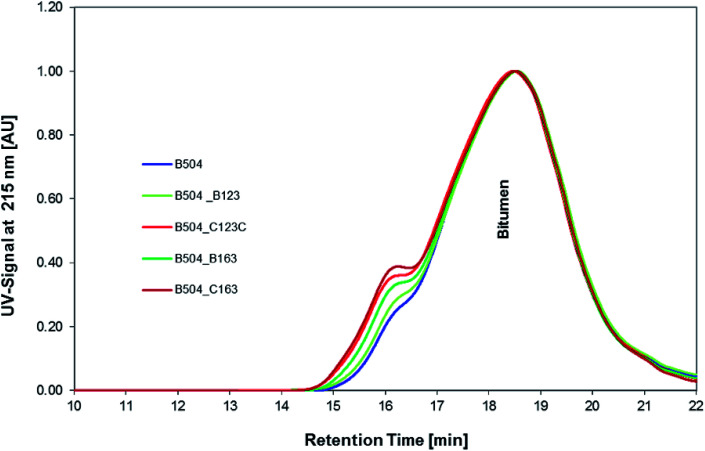
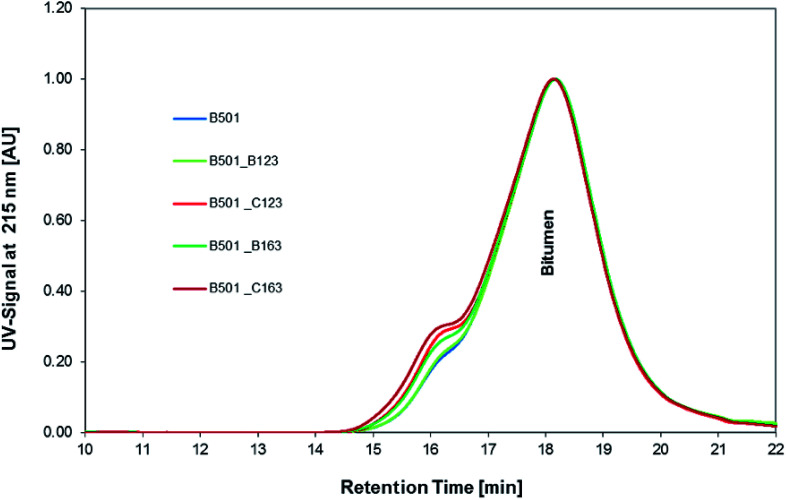
As the use of warm and cold asphalt mixing technologies provides an opportunity to save energy during production, it is important to determine if this lower mixing temperature also has a long-term effect on the binder chemical and rheological properties and performance. In this study, a link between the chemistry and rheology of bituminous binders with a focus on short-term aging temperature is proposed. This link is made using a rheological aging index (RAI), the crossover temperature and a chemical aging index (CAI). The RAI is calculated using the difference in the integration areas under shear modulus master curves generated from Dynamic Shear Rheometer (DSR) data on unaged and aged bitumen. The cross over temperature is defined as that when the material transitions from elastic to viscous behaviour. The CAI is obtained from Fourier-transform infrared spectroscopy (FTIR) measurements by combining the carbonyl and sulfoxide indices. In addition, the effect of aging on the molecular size distribution of the binders was evaluated using Gel Permeation Chromatography (GPC). Two asphalt binders from two sources at two RTFOT aging temperatures 123 °C and 163 °C corresponding to warm mixing and hot mix mixing temperatures respectively were used. The rheological aging index, the chemical aging index and GPC delivered the same trends, showing that the short-term aging temperature has a significant effect on long-term chemical and rheological properties. The extent of this depends on the source as some binders were identified as being more aging resistant.
由于温拌沥青和冷拌沥青技术的使用为生产过程中的节能提供了机会,确定这种较低的拌和温度是否也会对粘结剂的化学和流变性能及性能产生长期影响非常重要。在本研究中,提出了一种以短期老化温度为重点的沥青粘结剂化学与流变学之间的联系。这种联系是通过流变老化指数(RAI)、转变温度和化学老化指数(CAI)建立的。RAI是根据动态剪切流变仪(DSR)对未老化和老化沥青的数据生成的剪切模量主曲线下积分面积的差异来计算的。转变温度定义为材料从弹性行为转变为粘性行为时的温度。CAI是通过傅里叶变换红外光谱(FTIR)测量,结合羰基指数和亚砜指数获得的。此外,使用凝胶渗透色谱法(GPC)评估了老化对粘结剂分子尺寸分布的影响。使用了来自两个来源的两种沥青粘结剂,分别在123℃和163℃的两个RTFOT老化温度下,分别对应温拌温度和热拌温度。流变老化指数、化学老化指数和GPC呈现出相同的趋势,表明短期老化温度对长期化学和流变性能有显著影响。其影响程度取决于来源,因为一些粘结剂被确定为更耐老化。