Kishor Gandhari, Ramesh Vankudoth, Rao Vadithya Ranga, Pabbaraja Srihari, Adiyala Praveen Reddy
Department of Organic Synthesis & Process Chemistry, CSIR-Indian Institute of Chemical Technology (CSIR-IICT) Hyderabad 500007 India
Academy of Scientific and Innovative Research (AcSIR) Ghaziabad 201002 India.
RSC Adv. 2022 Apr 29;12(20):12235-12241. doi: 10.1039/d2ra00753c. eCollection 2022 Apr 22.
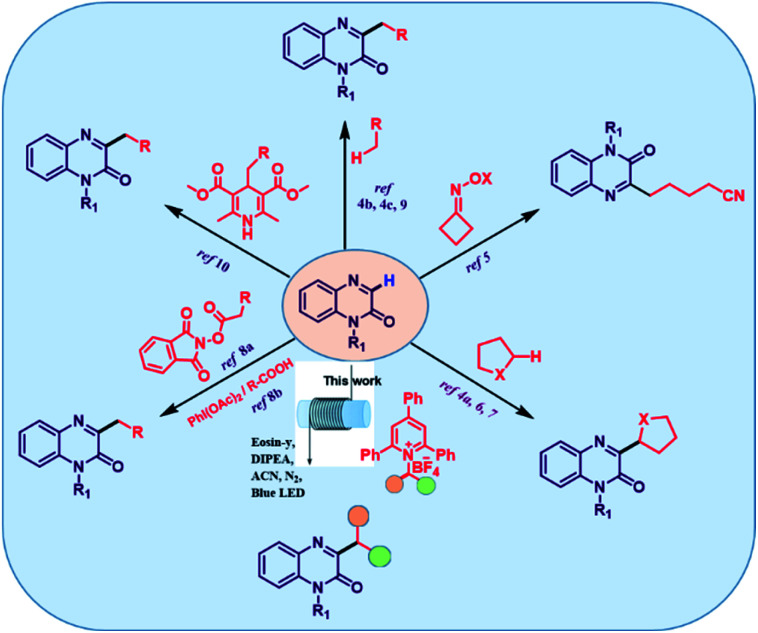
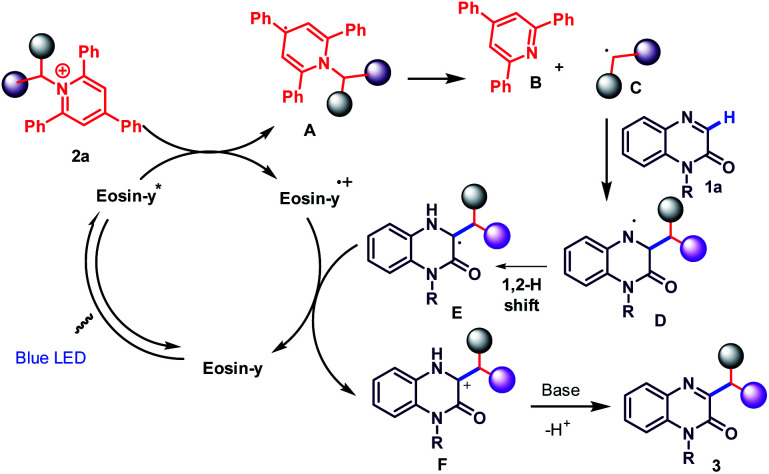
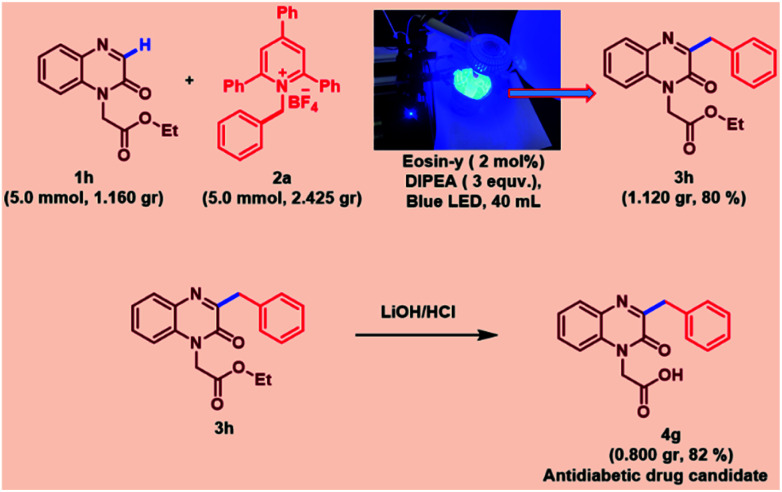
An efficient, transition metal-free visible-light-driven continuous-flow C-3-alkylation of quinoxalin-2(1)-ones has been demonstrated by employing Katritzky salts as alkylating agents in the presence of eosin-y as a photoredox catalyst and DIPEA as a base at room temperature. The present protocol was accomplished by utilizing abundant and inexpensive alkyl amine (both primary and secondary alkyl) and as well as this a few amino acid feedstocks were converted into their corresponding redox-active pyridinium salts and subsequently into alkyl radicals. A wide variety of C-3-alkylated quinoxalin-2(1)-ones were synthesized in moderate to high yields. Further this environmentally benign protocol is carried out in a PFA (Perfluoroalkoxy alkane) capillary based micro reactor under blue LED irradiation, enabling excellent yields (72% to 91%) and shorter reaction times (0.81 min) as compared to a batch system (16 h).
在室温下,以卡氏盐为烷基化试剂,曙红 - y为光氧化还原催化剂,二异丙基乙胺为碱,实现了喹喔啉 - 2(1) - 酮的高效、无过渡金属可见光驱动连续流C - 3烷基化反应。本方法通过使用丰富且廉价的烷基胺(伯烷基和仲烷基)来完成,并且一些氨基酸原料被转化为相应的氧化还原活性吡啶盐,随后转化为烷基自由基。以中等到高的产率合成了多种C - 3烷基化喹喔啉 - 2(1) - 酮。此外,该环境友好型方法在基于PFA(全氟烷氧基烷烃)毛细管的微反应器中,在蓝色LED照射下进行,与间歇系统(16小时)相比,产率优异(72%至91%)且反应时间更短(0.81分钟)。