Wang Shuai, Ding Haichang, Wang Yuesong, Fan Congbin, Liu Gang, Pu Shouzhi
Jiangxi Key Laboratory of Organic Chemistry, Jiangxi Science and Technology Normal University Nanchang Jiangxi 330013 PR China
Institute for Advanced Ceramics, State Key Laboratory of Urban Water Resource and Environment, Harbin Institute of Technology Harbin 150001 PR China.
RSC Adv. 2019 Feb 26;9(12):6643-6649. doi: 10.1039/c8ra09943j. eCollection 2019 Feb 22.
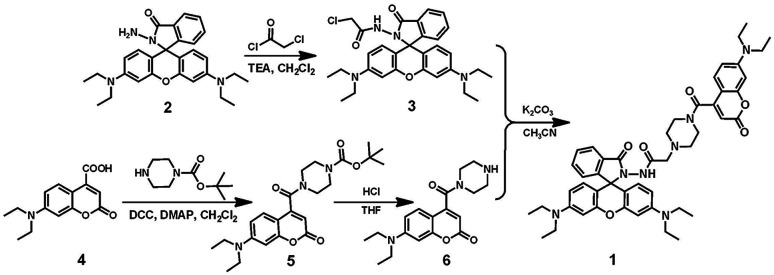
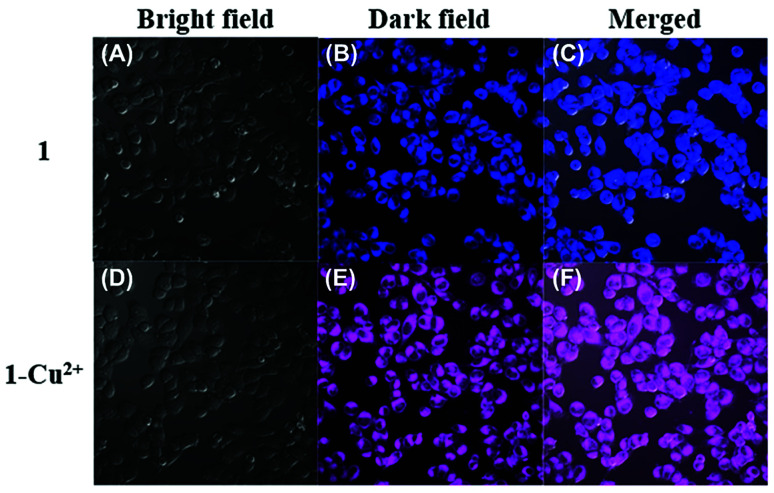
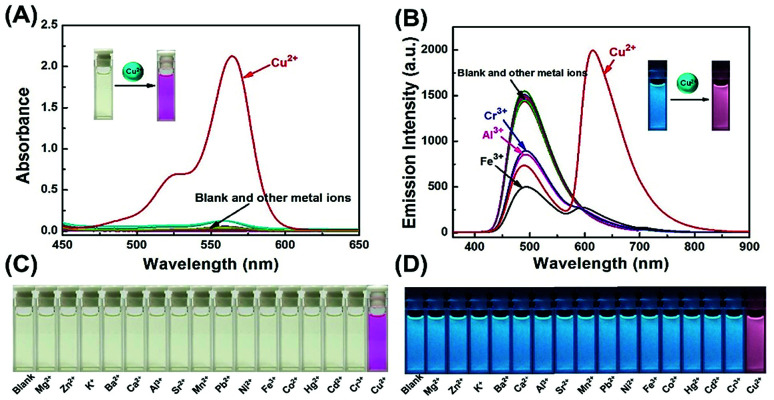
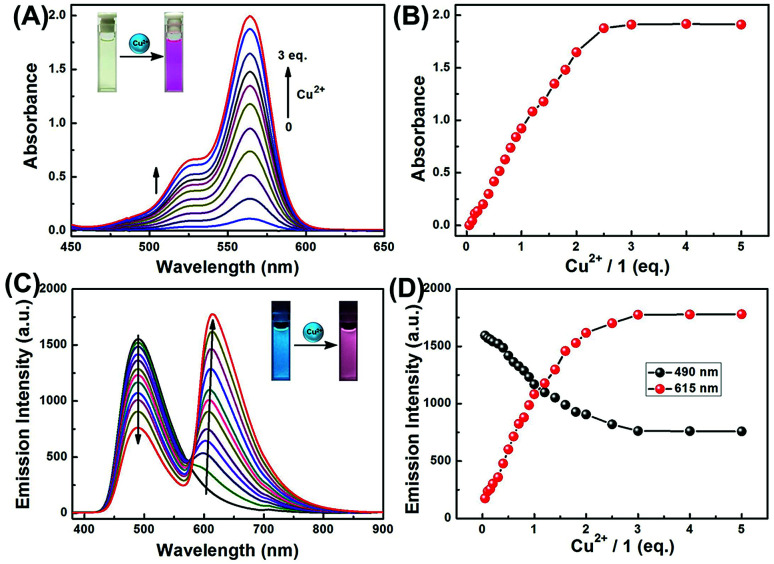
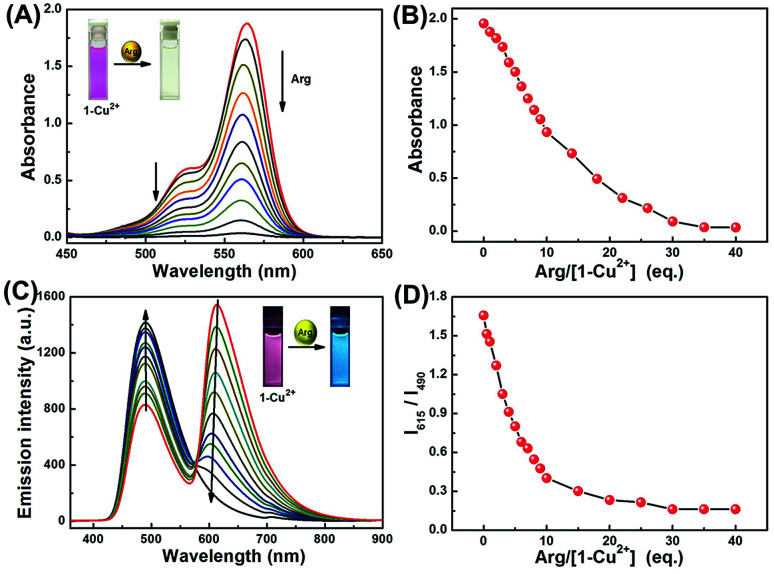
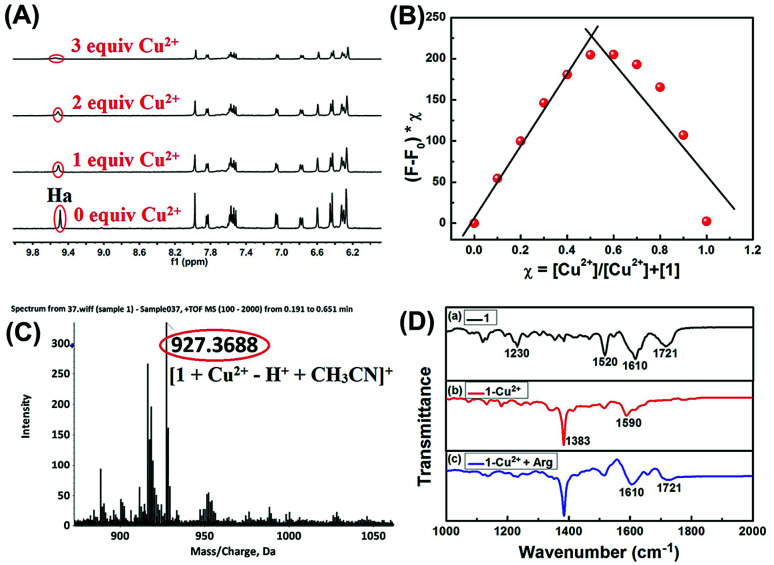
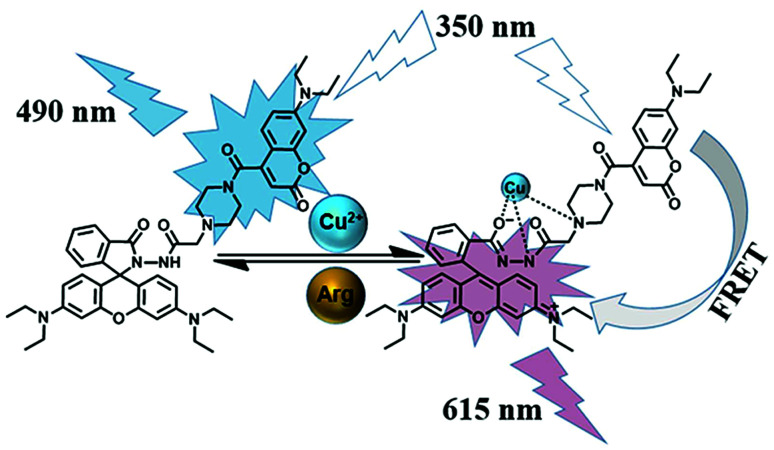
In this work, a colorimetric and ratiometric fluorescent sensor based on a coumarin-rhodamine B hybrid for the sequential recognition of Cu and arginine (Arg) the FRET mechanism was designed and synthesized. With the addition of Cu, the solution displayed a colorimetric change from pale yellow to pink which is discernible by the naked eye. Additionally, the fluorescence intensities of the sensor exhibited ratiometric changes for the detection of Cu at 490 and 615 nm under a single excitation wavelength of 350 nm, which corresponded to the emissions of coumarin and rhodamine B moieties, respectively. The fluorescence color change could be visualized from blue to pink. The limits of detection were determined to be as low as 0.50 and 0.47 μM for UV-vis and fluorescence measurements, respectively. More importantly, the sensor not only can recognize Cu and form a sensor-Cu complex but can also sequentially detect Arg with the resulting complex. The detection limits for Arg were as low as 0.60 μM (UV-vis measurement) and 0.33 μM (fluorescence measurement), respectively. A fluorescence imaging experiment in living cells demonstrated that the fabricated sensor could be utilized in ratiometric fluorescence imaging towards intracellular Cu, which is promising for the detection of low-level Cu and Arg with potentially practical significance.
在这项工作中,设计并合成了一种基于香豆素 - 罗丹明B杂化物的比色和比率荧光传感器,用于顺序识别铜离子(Cu)和精氨酸(Arg),该传感器基于荧光共振能量转移(FRET)机制。加入Cu后,溶液显示出从浅黄色到粉红色的比色变化,肉眼可辨。此外,在350 nm的单一激发波长下,传感器的荧光强度在490和615 nm处对Cu的检测呈现比率变化,这分别对应于香豆素和罗丹明B部分的发射。荧光颜色变化可从蓝色变为粉红色。紫外可见光谱和荧光测量的检测限分别低至0.50和0.47 μM。更重要的是,该传感器不仅可以识别Cu并形成传感器 - Cu络合物,还可以用所得络合物顺序检测Arg。Arg的检测限分别低至0.60 μM(紫外可见光谱测量)和0.33 μM(荧光测量)。活细胞中的荧光成像实验表明,所制备的传感器可用于对细胞内Cu进行比率荧光成像,这对于检测具有潜在实际意义的低水平Cu和Arg具有前景。