Bhandari Priyanka, Sapra Amit, Ajmeri Mohitkumar S, Albers Christine E, Sapra Devanshika
Family Medicine, Southern Illinois University School of Medicine, Springfield, USA.
Family and Community Medicine, Southern Illinois University School of Medicine, Springfield, USA.
Cureus. 2022 Apr 4;14(4):e23806. doi: 10.7759/cureus.23806. eCollection 2022 Apr.
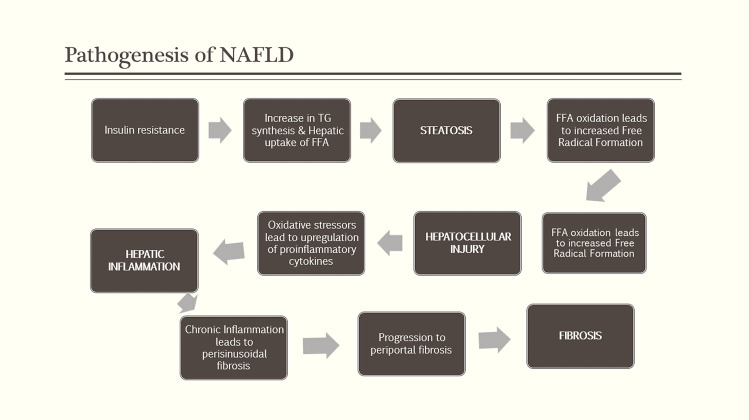
Nonalcoholic fatty liver disease (NAFLD) is a rapidly increasing cause of chronic liver disease with excess fat deposition in the liver, without an identifiable cause. NAFLD's benign form is called nonalcoholic fatty liver (NAFL), which can progress to nonalcoholic steatohepatitis (NASH) with or without fibrosis. Over time, NASH can progress to cirrhosis and eventually hepatocellular carcinoma (HCC) or progress to HCC without cirrhosis. Its incidence and prevalence are increasing to epidemic proportions, making it the most common cause of chronic liver disease in the western world. This review article attempts to understand the epidemiology, pathophysiology, evaluation, and management, and, most importantly, to generate awareness of this disease process.
非酒精性脂肪性肝病(NAFLD)是慢性肝病的一个迅速增加的病因,其特征为肝脏中脂肪过度沉积且无明确病因。NAFLD的良性形式称为非酒精性脂肪肝(NAFL),可进展为伴有或不伴有纤维化的非酒精性脂肪性肝炎(NASH)。随着时间的推移,NASH可进展为肝硬化并最终发展为肝细胞癌(HCC),或在无肝硬化的情况下发展为HCC。其发病率和患病率正上升至流行程度,使其成为西方世界慢性肝病的最常见病因。这篇综述文章试图了解其流行病学、病理生理学、评估和管理,最重要的是,提高对这一疾病过程的认识。