Abhilash Mavinakere Ramesh, Akshatha Gangadhar, Srikantaswamy Shivanna
Department of Studies in Environmental Science, University of Mysore Manasagangotri Mysore 570006 India.
Centre for Materials Science and Technology, Vijnana Bhavan, University of Mysore Manasagangotri Mysore 570006 India
RSC Adv. 2019 Mar 14;9(15):8557-8568. doi: 10.1039/c8ra09929d. eCollection 2019 Mar 12.
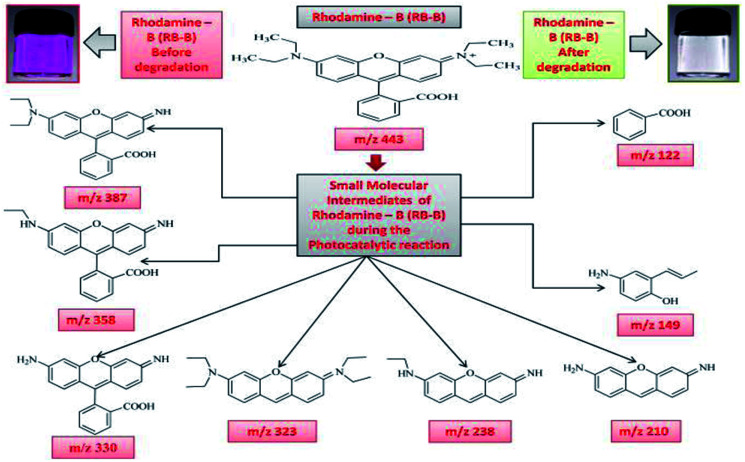
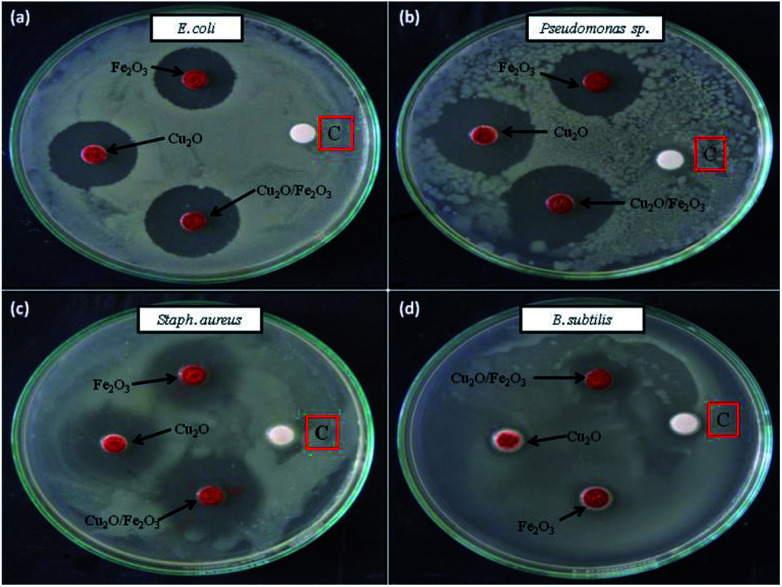
The present study reports the synthesis of the FeO/CuO nanocomposite a facile hydrothermal route. The products were characterized using X-ray diffractometry (XRD), Fourier-transform infrared spectroscopy (FTIR), dynamic light scattering (DLS), high-resolution transmission electron microscopy (HR-TEM), energy dispersive spectroscopy (EDS) and Brunauer-Emmett-Teller (BET) techniques. The composition, morphology and structural features of the nanoparticles were found to be size-dependent due to the temperature response in the particular time log during hydrothermal synthesis. HR-TEM confirmed the formation of hexagonal rod-shaped bare CuO, rhombohedral-shaped FeO and composite assembly. Rhodamine-B (RB) and Janus green (JG) were chosen as model dyes for the degradation studies. Photocatalytic degradation of the dyes was deliberated by altering the catalyst and dye concentrations. The results showed that the Rhodamine-B (RB) and Janus green (JG) dyes were degraded within a short time span. The synthesized materials were found to be highly stable in the visible light-driven degradation of the dyes; showed antibacterial activity against , , and ; and exhibited less toxicity against the skin melanoma cells (B16-F10). The fusion of these advantages paves the way for further applications in energy conversion, biological applications as well as in environmental remediation.
本研究报道了通过简便的水热法合成FeO/CuO纳米复合材料。使用X射线衍射仪(XRD)、傅里叶变换红外光谱仪(FTIR)、动态光散射仪(DLS)、高分辨率透射电子显微镜(HR-TEM)、能量色散光谱仪(EDS)和布鲁诺尔-埃米特-泰勒(BET)技术对产物进行了表征。由于水热合成过程中特定时间记录内的温度响应,发现纳米颗粒的组成、形态和结构特征与尺寸有关。HR-TEM证实了六方棒状裸CuO、菱面体状FeO和复合聚集体的形成。选择罗丹明-B(RB)和贾纳斯绿(JG)作为降解研究的模型染料。通过改变催化剂和染料浓度来研究染料的光催化降解。结果表明,罗丹明-B(RB)和贾纳斯绿(JG)染料在短时间内被降解。发现合成材料在可见光驱动的染料降解中高度稳定;对大肠杆菌、金黄色葡萄球菌、枯草芽孢杆菌和白色念珠菌具有抗菌活性;并且对皮肤黑色素瘤细胞(B16-F10)表现出较低的毒性。这些优点的融合为在能量转换、生物应用以及环境修复中的进一步应用铺平了道路。