Wu Changyue, Wu Yifan, Jin Yang, Zhu Piaoyu, Shi Weiwei, Li Jinlong, Wu Qiyun, Zhang Qinglin, Han Yu, Zhao Xinyuan
School of Medicine, Nantong University Nantong 226019 China.
School of Public Health, Nantong University Nantong 226019 China
RSC Adv. 2019 May 7;9(24):13855-13862. doi: 10.1039/c9ra00404a. eCollection 2019 Apr 30.
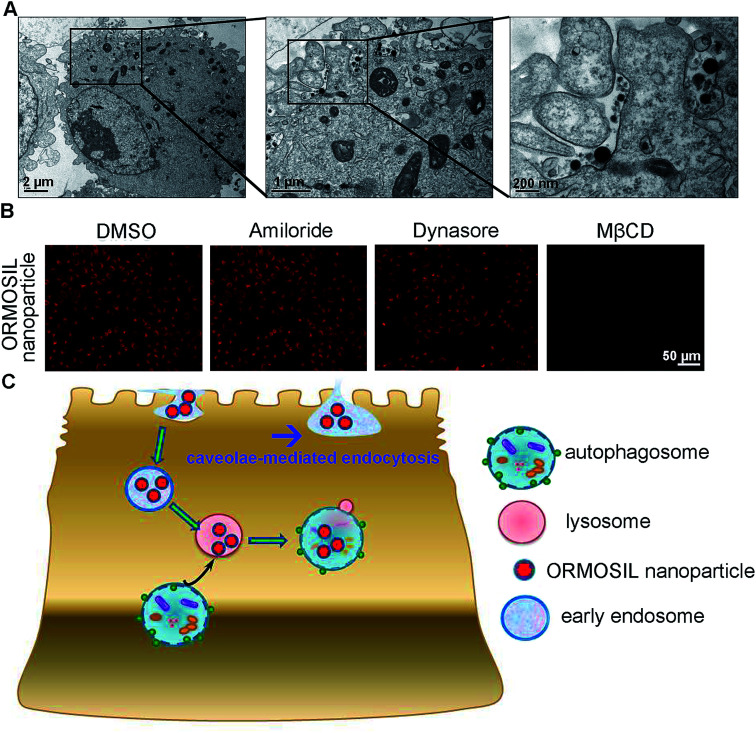
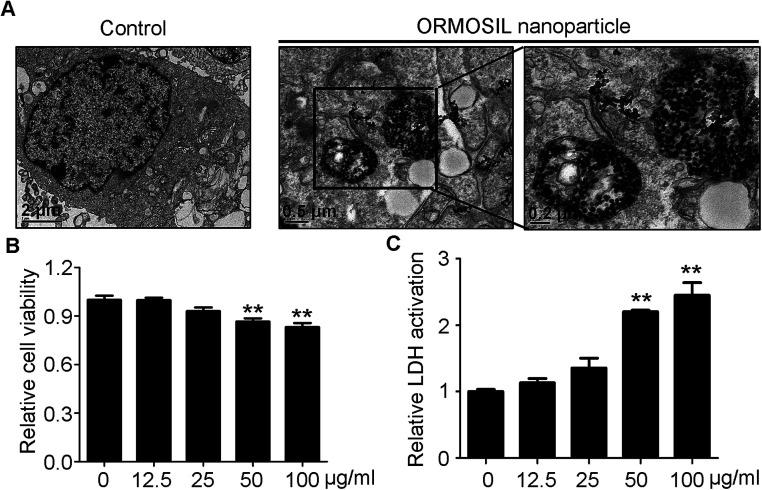
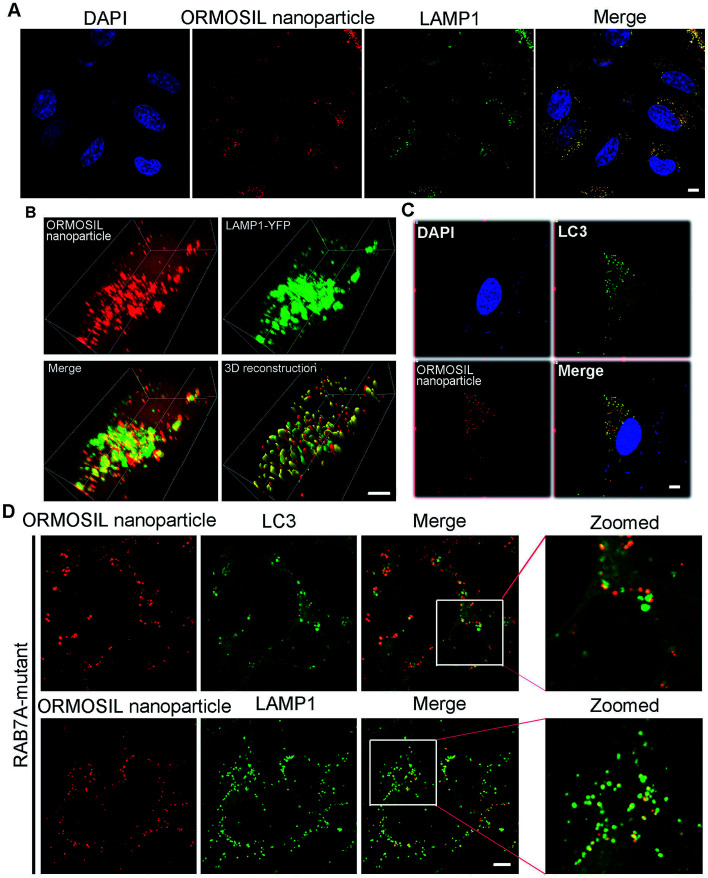
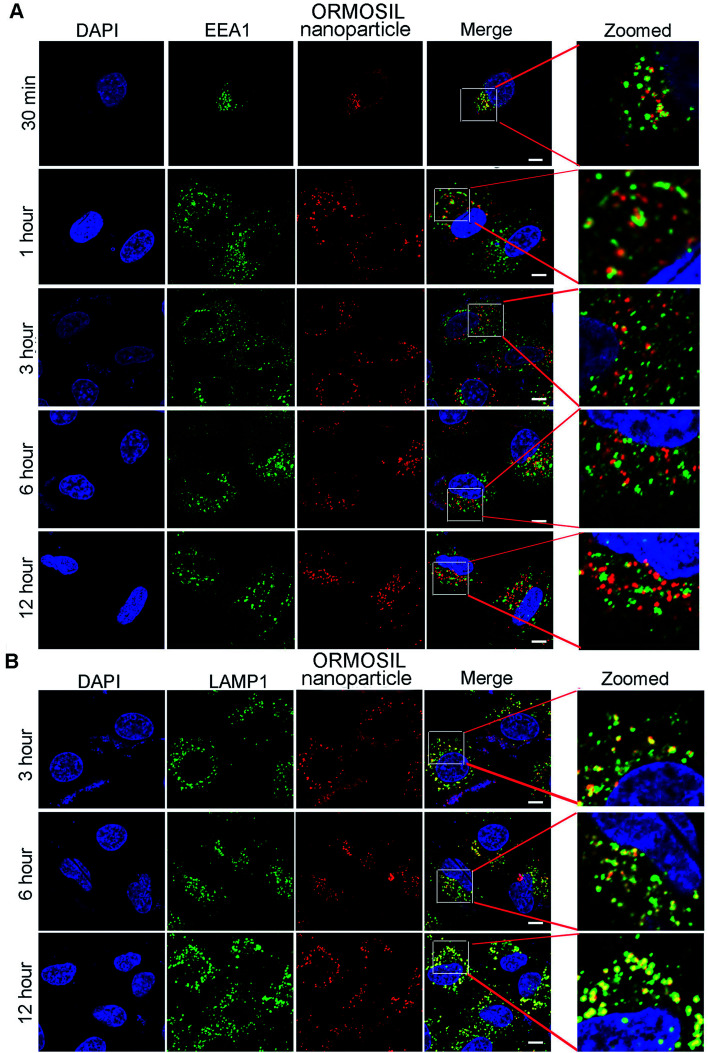
Organically modified silica (ORMOSIL) nanoparticles (NPs) are widely used in biomedicine. However, their cell uptake process has not yet been characterised in detail. Here, we investigated the mechanism underlying endocytosis and subcellular localisation of ORMOSIL NPs. Exposure to ORMOSIL NPs induced a decrease in cell viability and increase in lactate dehydrogenase release in a dose-dependent manner in A549 cells. Once internalised, ORMOSIL NPs were translocated from early endosomes to the lysosomes, where they accumulated. Furthermore, deficiency of autophagosomal/lysosomal fusion failed to block lysosomal localisation of ORMOSIL NPs, suggesting that autophagy was not involved in the final lysosomal accumulation of ORMOSIL NPs. Meanwhile, an inhibitor of caveolae-mediated endocytosis, rather than inhibitors of phagocytosis or clathrin-mediated endocytosis, succeeded in blocking ORMOSIL NP cell uptake, indicating the involvement of caveolae-mediated endocytosis. Together, these results provide a new understanding of the toxicity, and suggest better biomedical applications, of ORMOSIL NPs.
有机改性二氧化硅(ORMOSIL)纳米颗粒(NPs)在生物医学中被广泛应用。然而,其细胞摄取过程尚未得到详细表征。在此,我们研究了ORMOSIL NPs的内吞作用机制及其亚细胞定位。在A549细胞中,暴露于ORMOSIL NPs会导致细胞活力下降,并以剂量依赖的方式增加乳酸脱氢酶的释放。一旦内化,ORMOSIL NPs会从早期内体转运至溶酶体并在其中积累。此外,自噬体/溶酶体融合缺陷未能阻止ORMOSIL NPs在溶酶体中的定位,这表明自噬不参与ORMOSIL NPs最终在溶酶体中的积累。同时,小窝介导的内吞作用抑制剂成功阻断了ORMOSIL NPs的细胞摄取,而非吞噬作用或网格蛋白介导的内吞作用抑制剂,这表明小窝介导的内吞作用参与其中。总之,这些结果为理解ORMOSIL NPs的毒性提供了新的认识,并为其更好地应用于生物医学领域提供了建议。