Zhang Yanzhuo, Wan Huilin, Zhao Jing, Li Jun
School of Environment, Henan Normal University, Key Laboratory for Yellow River and Huai River Water Environmental and Pollution Control, Ministry of Education, Henan Key Laboratory for Environmental Pollution Control Xinxiang Henan 453007 P. R. China
School of Chemistry and Chemical Engineering, Henan Normal University Xinxiang Henan 453007 P. R. China
RSC Adv. 2019 Apr 10;9(20):11202-11211. doi: 10.1039/c9ra00378a. eCollection 2019 Apr 9.
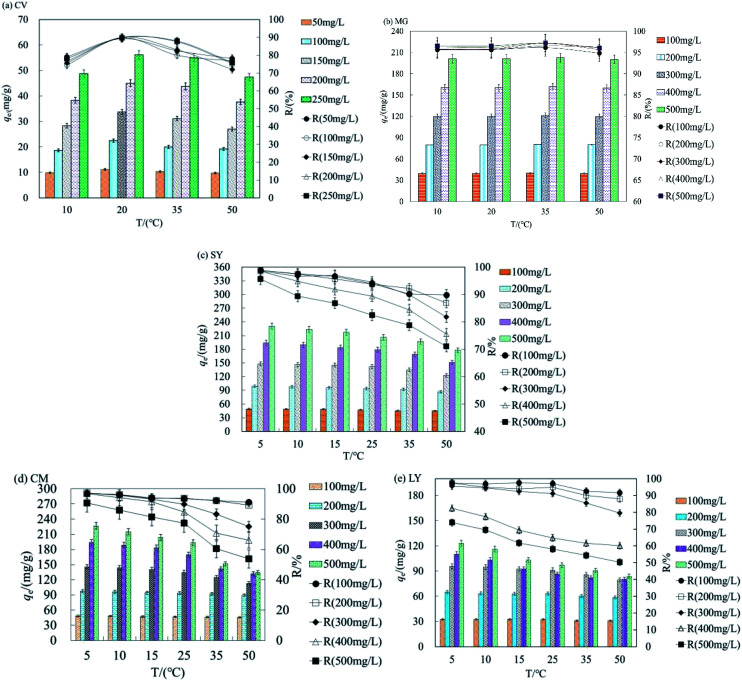
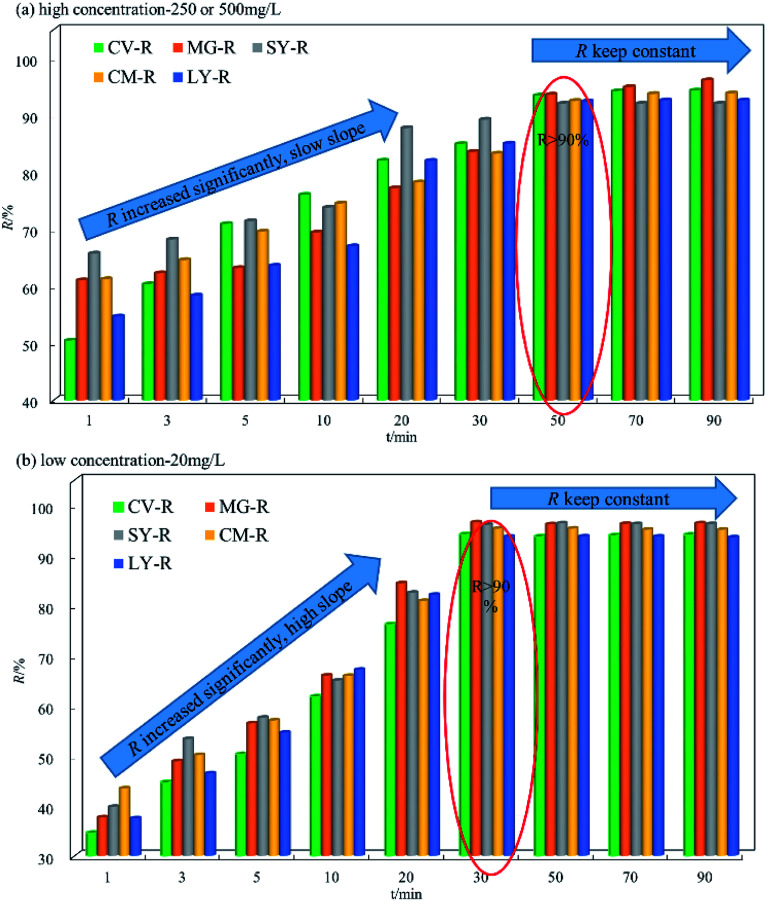
Raw Huai Flos Chrysanthemum (HFC) and modified HFC (HFC@CO) were used for the first time as a biosorbent material to remove cationic dyes Malachite green (MG) and Crystal violet (CV), and anionic dyes Sunset yellow (SY), Lemon yellow (LY), and Carmine (CM), at different temperatures (5-50 °C). The highest removal rates () for dye adsorption were observed at low temperature (5 °C) and room temperature (20 °C). At high (500 mg L) dye concentration, adsorption was completed within one minute, but the time required to reach adsorption equilibrium was longer than at the low (20 mg L) concentration. The experimental data fitted very well to the Langmuir model and the values of the maximum adsorption capacity for SY, LY, CM, CV, and MG, were 481.41, 507.23, 141.78 mg g, 526.32, and 769.23 mg L, respectively. The adsorption data fit well to a pseudo-second-order kinetic model.
首次使用生怀菊花(HFC)和改性怀菊花(HFC@CO)作为生物吸附材料,在不同温度(5-50°C)下去除阳离子染料孔雀石绿(MG)和结晶紫(CV)以及阴离子染料日落黄(SY)、柠檬黄(LY)和胭脂红(CM)。在低温(5°C)和室温(20°C)下观察到染料吸附的最高去除率()。在高(500 mg L)染料浓度下,吸附在一分钟内完成,但达到吸附平衡所需的时间比低(20 mg L)浓度时长。实验数据与朗缪尔模型拟合得非常好,SY、LY、CM、CV和MG的最大吸附容量值分别为481.41、507.23、141.78 mg g、526.32和769.23 mg L。吸附数据与伪二级动力学模型拟合良好。