Jesmer Alexander H, Huynh Vincent, Wylie Ryan G
Department of Chemistry and Chemical Biology, McMaster University Hamilton Ontario L8S 4M1 Canada
School of Biomedical Engineering, McMaster University Hamilton Ontario L8S 4M1 Canada.
RSC Adv. 2020 May 27;10(34):20302-20312. doi: 10.1039/d0ra02693j. eCollection 2020 May 26.
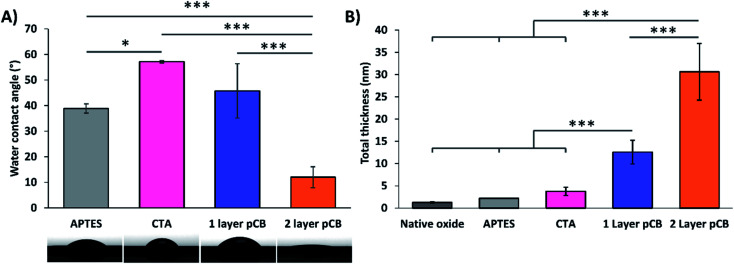
Low-fouling and high-loading surfaces are increasingly important for biosensing and blood purification technologies. Selective and efficient target binding from complex media can be achieved with poly(carboxybetaine) (pCB) surfaces that consist of a dense brush layer to resist non-specific protein adsorption and a sparse "mushroom" upper layer for high-density capture agent immobilization ( high-loading). We developed pH-controlled surface-reversible addition-fragmentation chain-transfer (S-RAFT) polymerization to simplify fabrication of multi-modal, low-fouling and high-loading pCB surfaces without the need for quenching or re-initiation steps, toxic transition metals or light irradiation. Multi-modal polymer layers were produced through partial polymer termination by temporarily raising the pH to aminolyse a fraction of dormant chain transfer agents (CTAs); remaining polymer chains with intact CTAs continued uninterrupted extension to create the "mushroom" upper layer. The multi-modal pCB surfaces were low-fouling towards proteins (<6.7 ng cm), and macrophages. Compared to mono-modal brush surfaces, multi-modal pCB surfaces were high-loading with 5-fold greater capture agent immobilization ( antibody) and 4-fold greater target binding ( biotin-fluorescein).
低污染且高负载的表面对于生物传感和血液净化技术而言愈发重要。由致密刷层(用于抵抗非特异性蛋白质吸附)和稀疏“蘑菇”上层(用于高密度固定捕获剂,即高负载)组成的聚(羧酸甜菜碱)(pCB)表面,能够从复杂介质中实现选择性且高效的目标物结合。我们开发了pH控制的表面可逆加成-断裂链转移(S-RAFT)聚合反应,以简化多模式、低污染且高负载的pCB表面的制备过程,无需淬灭或重新引发步骤、有毒过渡金属或光照射。通过临时提高pH值以氨解一部分休眠链转移剂(CTA)来实现部分聚合物终止,从而制备多模式聚合物层;带有完整CTA的剩余聚合物链继续不间断延伸,以形成“蘑菇”上层。多模式pCB表面对蛋白质(<6.7 ng/cm²)和巨噬细胞具有低污染性。与单模式刷表面相比,多模式pCB表面具有高负载能力,捕获剂(抗体)固定量高5倍,目标物结合(生物素-荧光素)能力高4倍。