Yu Hui, Zhu Wenjian, Zhou Hu, Liu Jianfeng, Yang Zhen, Hu Xiaocai, Yuan Aihua
School of Environmental and Chemical Engineering, Jiangsu University of Science and Technology Zhenjiang 212003 China
School of Material Science and Engineering, Jiangsu University of Science and Technology Zhenjiang 212003 China.
RSC Adv. 2019 Mar 26;9(17):9577-9583. doi: 10.1039/c9ra01488h. eCollection 2019 Mar 22.
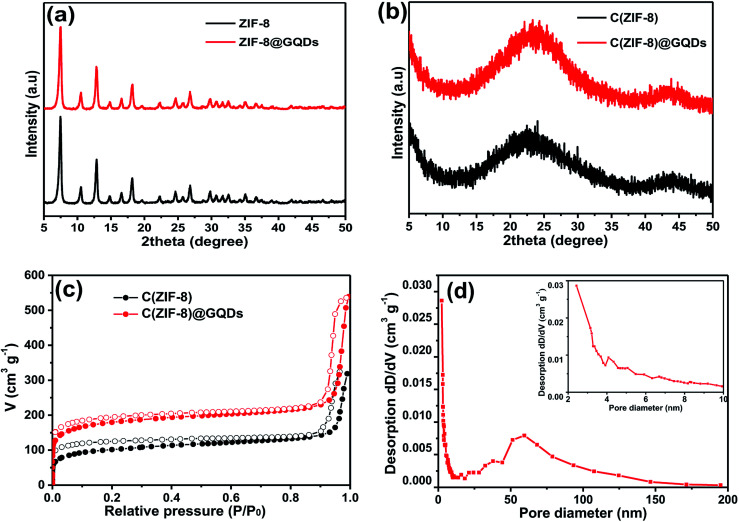
The C@GQD composite was prepared by the combination of metal-organic framework (ZIF-8)-derived porous carbon and graphene quantum dots (GQDs) by a simple method. The resulting composite has a high specific surface area of 668 m g and involves numerous micro- and mesopores. As a supercapacitor electrode, the material showed an excellent double-layer capacitance and a high capacity retention of 130 F g at 2 A g. The excellent long-term stability was observed even after ∼10 000 charge-discharge cycles. Moreover, the composite as an anode material for a lithium-ion battery exhibited a good reversible capacity and outstanding cycle stability (493 mA h g at 100 mA g after 200 cycles). The synergistic effect of a MOF-derived porous carbon and GQDs was responsible for the improvement of electrochemical properties.
通过一种简单的方法,将金属有机框架(ZIF-8)衍生的多孔碳与石墨烯量子点(GQDs)相结合,制备了C@GQD复合材料。所得复合材料具有668 m²/g的高比表面积,并且包含大量的微孔和介孔。作为超级电容器电极,该材料表现出优异的双电层电容,在2 A/g时具有130 F/g的高容量保持率。即使经过约10000次充放电循环,仍观察到优异的长期稳定性。此外,该复合材料作为锂离子电池的负极材料,表现出良好的可逆容量和出色的循环稳定性(在100 mA/g下循环200次后为493 mA h/g)。MOF衍生的多孔碳和GQDs的协同效应是电化学性能改善的原因。