Deng Zhongwei, Hu Xiaosong, Xie Yi, Xu Le, Li Penghua, Lin Xianke, Bian Xiaolei
College of Mechanical and Vehicle Engineering, Chongqing University, Chongqing 400044, China.
College of Automation, Chongqing University of Posts and Telecommunications, Chongqing 400065, China.
iScience. 2022 Apr 12;25(5):104260. doi: 10.1016/j.isci.2022.104260. eCollection 2022 May 20.
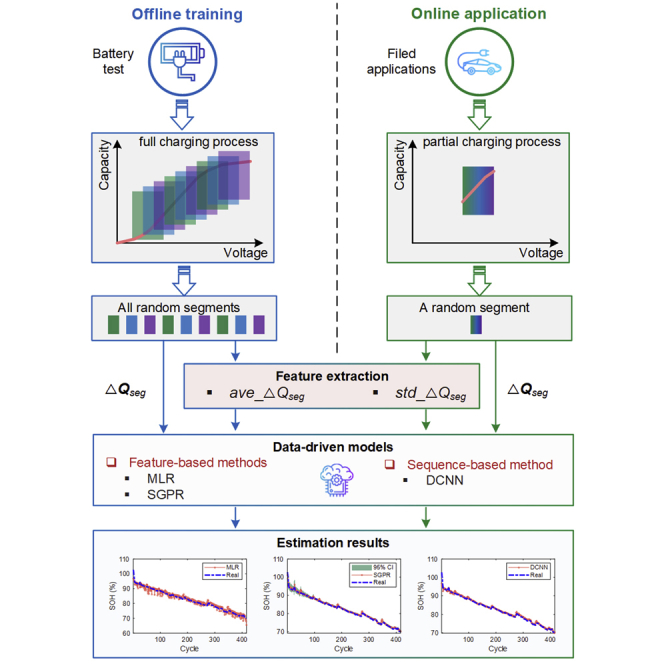
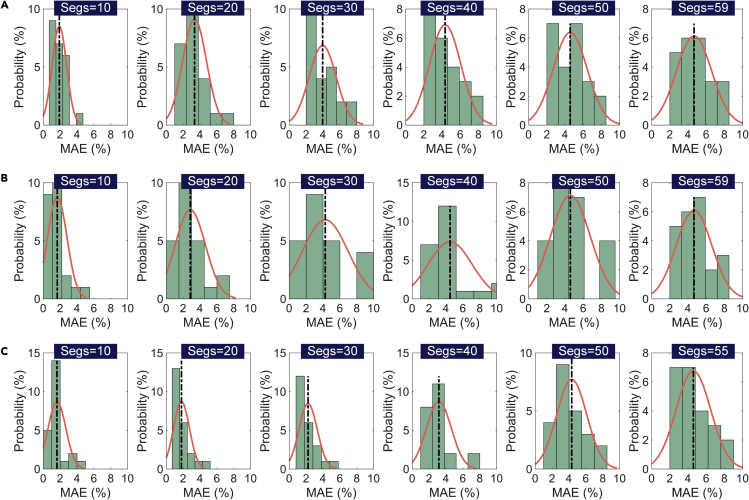
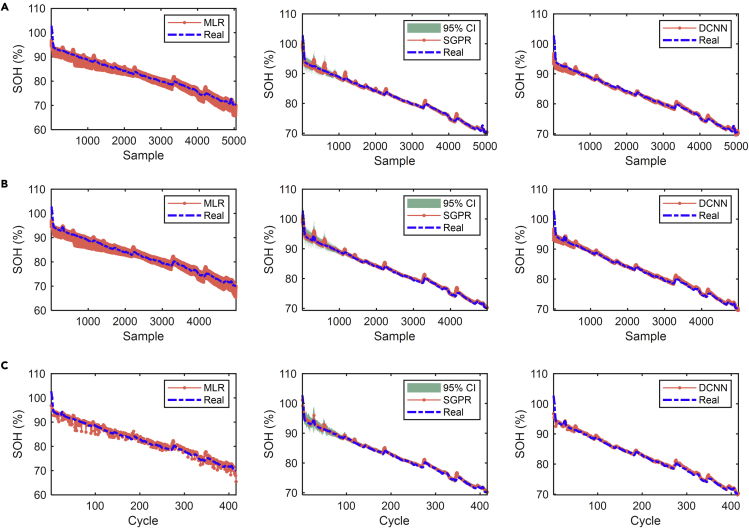
Accurately evaluating the health status of lithium-ion batteries (LIBs) is significant to enhance the safety, efficiency, and economy of LIBs deployment. However, the complex degradation processes inside the battery make it a thorny challenge. Data-driven methods are widely used to resolve the problem without exploring the complex aging mechanisms; however, random and incomplete charging-discharging processes in actual applications make the existing methods fail to work. Here, we develop three data-driven methods to estimate battery state of health (SOH) using a short random charging segment (RCS). Four types of commercial LIBs (75 cells), cycled under different temperatures and discharging rates, are employed to validate the methods. Trained on a nominal cycling condition, our models can achieve high-precision SOH estimation under other different conditions. We prove that an RCS with a 10mV voltage window can obtain an average error of less than 5%, and the error plunges as the voltage window increases.
准确评估锂离子电池(LIBs)的健康状态对于提高LIBs部署的安全性、效率和经济性具有重要意义。然而,电池内部复杂的降解过程使其成为一项棘手的挑战。数据驱动方法被广泛用于解决该问题,而无需探究复杂的老化机制;然而,实际应用中随机且不完整的充放电过程使现有方法失效。在此,我们开发了三种数据驱动方法,利用短随机充电段(RCS)来估计电池健康状态(SOH)。使用在不同温度和放电速率下循环的四种商用LIBs(75个电池)来验证这些方法。在标称循环条件下训练的我们的模型,能够在其他不同条件下实现高精度的SOH估计。我们证明,具有10mV电压窗口的RCS可获得小于5%的平均误差,并且随着电压窗口的增加误差会大幅下降。