Lee Tae Hee, Bu Jiyoon, Kim Byoung Hyuck, Poellmann Michael J, Hong Seungpyo, Hyun Sung Hee
Department of Senior Healthcare, BK21 plus program, Graduated School, Eulji University 77 Gyeryong-ro, Jung-gu Daejeon 34824 Republic of Korea
Division of Pharmaceutical Sciences, School of Pharmacy, University of Wisconsin-Madison 777 Highland Ave. Madison Wisconsin 53705 USA
RSC Adv. 2018 Dec 20;9(1):52-57. doi: 10.1039/c8ra08472f. eCollection 2018 Dec 19.
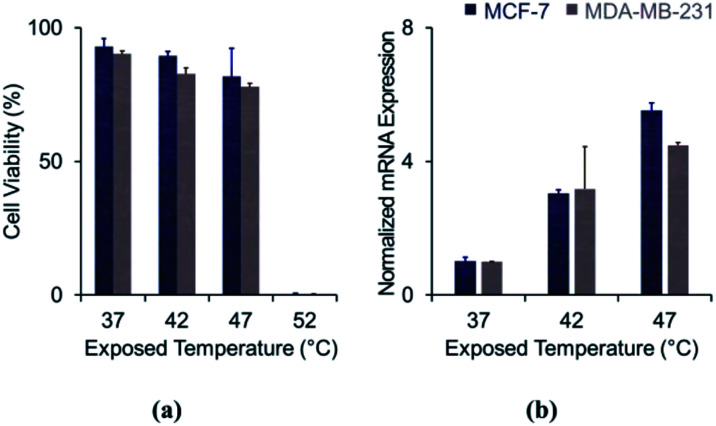
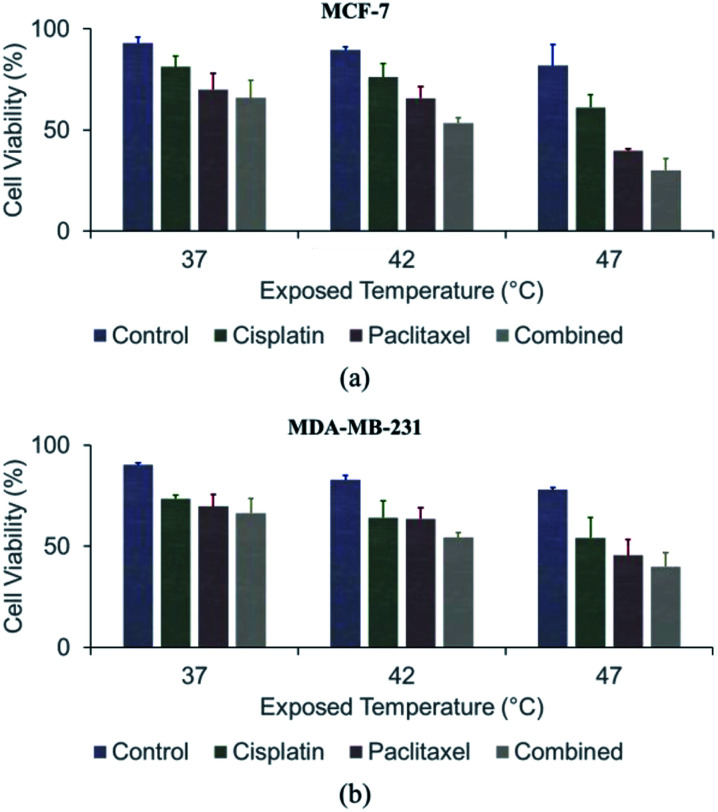
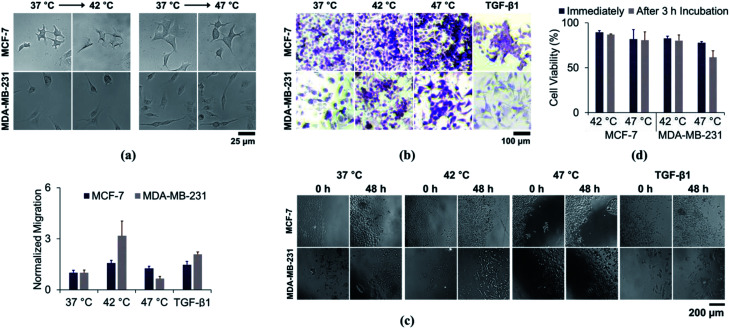
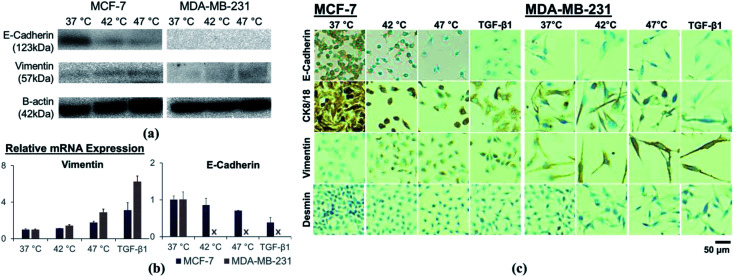
Thermotherapy has demonstrated a potential to be an effective non-surgical technique to treat breast cancer. Despite its advantages, including low toxicity and high repeatability, thermotherapy is typically required to be applied in combination with other treatments since the residual tumor cells that survive after hyperthermal treatment often cause recurrence. In this study, we confirmed that breast cancer cells tolerate temperature of up to 47 °C by synthesizing a large amount of heat shock proteins. Further changes in the molecular properties of the heat-exposed cells were investigated using western blotting, quantitative reverse transcription polymerase chain reaction, and immunocytochemistry. We found that low-temperature hyperthermia promoted epithelial-to-mesenchymal-like transition (EMT), as observed by the increased mesenchymal marker expression levels while decreasing epithelial markers. Moreover, cell morphology changed from cobblestone-like to a more spindle-like appearance, in addition to significantly enhanced cell motility upon heat treatment. These results all support that sub-lethal hyperthermal stress induces EMT. In addition, we examined changes in the chemo-sensitivity of the heat-treated cells. Addition of a chemo-drugs caused increased cytotoxicity of the heat-treated cells compared to the cells that were not co-treated with heat. Our study demonstrates that thermotherapy alone may cause undesirable EMT, which could be well overcome through a synergistic effect when applied with chemotherapy.
热疗法已显示出成为一种治疗乳腺癌的有效非手术技术的潜力。尽管热疗法具有包括低毒性和高重复性等优点,但由于热疗后存活的残留肿瘤细胞常导致复发,通常需要将热疗法与其他治疗方法联合应用。在本研究中,我们证实乳腺癌细胞通过合成大量热休克蛋白来耐受高达47°C的温度。使用蛋白质免疫印迹法、定量逆转录聚合酶链反应和免疫细胞化学方法进一步研究了受热细胞分子特性的变化。我们发现,如通过间充质标志物表达水平升高而上皮标志物表达水平降低所观察到的,低温热疗促进上皮-间充质样转化(EMT)。此外,细胞形态从鹅卵石样变为更纺锤样外观,并且热处理后细胞运动性显著增强。这些结果均支持亚致死性热应激诱导EMT。此外,我们检测了热处理细胞化疗敏感性的变化。与未进行热联合处理的细胞相比,添加化疗药物导致热处理细胞的细胞毒性增加。我们的研究表明,单独的热疗法可能会导致不良的EMT,而与化疗联合应用时通过协同作用可以很好地克服这一问题。