Monash Health Imaging, Monash Health, Clayton, Victoria, Australia.
Centre for Medical Radiation Physics, School of Physics, Faculty of Engineering and Information Sciences, University of Wollongong, Wollongong, New South Wales, Australia.
J Appl Clin Med Phys. 2022 Jun;23(6):e13625. doi: 10.1002/acm2.13625. Epub 2022 May 6.
Computational dosimetry software is routinely used to evaluate the organ and effective doses from computed tomography (CT) examinations. Studies have shown a significant variation in dose estimates between software in adult cohorts, and few studies have evaluated software for pediatric dose estimates. This study aims to compare the primary organ and effective doses estimated by four commercially available CT dosimetry software to thermoluminescent dosimeter (TLD) measurements in a 1-year-old phantom.
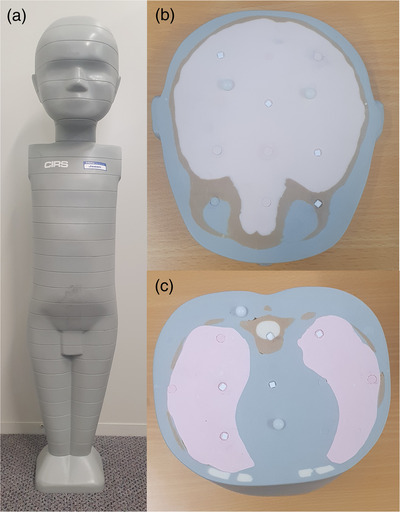
One hundred fifteen calibrated LiF (Mg, Cu, P)-TLD 100-H chips were embedded within an anthropomorphic phantom representing a 1-year-old child at positions that matched the approximate location of organs within an infant. The phantom was scanned under three protocols, each with whole-body coverage. The mean absorbed doses from 25 radiosensitive organs and skeletal tissues were determined from the TLD readings. Effective doses for each of the protocols were subsequently calculated using ICRP 103 formalism. Dose estimates by the four Monte Carlo-based dose calculation systems were determined and compared to the directly measured doses.
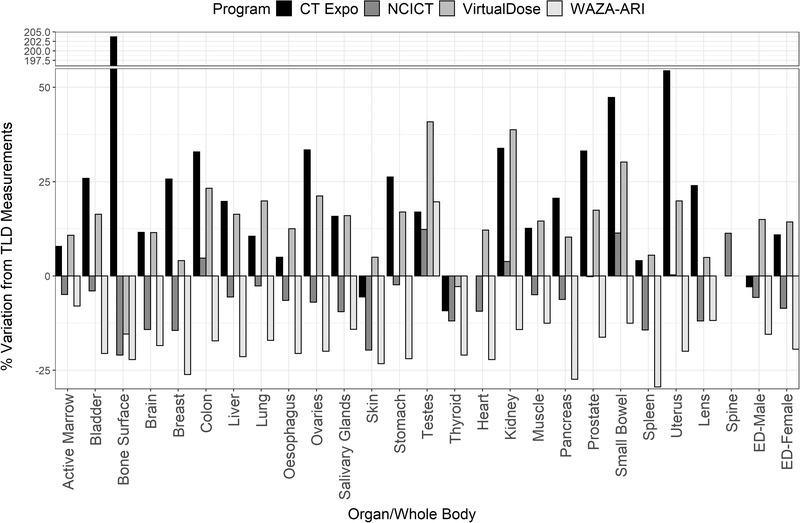
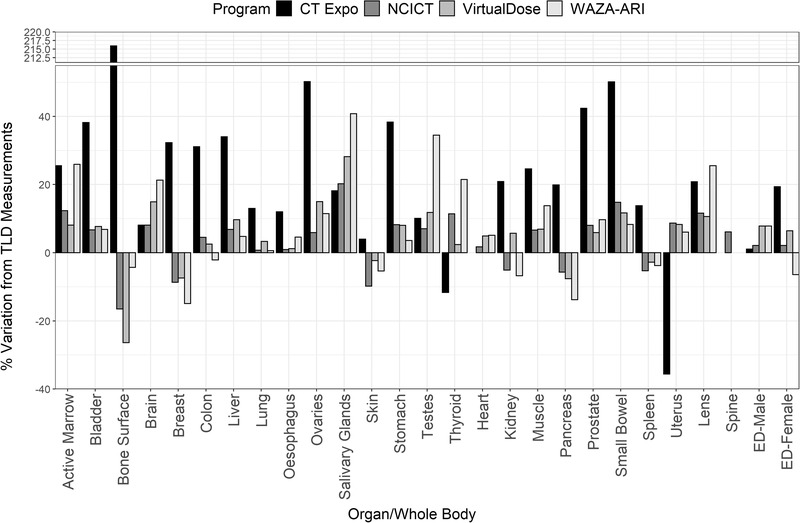
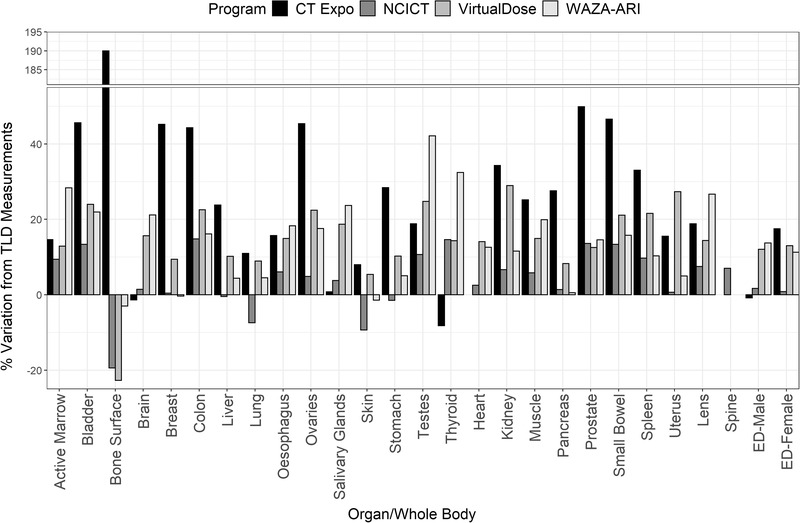
Most organ doses determined by computation dosimetry software aligned to phantom measurements within 20%. Additionally, comparisons between effective doses are calculated using computational and direct measurement methods aligned within 20% across the three protocols. Significant variances were found in bone surface dose estimations among dosimetry methods, likely caused by differences in bone tissue modeling.
All four-dosimetry software evaluated in this study provide adequate primary organ and effective dose estimations. Users should be aware, however, of the possible estimated uncertainty associated with each of the programs.
计算剂量软件通常用于评估 CT 检查中的器官和有效剂量。研究表明,成人队列中软件之间的剂量估计存在显著差异,很少有研究评估过儿科剂量估计的软件。本研究旨在比较四种商业可用的 CT 剂量计算软件对 1 岁儿童模型体模的主要器官和有效剂量的估计值与热释光剂量计(TLD)测量值。
将 115 个经过校准的 LiF(Mg、Cu、P)-TLD 100-H 芯片嵌入到一个代表 1 岁儿童的人体模型中,这些芯片位于与婴儿器官大致位置匹配的位置。对模型进行了三种全身覆盖的协议扫描。从 TLD 读数中确定 25 个敏感器官和骨骼组织的平均吸收剂量。随后,使用 ICRP 103 公式计算每个协议的有效剂量。通过四个基于蒙特卡罗的剂量计算系统确定并比较了剂量估计值与直接测量的剂量。
大多数由计算剂量软件确定的器官剂量与体模测量值相差在 20%以内。此外,在三种协议中,通过计算和直接测量方法计算的有效剂量之间的比较在 20%以内。在剂量计算方法中,骨表面剂量的估计值存在显著差异,这可能是由于骨组织建模的差异所致。
本研究评估的四种剂量计算软件都能提供足够的主要器官和有效剂量估计值。然而,用户应该注意到每个程序的可能存在的估计不确定性。