Department of Applied Health Research, Institute of Epidemiology and Health Care, University College London, London, UK.
Care Policy and Evaluation Centre, London School of Economics and Political Science, London, UK.
Eur J Health Econ. 2023 Mar;24(2):179-186. doi: 10.1007/s10198-022-01468-4. Epub 2022 May 6.
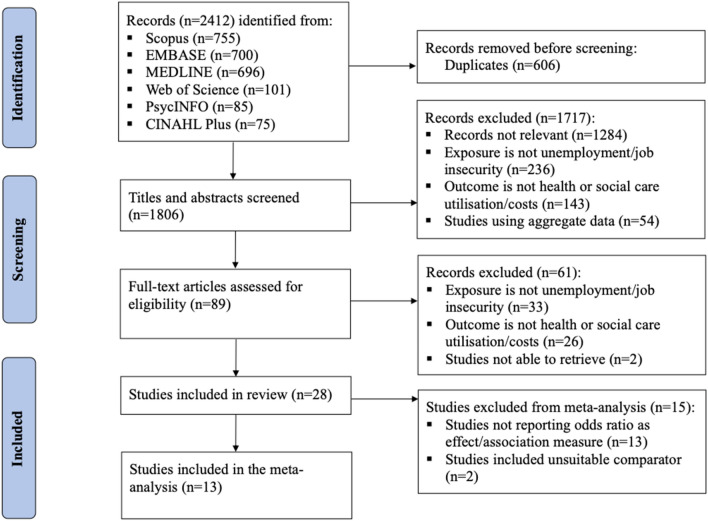
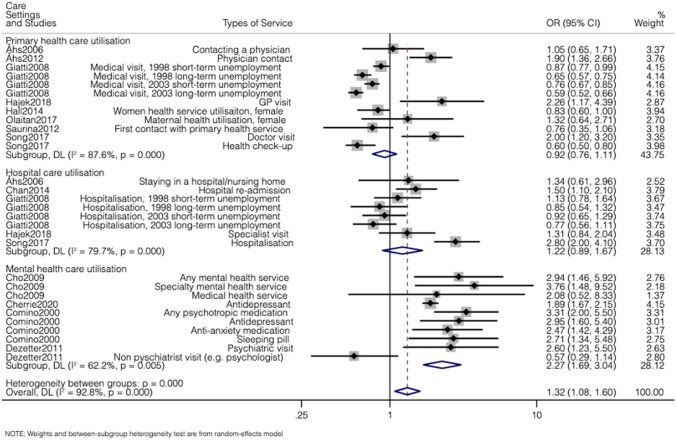
While the negative impact of unemployment on health is relatively well established, the extent to which that impact reflects on changes in health and social care utilisation is not well understood. This paper critically reviews the direction, magnitude and drivers of the impact of unemployment and job insecurity on health and social care utilisation across different care settings. We identified 28 relevant studies, which included 79 estimates of association between unemployment/job insecurity and healthcare utilisation. Positive associations dominated mental health services (N = 8 out of 11), but not necessarily primary care (N = 25 out of 43) or hospital care (N = 5 out of 22). We conducted a meta-analysis to summarise the magnitude of the impact and found that unemployed individuals were about 30% more likely to use health services compared to those employed, although this was largely driven by mental health service use. Key driving factors included financial pressure, health insurance, social network, disposable time and depression/anxiety. This review suggests that unemployment is likely to be associated with increased mental health service use, but there is considerable uncertainty around primary and hospital care utilisation. Future work to examine the impact across other settings, including community and social care, and further explore non-health determinants of utilisation is needed. The protocol was registered in PROSPERO (CRD42020177668).
虽然失业对健康的负面影响已得到广泛证实,但人们对这种影响在多大程度上反映在健康和社会保健利用的变化上还不甚了解。本文批判性地回顾了失业和工作不稳定对不同保健环境中健康和社会保健利用的影响的方向、程度和驱动因素。我们确定了 28 项相关研究,其中包括 79 项关于失业/工作不稳定与医疗保健利用之间关联的估计。积极关联主要集中在精神卫生服务(11 项中的 8 项),但不一定是初级保健(43 项中的 25 项)或医院护理(22 项中的 5 项)。我们进行了荟萃分析以总结影响的幅度,发现与就业者相比,失业者使用卫生服务的可能性约高 30%,尽管这主要是由于精神卫生服务的利用。主要驱动因素包括经济压力、健康保险、社交网络、可支配时间和抑郁/焦虑。这一综述表明,失业可能与心理健康服务利用的增加有关,但在初级保健和医院保健利用方面存在相当大的不确定性。需要进一步研究其他环境(包括社区和社会保健)的影响,并进一步探讨利用的非健康决定因素。该方案已在 PROSPERO(CRD42020177668)中注册。