Center for Outcomes Research, Houston Methodist, Houston, TX, United States of America.
Department of Nutrition, Metabolism & Rehabilitation Sciences, University of Texas Medical Branch, Galveston, TX, United States of America.
PLoS One. 2022 May 6;17(5):e0268249. doi: 10.1371/journal.pone.0268249. eCollection 2022.
Sex differences in post-stroke cognitive decline have not been systematically evaluated in a nationally representative cohort. We use a quasi-experimental design to investigate sex differences in rate of post-stroke cognitive decline.
Utilizing the event study design, we use the Health and Retirement Study (HRS) data (1996-2016) to evaluate the differences (percentage points [95% Confidence interval]) in the rate of change in cognitive function, measured using the modified version of the Telephone Interview for Cognitive Status (TICS-m) score, before and after incident stroke, and among patients with and without incident stroke. We estimated this event study model for the overall study population and separately fit the same model for male and female participants.
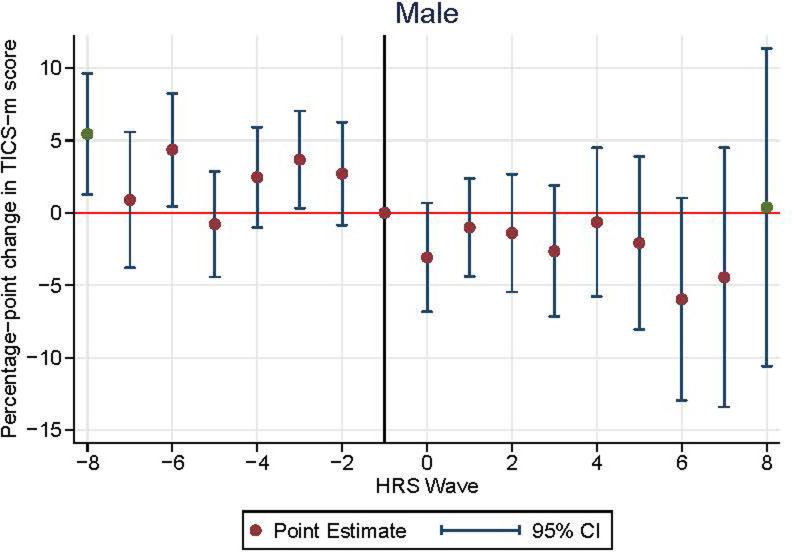
Of 25,872 HRS participants included in our study, 14,459 (55.9%) were females with an overall mean age (SD) of 61.2 (9.3) years. Overall, 2,911 (11.3%) participants reported experiencing incident stroke. Participants with incident stroke (vs. no stroke) had lower baseline TICS-m score (15.6 vs. 16.1). Among participants with incident stroke, the mean pre-stroke TICS-m score was higher than the mean post-stroke TICS-m score (14.9 vs. 12.7). Event study revealed a significant short-term acceleration of cognitive decline for the overall population (4.2 [1.7-6.6] percentage points, p value = 0.001) and among female participants (5.0 [1.7-8.3] percentage points, p value = 0.003). We, however, found no evidence of long-term acceleration of cognitive decline after stroke. Moreover, among males, incident stroke was not associated with significant changes in rate of post-stroke cognitive decline.
Females, in contrast to males, experience post-stroke cognitive deficits, particularly during early post-stroke period. Identifying the sex-specific stroke characteristics contributing to differences in post stroke cognitive decline may inform future strategies for reducing the burden of post-stroke cognitive impairment and dementia.
在具有全国代表性的队列中,尚未系统评估卒中后认知能力下降的性别差异。我们使用准实验设计来研究卒中后认知能力下降的发生率的性别差异。
利用事件研究设计,我们使用健康与退休研究(HRS)数据(1996-2016 年),来评估认知功能变化率的差异(百分点[95%置信区间]),认知功能使用改良后的电话访谈认知状态量表(TICS-m)评分来衡量,在发生卒中前后,以及在发生卒中与未发生卒中的患者中。我们对整个研究人群进行了该事件研究模型的估计,并分别为男性和女性参与者拟合了相同的模型。
在我们的研究中,纳入了 25872 名 HRS 参与者,其中 14459 名(55.9%)为女性,平均年龄(标准差)为 61.2(9.3)岁。总体而言,2911 名(11.3%)参与者报告发生了卒中事件。发生卒中的参与者(与未发生卒中的参与者相比)的基线 TICS-m 评分较低(15.6 比 16.1)。在发生卒中的参与者中,卒中前的 TICS-m 评分均值高于卒中后的 TICS-m 评分均值(14.9 比 12.7)。事件研究显示,整体人群(4.2[1.7-6.6]个百分点,p 值=0.001)和女性参与者(5.0[1.7-8.3]个百分点,p 值=0.003)的认知能力下降有显著的短期加速。然而,我们没有发现卒中后认知能力下降的长期加速证据。此外,在男性中,发生卒中与卒中后认知能力下降的发生率变化无关。
与男性相比,女性在卒中后会出现认知缺陷,尤其是在卒中后早期。确定导致卒中后认知能力下降差异的性别特异性卒中特征,可能为降低卒中后认知障碍和痴呆的负担提供未来策略。