J Am Chem Soc. 2022 May 18;144(19):8613-8623. doi: 10.1021/jacs.2c00815. Epub 2022 May 6.
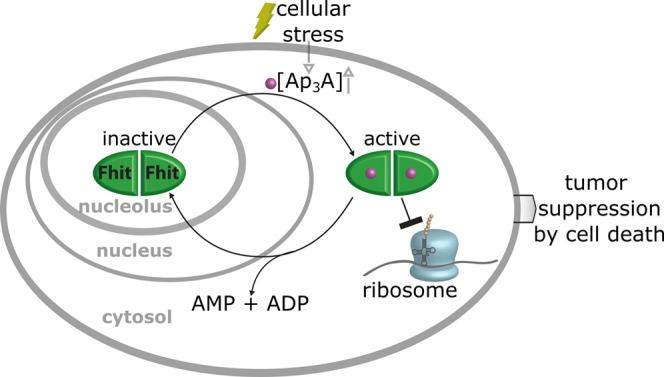
The tumor suppressor protein (Fhit) is known to be associated with genomic instability and apoptosis. The tumor-suppressive function of Fhit depends on the interaction with the alarmone diadenosine triphosphate (ApA), a noncanonical nucleotide whose concentration increases upon cellular stress. How the Fhit-ApA complex exerts its signaling function is unknown. Here, guided by a chemical proteomics approach employing a synthetic stable Fhit-ApA complex, we found that the Fhit-ApA complex, but not Fhit or ApA alone, impedes translation. Our findings provide a mechanistic model in which Fhit translocates from the nucleolus into the cytosol upon stress to form an Fhit-ApA complex. The Fhit-ApA complex impedes translation both and , resulting in reduced cell viability. Overall, our findings provide a mechanistic model by which the tumor suppressor Fhit collaborates with the alarmone ApA to regulate cellular proliferation.
抑癌蛋白 (Fhit) 已知与基因组不稳定性和细胞凋亡有关。Fhit 的肿瘤抑制功能取决于与警报素二腺苷三磷酸 (ApA) 的相互作用,ApA 是一种非典型核苷酸,其浓度在细胞应激时增加。Fhit-ApA 复合物如何发挥其信号转导功能尚不清楚。在这里,我们通过采用一种合成的稳定 Fhit-ApA 复合物的化学蛋白质组学方法指导,发现 Fhit-ApA 复合物,而不是单独的 Fhit 或 ApA,会阻碍翻译。我们的发现提供了一个机制模型,即在应激下,Fhit 从核仁易位到细胞质中形成 Fhit-ApA 复合物。Fhit-ApA 复合物既抑制起始又抑制延伸,导致细胞活力降低。总的来说,我们的发现提供了一个机制模型,即肿瘤抑制因子 Fhit 与警报素 ApA 合作调节细胞增殖。