Peter Medawar Building for Pathogen Research, Nuffield Department of Clinical Medicine, University of Oxford, Oxford, UK.
Oxford University Hospitals NHS Foundation Trust, John Radcliffe Hospital, Oxford, UK.
Clin Exp Immunol. 2022 Jul 22;209(1):90-98. doi: 10.1093/cei/uxac042.
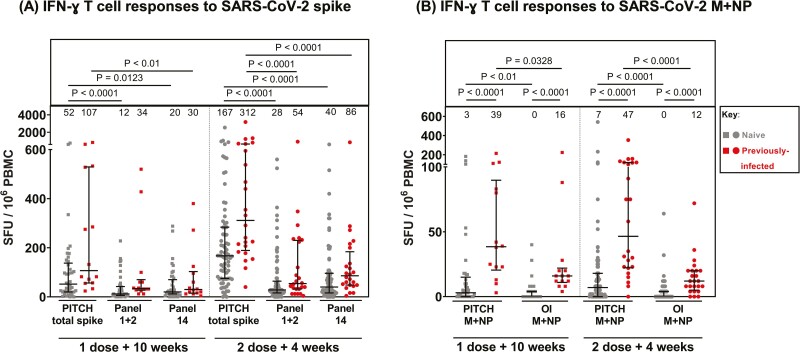
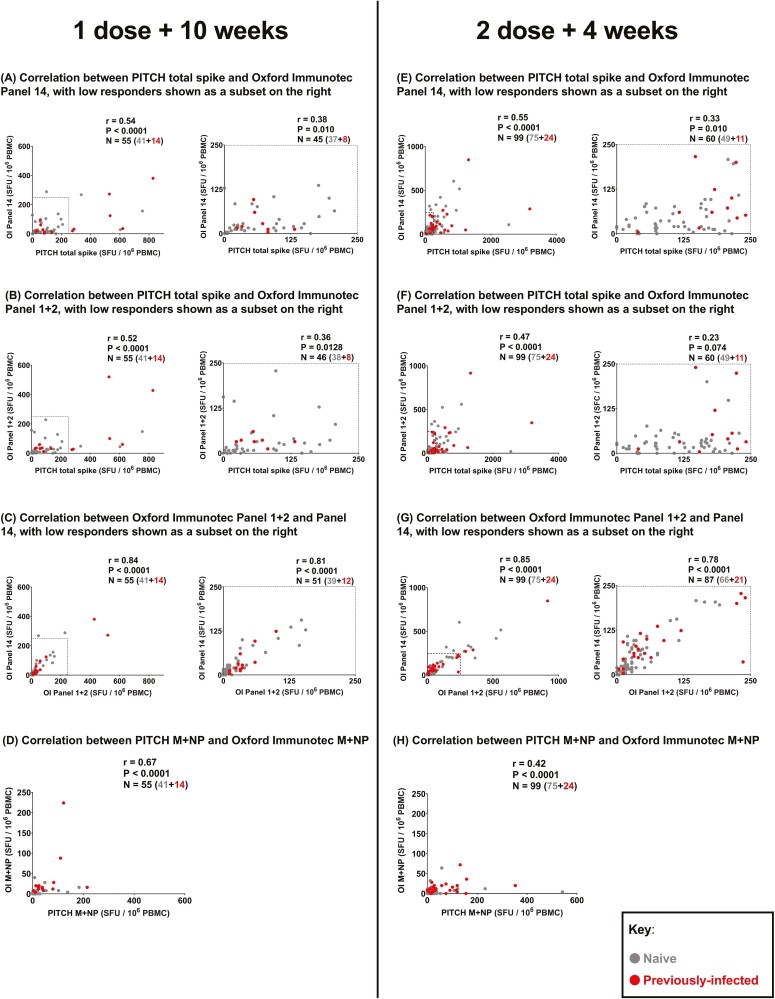
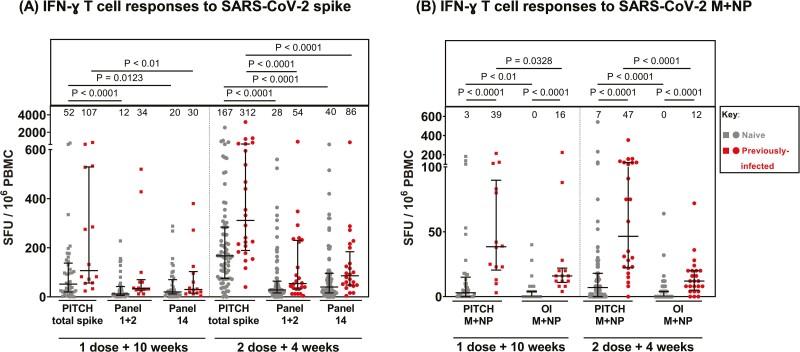
T-cell responses to SARS-CoV-2 following infection and vaccination are less characterized than antibody responses, due to a more complex experimental pathway. We measured T-cell responses in 108 healthcare workers (HCWs) using the commercialized Oxford Immunotec T-SPOT Discovery SARS-CoV-2 assay service (OI T-SPOT) and the PITCH ELISpot protocol established for academic research settings. Both assays detected T-cell responses to SARS-CoV-2 spike, membrane, and nucleocapsid proteins. Responses were significantly lower when reported by OI T-SPOT than by PITCH ELISpot. Four weeks after two doses of either Pfizer/BioNTech BNT162b or ChAdOx1 nCoV-19 AZD1222 vaccine, the responder rate was 63% for OI T-SPOT Panels 1 + 2 (peptides representing SARS-CoV-2 spike protein excluding regions present in seasonal coronaviruses), 69% for OI T-SPOT Panel 14 (peptides representing the entire SARS-CoV-2 spike), and 94% for the PITCH ELISpot total spike. The two OI T-SPOT panels correlated strongly with each other showing that either readout quantifies spike-specific T-cell responses, although the correlation between the OI T-SPOT panels and the PITCH ELISpot total spike was moderate. The standardization, relative scalability, and longer interval between blood acquisition and processing are advantages of the commercial OI T-SPOT assay. However, the OI T-SPOT assay measures T-cell responses at a significantly lower magnitude compared to the PITCH ELISpot assay, detecting T-cell responses in a lower proportion of vaccinees. This has implications for the reporting of low-level T-cell responses that may be observed in patient populations and for the assessment of T-cell durability after vaccination.
T 细胞对 SARS-CoV-2 的反应,无论是在感染后还是接种疫苗后,都不如抗体反应那么明显,这是因为其实验途径更为复杂。我们使用商业化的 Oxford Immunotec T-SPOT Discovery SARS-CoV-2 检测服务(OI T-SPOT)和为学术研究环境建立的 PITCH ELISpot 方案,在 108 名医护人员(HCWs)中测量了 T 细胞对 SARS-CoV-2 刺突、膜和核衣壳蛋白的反应。两种检测方法均检测到了对 SARS-CoV-2 刺突、膜和核衣壳蛋白的 T 细胞反应。与 PITCH ELISpot 相比,OI T-SPOT 报告的反应明显较低。在接种两剂辉瑞/生物科技的 BNT162b 或阿斯利康的 ChAdOx1 nCoV-19 AZD1222 疫苗四周后,OI T-SPOT Panels 1 + 2(代表 SARS-CoV-2 刺突蛋白的肽段,不包括季节性冠状病毒中存在的区域)的应答率为 63%,OI T-SPOT Panel 14(代表整个 SARS-CoV-2 刺突)的应答率为 69%,PITCH ELISpot 总刺突的应答率为 94%。两个 OI T-SPOT 面板彼此之间强烈相关,表明这两种检测方法均可以定量检测刺突特异性 T 细胞反应,尽管 OI T-SPOT 面板与 PITCH ELISpot 总刺突之间的相关性是中等的。商业 OI T-SPOT 检测具有标准化、相对可扩展性和更长的血液采集和处理间隔等优势。然而,与 PITCH ELISpot 检测相比,OI T-SPOT 检测测量的 T 细胞反应幅度明显较低,检测到疫苗接种者中较低比例的 T 细胞反应。这对报告可能在患者人群中观察到的低水平 T 细胞反应以及评估接种疫苗后的 T 细胞持久性具有影响。