Department of Psychiatry, Western Psychiatric Institute and Clinic, University of Pittsburgh Medical Center, University of Pittsburgh, Pittsburgh, PA, USA.
Department of Psychiatry, Western Psychiatric Institute and Clinic, University of Pittsburgh Medical Center, University of Pittsburgh, Pittsburgh, PA, USA.
Acta Psychol (Amst). 2022 Jul;227:103603. doi: 10.1016/j.actpsy.2022.103603. Epub 2022 May 4.
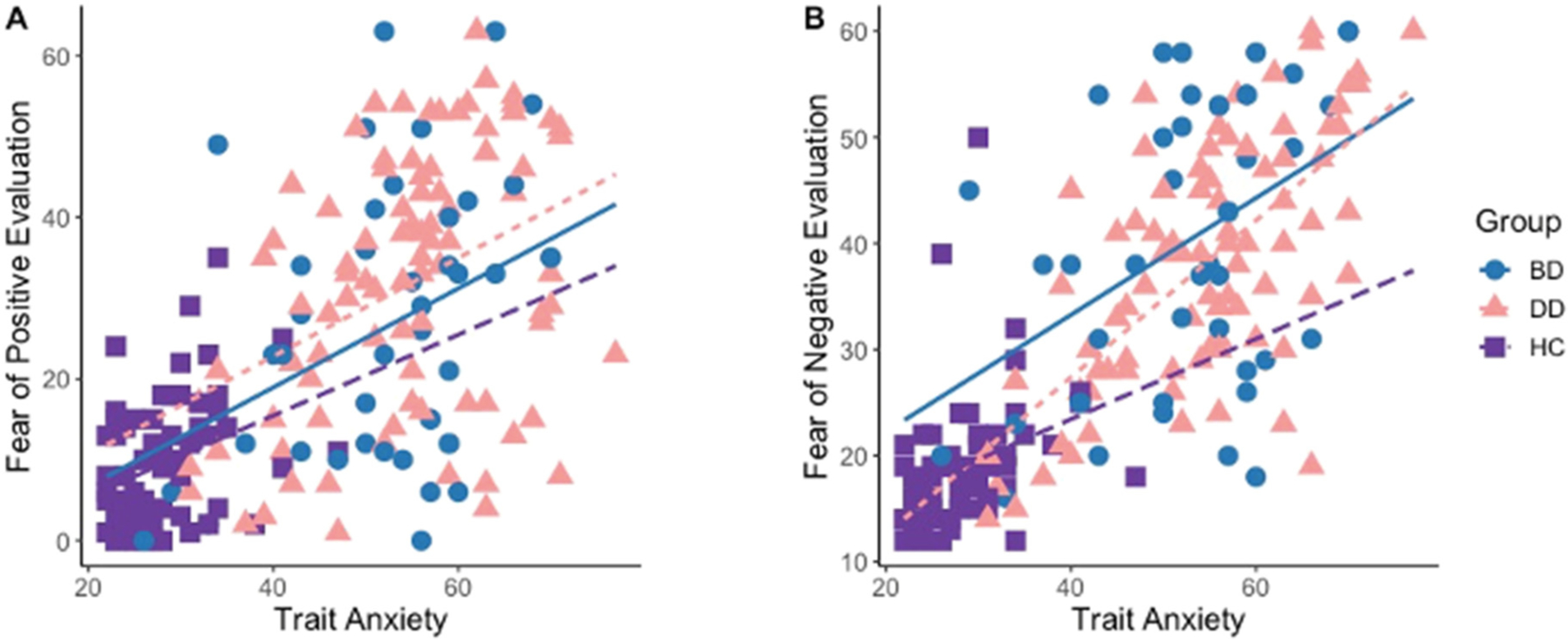
Fear of positive and negative evaluation is maladaptive and may result in psychosocial dysfunction. Although being diagnosed with mood disorders or experiencing childhood trauma may potentially affect fear of evaluation, previous studies examined this phenomenon mostly in social anxiety disorders. To fill this gap, we investigated the relationship between childhood trauma and fear of positive and negative evaluation in individuals with bipolar disorder (BD), depressive disorders (DD), and healthy controls (HC). 43 individuals with BD, 89 with DD, and 65 HC completed clinical interviews and self-report assessments. The relationship between participants' diagnoses and presence of trauma on fear of positive and negative evaluation was examined using ANCOVA. Independently of experiencing childhood trauma, fear of positive evaluation was significantly higher in individuals with mood disorders vs. HC. Fear of negative evaluation was significantly associated with diagnosis-by-trauma interaction. Significantly lower scores were observed in individuals with BD without childhood trauma compared to those with childhood trauma and individuals with DD. Compared to HC, more individuals with mood disorders experienced childhood trauma. While experiencing childhood trauma may increase vulnerability to mood disorders in general, it is especially detrimental for individuals with BD by increasing the risk for developing a fear of negative evaluation.
对正面和负面评价的恐惧是适应不良的,可能导致心理社会功能障碍。虽然被诊断患有情绪障碍或经历过童年创伤可能会影响对评价的恐惧,但之前的研究大多在社交焦虑障碍中研究了这一现象。为了填补这一空白,我们研究了双相情感障碍(BD)、抑郁障碍(DD)和健康对照组(HC)个体中童年创伤与对正面和负面评价的恐惧之间的关系。43 名 BD 患者、89 名 DD 患者和 65 名 HC 完成了临床访谈和自我报告评估。使用协方差分析(ANCOVA)检验参与者的诊断与创伤对正面和负面评价恐惧之间的关系。独立于经历童年创伤,与 HC 相比,情绪障碍患者的正面评价恐惧明显更高。负面评价恐惧与诊断-创伤相互作用显著相关。与有童年创伤的个体和 DD 患者相比,无童年创伤的 BD 患者的评分显著较低。与 HC 相比,更多的情绪障碍患者经历过童年创伤。虽然经历童年创伤可能会增加一般情绪障碍的易感性,但对 BD 患者来说尤其不利,因为它会增加对负面评价恐惧的风险。