Janet Stoia-Davis, RN, CWOCN, FCN, Stoia Consultants, Riverside, California.
Janice C. Colwell, APRN, CWOCN, FAAN, Department of Surgery, University of Chicago Medicine, Chicago, Illinois.
J Wound Ostomy Continence Nurs. 2022;49(3):247-250. doi: 10.1097/WON.0000000000000877.
The purpose of this study was to validate time frames for postoperative care following stoma surgery and to determine participants' current practice with convex pouching systems during the postoperative period.
A Cross-sectional survey.
The sample comprised 332 ostomy care specialists practicing in the United States. Most (n = 220; 66%) had more than 10 years' experience caring for patients with ostomies, 82% (n = 272) were certified WOC or ostomy care nurses (CWOCN and COCN), and 7% (n = 23) were board-certified colorectal surgeons.
A 23-item online questionnaire was created for purposes of the study. Items in the questionnaire queried professional background and experience caring for patients with an ostomy. A single item was used to identify postoperative care periods following ostomy surgery. Additional items queried current practice patterns related to use of convex pouching systems and the timing of their use. Data were collected from January 18 to February 8, 2021.
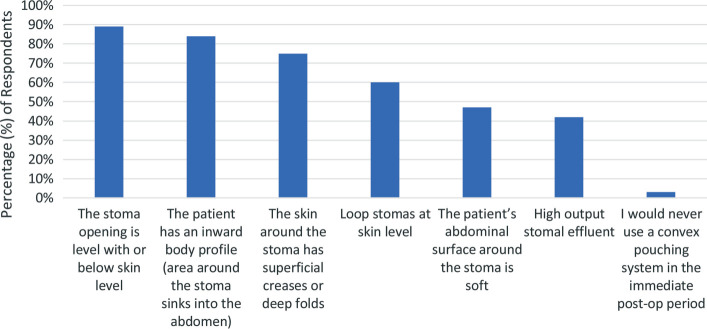
Most respondents (n = 270; 90%) agreed with the following postoperative periods after ostomy surgery: immediate postoperative period (days 0-8); postoperative period (days 9-30); and transition phase (days 31-180). Most respondents (n = 274; 95%) indicated they would use a convex pouching system when clinically appropriate during the first 30 days following ostomy surgery and 79% (n = 228) indicated using a convex pouching system regardless of when the surgery was performed. Less than 1% (n = 2) indicated never using convexity within the first 30 days following stoma surgery, and only 3% (n = 8) indicated avoidance of convexity pouching systems in the immediate postoperative period.
Findings indicate that use of convexity during the postoperative period is prevalent to provide a secure seal and predictable wear time.
本研究旨在验证造口手术后的术后护理时间框架,并确定参与者在术后期间当前使用凸面袋系统的情况。
横断面调查。
样本由 332 名在美国执业的造口护理专家组成。大多数(n = 220;66%)有超过 10 年的护理造口患者的经验,82%(n = 272)是经过认证的 WOC 或造口护理护士(CWOCN 和 COCN),7%(n = 23)是经过认证的结直肠外科医生。
为研究目的创建了一个 23 项的在线问卷。问卷中的项目询问了专业背景和护理造口患者的经验。一个单项用于确定造口手术后的术后护理期。其他项目询问了与使用凸面袋系统相关的当前实践模式及其使用时间。数据于 2021 年 1 月 18 日至 2 月 8 日收集。
大多数受访者(n = 270;90%)同意以下造口手术后的术后期:即刻术后期(第 0-8 天);术后期(第 9-30 天);和过渡阶段(第 31-180 天)。大多数受访者(n = 274;95%)表示,在造口手术后的头 30 天内,只要临床需要,他们将使用凸面袋系统,79%(n = 228)表示无论手术何时进行,都将使用凸面袋系统。不到 1%(n = 2)表示在造口手术后的头 30 天内从未使用过凸度,只有 3%(n = 8)表示在即刻术后期间避免使用凸面袋系统。
研究结果表明,在术后期间使用凸度很普遍,可以提供安全的密封和可预测的佩戴时间。