Department of Psychological Medicine, Institute of Psychiatry, Psychology and Neuroscience, King's College London, London, UK
NIHR Maudsley Biomedical Research Centre, South London and Maudsley NHS Foundation Trust, London, UK.
BMJ Open. 2022 May 6;12(5):e059258. doi: 10.1136/bmjopen-2021-059258.
Digital health tools such as smartphones and wearable devices could improve psychological treatment outcomes in depression through more accurate and comprehensive measures of patient behaviour. However, in this emerging field, most studies are small and based on student populations outside of a clinical setting. The current study aims to determine the feasibility and acceptability of using smartphones and wearable devices to collect behavioural and clinical data in people undergoing therapy for depressive disorders and establish the extent to which they can be potentially useful biomarkers of depression and recovery after treatment.
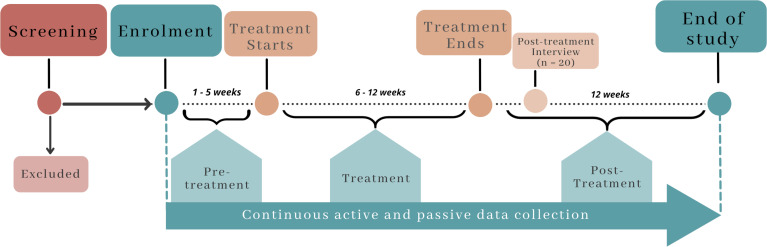
This is an observational, prospective cohort study of 65 people attending psychological therapy for depression in multiple London-based sites. It will collect continuous passive data from smartphone sensors and a Fitbit fitness tracker, and deliver questionnaires, speech tasks and cognitive assessments through smartphone-based apps. Objective data on sleep, physical activity, location, Bluetooth contact, smartphone use and heart rate will be gathered for 7 months, and compared with clinical and contextual data. A mixed methods design, including a qualitative interview of patient experiences, will be used to evaluate key feasibility indicators, digital phenotypes of depression and therapy prognosis. Patient and public involvement was sought for participant-facing documents and the study design of the current research proposal.
Ethical approval has been obtained from the London Westminster Research Ethics Committee, and the Health Research Authority, Integrated Research Application System (project ID: 270918). Privacy and confidentiality will be guaranteed and the procedures for handling, processing, storage and destruction of the data will comply with the General Data Protection Regulation. Findings from this study will form part of a doctoral thesis, will be presented at national and international meetings or academic conferences and will generate manuscripts to be submitted to peer-reviewed journals.
智能手机和可穿戴设备等数字健康工具可以通过更准确、全面地衡量患者行为,改善抑郁症的心理治疗效果。然而,在这个新兴领域,大多数研究规模较小,且基于临床环境之外的学生群体。本研究旨在确定使用智能手机和可穿戴设备收集正在接受抑郁症治疗的人群的行为和临床数据的可行性和可接受性,并确定它们在多大程度上可以作为抑郁和治疗后恢复的潜在有用生物标志物。
这是一项在伦敦多个地点进行的针对接受心理治疗的抑郁症患者的观察性、前瞻性队列研究。它将从智能手机传感器和 Fitbit 健身追踪器收集连续被动数据,并通过基于智能手机的应用程序提供问卷、语音任务和认知评估。将在 7 个月内收集睡眠、身体活动、位置、蓝牙接触、智能手机使用和心率等客观数据,并与临床和背景数据进行比较。将使用混合方法设计,包括对患者体验的定性访谈,评估关键可行性指标、抑郁的数字表型和治疗预后。患者和公众参与了面向参与者的文件和当前研究方案的设计。
已获得伦敦威斯敏斯特伦理委员会和健康研究管理局综合研究应用系统的伦理批准(项目 ID:270918)。将保证隐私和机密性,数据的处理、加工、存储和销毁程序将符合《通用数据保护条例》。本研究的结果将作为博士论文的一部分,将在国内外会议或学术会议上展示,并生成提交给同行评议期刊的手稿。