Simblett Sara, Greer Ben, Matcham Faith, Curtis Hannah, Polhemus Ashley, Ferrão José, Gamble Peter, Wykes Til
Institute of Psychiatry, Psychology and Neuroscience, Psychology, King's College London, London, United Kingdom.
MSD IT Global Innovation Center, Prague, Czech Republic.
J Med Internet Res. 2018 Jul 12;20(7):e10480. doi: 10.2196/10480.
Remote measurement technology refers to the use of mobile health technology to track and measure change in health status in real time as part of a person's everyday life. With accurate measurement, remote measurement technology offers the opportunity to augment health care by providing personalized, precise, and preemptive interventions that support insight into patterns of health-related behavior and self-management. However, for successful implementation, users need to be engaged in its use.
Our objective was to systematically review the literature to update and extend the understanding of the key barriers to and facilitators of engagement with and use of remote measurement technology, to guide the development of future remote measurement technology resources.
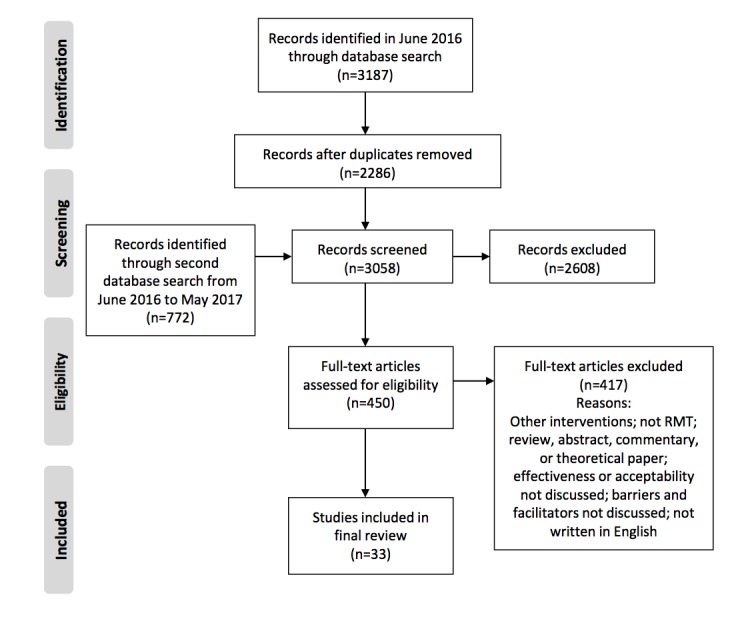
We conducted a systematic review using the Preferred Reporting Items for Systematic Reviews and Meta-Analyses guidelines involving original studies dating back to the last systematic review published in 2014. We included studies if they met the following entry criteria: population (people using remote measurement technology approaches to aid management of health), intervention (remote measurement technology system), comparison group (no comparison group specified), outcomes (qualitative or quantitative evaluation of the barriers to and facilitators of engagement with this system), and study design (randomized controlled trials, feasibility studies, and observational studies). We searched 5 databases (MEDLINE, IEEE Xplore, EMBASE, Web of Science, and the Cochrane Library) for articles published from January 2014 to May 2017. Articles were independently screened by 2 researchers. We extracted study characteristics and conducted a content analysis to define emerging themes to synthesize findings. Formal quality assessments were performed to address risk of bias.
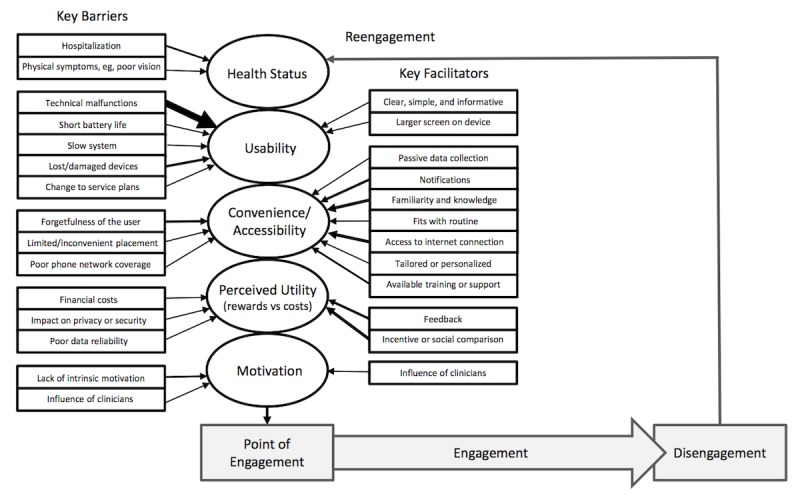
A total of 33 studies met inclusion criteria, employing quantitative, qualitative, or mixed-methods designs. Studies were conducted in 10 countries, included male and female participants, with ages ranging from 8 to 95 years, and included both active and passive remote monitoring systems for a diverse range of physical and mental health conditions. However, they were relatively short and had small sample sizes, and reporting of usage statistics was inconsistent. Acceptability of remote measurement technology according to the average percentage of time used (64%-86.5%) and dropout rates (0%-44%) was variable. The barriers and facilitators from the content analysis related to health status, perceived utility and value, motivation, convenience and accessibility, and usability.
The results of this review highlight gaps in the design of studies trialing remote measurement technology, including the use of quantitative assessment of usage and acceptability. Several processes that could facilitate engagement with this technology have been identified and may drive the development of more person-focused remote measurement technology. However, these factors need further testing through carefully designed experimental studies.
International Prospective Register of Systematic Reviews (PROSPERO) CRD42017060644; https://www.crd.york.ac.uk/PROSPERO/display_record.php?RecordID=60644 (Archived by WebCite at http://www.webcitation.org/70K4mThTr).
远程测量技术是指利用移动健康技术在人们日常生活中实时跟踪和测量健康状况的变化。借助精确测量,远程测量技术通过提供个性化、精准且具有前瞻性的干预措施,为增强医疗保健提供了契机,这些干预措施有助于深入了解与健康相关的行为模式和自我管理情况。然而,要成功实施,用户需要积极参与其使用。
我们的目的是系统回顾文献,以更新和拓展对参与及使用远程测量技术的关键障碍和促进因素的理解,从而指导未来远程测量技术资源的开发。
我们按照系统评价与Meta分析的首选报告项目指南进行了一项系统回顾,纳入了可追溯至2014年发表的上一次系统回顾以来的原始研究。若研究符合以下纳入标准,我们便将其纳入:研究对象(使用远程测量技术方法辅助健康管理的人群)、干预措施(远程测量技术系统)、对照组(未指定对照组)、结局指标(对参与该系统的障碍和促进因素进行定性或定量评估)以及研究设计(随机对照试验、可行性研究和观察性研究)。我们在5个数据库(MEDLINE、IEEE Xplore、EMBASE、科学引文索引和考克兰图书馆)中检索了2014年1月至2017年5月发表的文章。文章由2名研究人员独立筛选。我们提取了研究特征并进行了内容分析,以确定新出现的主题,从而综合研究结果。进行了正式的质量评估以解决偏倚风险。
共有33项研究符合纳入标准,采用了定量、定性或混合方法设计。研究在10个国家开展,纳入了男性和女性参与者,年龄范围为8至95岁,涵盖了针对各种身心健康状况的主动和被动远程监测系统。然而,这些研究相对较短且样本量较小,使用统计数据的报告也不一致。根据使用时间的平均百分比(64% - 86.5%)和退出率(0% - 44%),远程测量技术的可接受性各不相同。内容分析得出的障碍和促进因素与健康状况、感知效用和价值、动机、便利性和可及性以及可用性有关。
本综述结果凸显了远程测量技术试验研究设计中的差距,包括对使用情况和可接受性的定量评估。已确定了几个可促进参与该技术的过程,这些过程可能推动更以用户为中心的远程测量技术的发展。然而,这些因素需要通过精心设计的实验研究进行进一步测试。
国际前瞻性系统评价注册库(PROSPERO)CRD42017060644;https://www.crd.york.ac.uk/PROSPERO/display_record.php?RecordID=60644(由WebCite存档于http://www.webcitation.org/70K4mThTr)