INSERM, Institut Pierre Louis d'Epidémiologie et de Santé Publique, Sorbonne Université, Paris, France
Herne and Ruhr-Universität, Rheumazentrum Ruhrgebiet, Bochum, Germany.
RMD Open. 2022 May;8(1). doi: 10.1136/rmdopen-2021-002031.
Patient care can vary substantially by country. The objective was to explore differences in psoriatic arthritis (PsA) across countries for disease activity, impact and treatments.
A cross-sectional analysis of 13 countries from the Remission/Flare in PsA study (NCT03119805) of consecutive adult patients with definite PsA was performed. Countries were classified into tertiles by gross domestic product (GDP)/capita. Disease activity (Disease Activity in PsA, DAPSA and Minimal Disease Activity, MDA) and their components, disease impact (patient-reported outcomes) and biological disease-modifying antirheumatic drugs (bDMARDs) were analysed per country and compared between the three tertiles of GDP/capita by parametric and non-parametric tests. We also explored the percentage of patients with significant disease activity (DAPSA >14) and no ongoing bDMARD prescription.
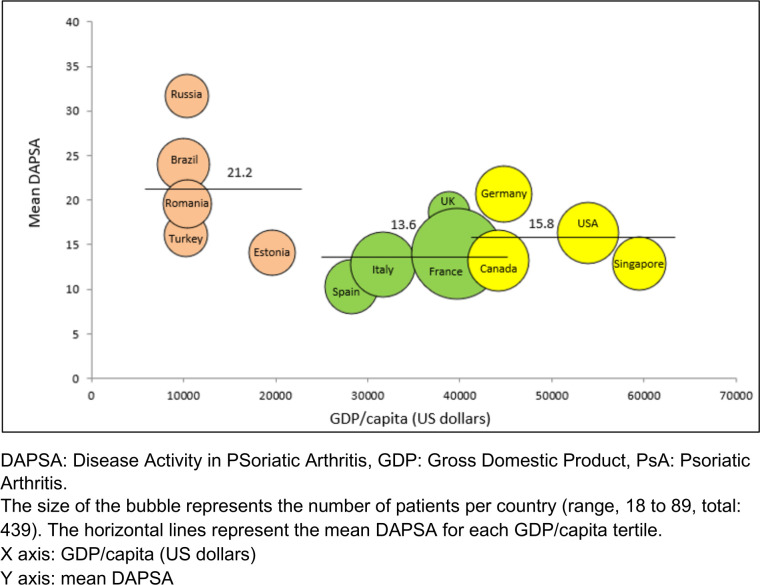
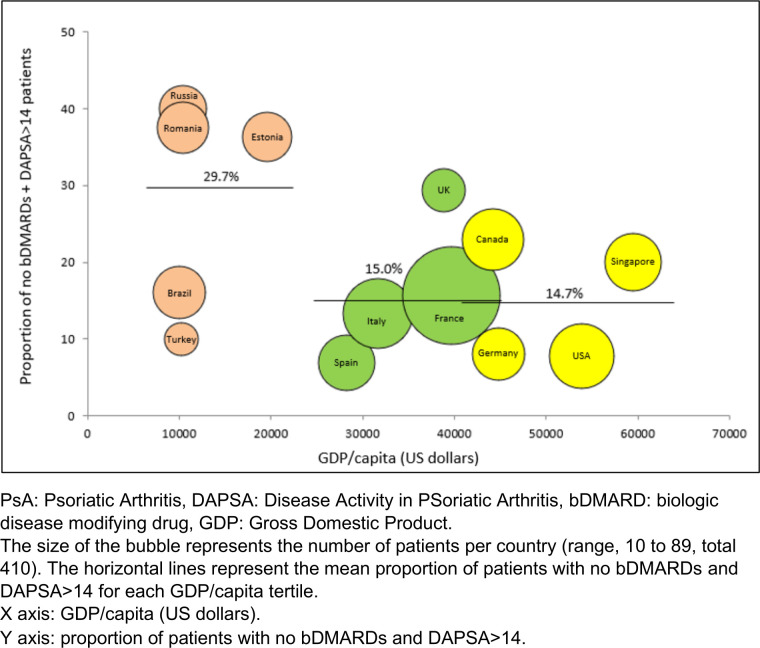
In 439 patients (50.6% male, mean age 52.3 years, mean disease duration 10.1 years), disease activity and disease impact were higher in the lowest GDP/capita countries. DAPSA remission and MDA were attained in the lowest tertile in 7.0% and 18.4% patients, vs 29.1% and 49.5% in the middle tertile and 16.8% and 41.3% in the high tertile, respectively (all p<0.001). bDMARDs use was similar in the tertiles (overall mean 61%). The overall rate of patients with DAPSA >14 and no bDMARDs was 18.5%, and was higher in lower GDP/capita countries (p=0.004).
PsA patients from countries with the lowest GDP/capita, despite similar use of bDMARDs, were more likely to have high disease activity and worse disease impact. There is a need for more equity in healthcare.
患者护理在不同国家可能存在较大差异。本研究旨在探讨不同国家中银屑病关节炎(PsA)在疾病活动度、影响和治疗方面的差异。
对连续确诊的成年银屑病关节炎患者进行了一项横断面分析,共纳入来自 Remission/Flare in PsA 研究的 13 个国家(NCT03119805)。根据国内生产总值(GDP)/人均 GDP 将国家分为三个三分位组。分析了每个国家的疾病活动度(PsA 疾病活动度、DAPSA 和最小疾病活动度、MDA)及其组成部分、疾病影响(患者报告的结局)和生物改善病情抗风湿药物(bDMARDs),并通过参数和非参数检验比较了 GDP/人均 GDP 的三个三分位组之间的差异。我们还探讨了具有显著疾病活动度(DAPSA>14)且未接受持续 bDMARD 治疗的患者比例。
在 439 名患者(50.6%为男性,平均年龄 52.3 岁,平均病程 10.1 年)中,GDP/人均 GDP 最低的国家疾病活动度和疾病影响更高。在最低三分位组中,7.0%和 18.4%的患者达到 DAPSA 缓解和 MDA,而中间三分位组和最高三分位组分别为 29.1%和 49.5%、16.8%和 41.3%(均 p<0.001)。三分位组之间 bDMARDs 的使用率相似(总体平均值为 61%)。DAPSA>14 且无 bDMARDs 的患者总体比例为 18.5%,且在 GDP/人均 GDP 较低的国家中更高(p=0.004)。
尽管使用 bDMARDs 的情况相似,但 GDP/人均 GDP 最低的国家的银屑病关节炎患者更有可能出现高度疾病活动和更差的疾病影响。需要在医疗保健方面实现更大的公平性。