Department of Computer Science and Engineering, The Ohio State University College of Engineering, Columbus, OH, USA.
Battelle Center for Mathematical Medicine, Columbus, OH, USA.
Sci Rep. 2022 May 6;12(1):7490. doi: 10.1038/s41598-022-11402-6.
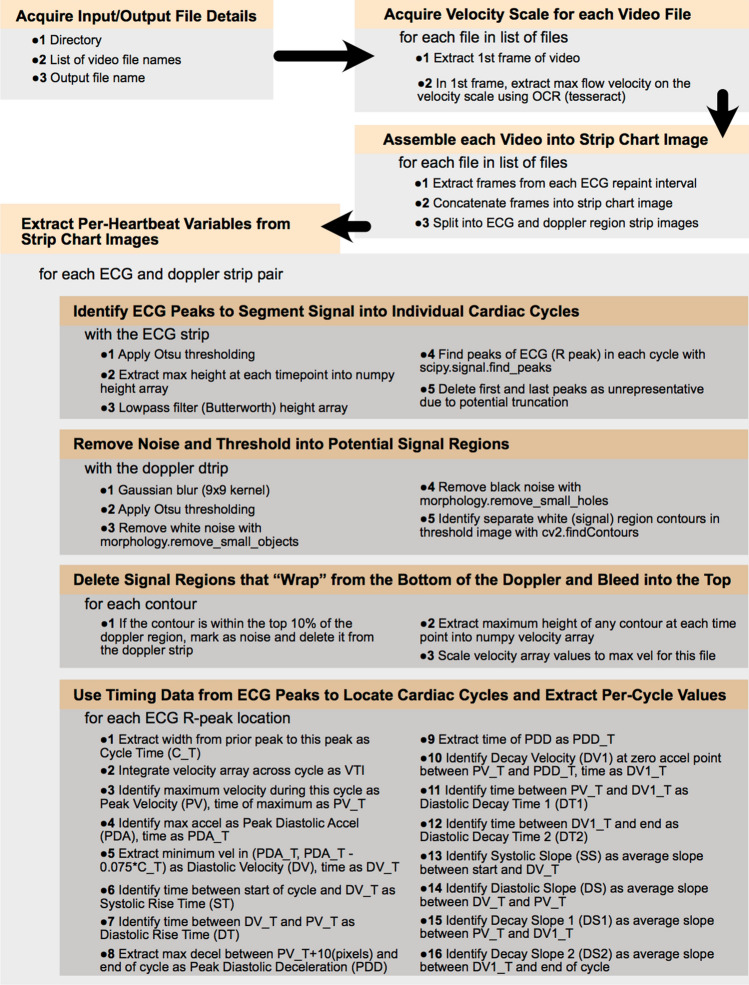
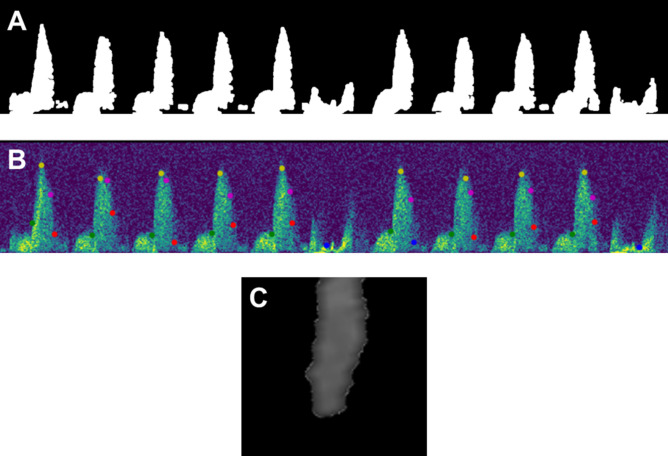
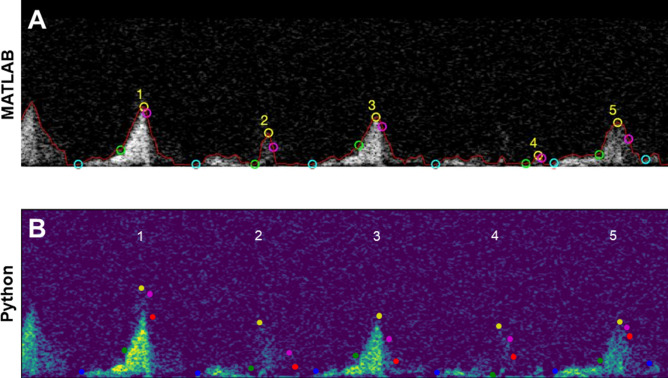
Coronary artery disease is the leading cause of heart disease, and while it can be assessed through transthoracic Doppler echocardiography (TTDE) by observing changes in coronary flow, manual analysis of TTDE is time consuming and subject to bias. In a previous study, a program was created to automatically analyze coronary flow patterns by parsing Doppler videos into a single continuous image, binarizing and separating the image into cardiac cycles, and extracting data values from each of these cycles. The program significantly reduced variability and time to complete TTDE analysis, but some obstacles such as interfering noise and varying video sizes left room to increase the program's accuracy. The goal of this current study was to refine the existing automation algorithm and heuristics by (1) moving the program to a Python environment, (2) increasing the program's ability to handle challenging cases and video variations, and (3) removing unrepresentative cardiac cycles from the final data set. With this improved analysis, examiners can use the automatic program to easily and accurately identify the early signs of serious heart diseases.
冠状动脉疾病是心脏病的主要病因,虽然可以通过观察冠状动脉血流变化来进行经胸多普勒超声心动图(TTDE)评估,但 TTDE 的手动分析既耗时又容易产生偏差。在之前的一项研究中,创建了一个程序,通过将多普勒视频解析为单个连续图像、对图像进行二值化和分割成心动周期以及从每个心动周期中提取数据值,从而自动分析冠状动脉血流模式。该程序显著减少了 TTDE 分析的可变性和时间,但一些障碍,如干扰噪声和视频大小的变化,为提高程序的准确性留出了空间。本研究的目的是通过(1)将程序转移到 Python 环境中,(2)提高程序处理挑战性病例和视频变化的能力,以及(3)从最终数据集删除无代表性的心动周期来改进现有的自动化算法和启发式算法。通过这种改进的分析,检查者可以使用自动程序轻松、准确地识别严重心脏病的早期迹象。