Erasmus School of Social and Behavioural Sciences, Erasmus University Rotterdam, Burgemeester Oudlaan 50, 3062 PA, Rotterdam, The Netherlands.
Radboud University Nijmegen, Nijmegen, The Netherlands.
Sci Rep. 2022 May 6;12(1):7458. doi: 10.1038/s41598-022-11421-3.
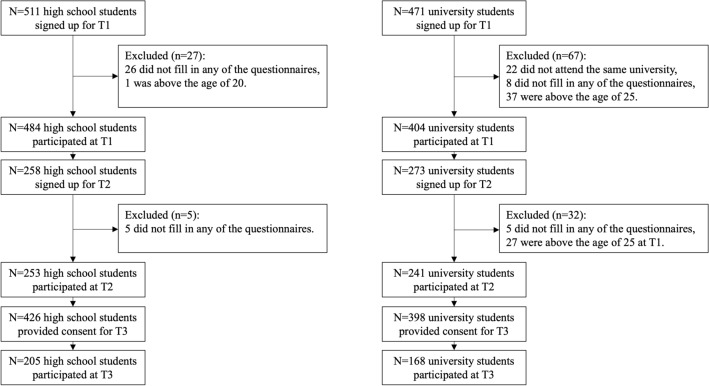
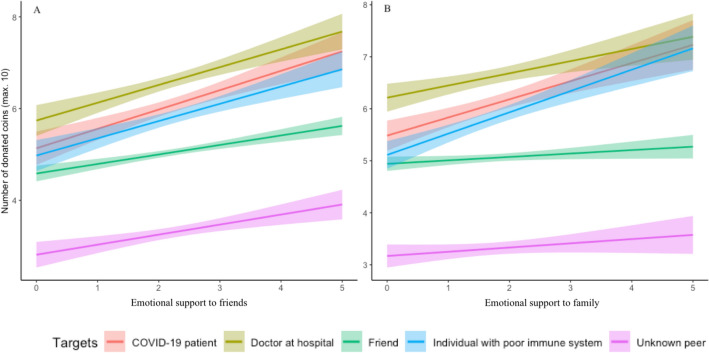
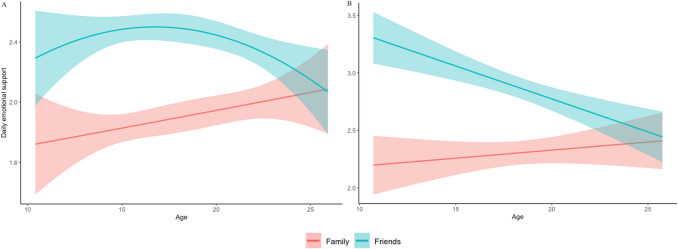
Prosocial actions are a building block for developing mature and caring social relations. However, the global pandemic may hamper adolescents' prosocial actions. In this preregistered study, we examined the extent to which adolescents provided daily emotional support during the COVID-19 pandemic. In total, 10-25-year-old high school and university students participated at three timepoints (N = 888 at the first timepoint (May 2020); 494 at the second timepoint (Nov 2020) and 373 at the third timepoint (May 2021)). At the first and second timepoint, participants completed 2 weeks of daily diaries on providing emotional support. At all timepoints, participants performed Dictator Games to measure giving to peers, friends and COVID-19 targets (medical doctors, COVID-19 patients, individuals with a poor immune system). Across the three timepoints, adolescents gave more to COVID-19 targets than peers and friends, but giving to COVID-19 target was highest in the beginning of the pandemic (first timepoint relative to second and third timepoint). Results from the first timepoint showed that emotional support directed to friends peaked in mid-adolescence, whereas emotional support towards family members showed a gradual increase from childhood to young adulthood. Furthermore, daily emotional support increased between the first and second timepoint. Daily emotional support to friends predicted giving behavior to all targets, whereas emotional support to family was specifically associated with giving to COVID-19 targets. These findings elucidate the relation between daily actions and prosocial giving to societally-relevant targets in times of crisis, underlying the importance of prosocial experiences during adolescence.
亲社会行为是发展成熟和关爱的社会关系的基础。然而,全球大流行可能会阻碍青少年的亲社会行为。在这项预先注册的研究中,我们考察了青少年在 COVID-19 大流行期间提供日常情感支持的程度。共有 10-25 岁的高中生和大学生在三个时间点参与(第一次时间点(2020 年 5 月)有 888 人;第二次时间点(2020 年 11 月)有 494 人;第三次时间点(2021 年 5 月)有 373 人)。在第一次和第二次时间点,参与者完成了为期两周的提供情感支持的日常日记。在所有时间点,参与者都进行了独裁者游戏,以衡量对同龄人、朋友和 COVID-19 目标(医生、COVID-19 患者、免疫系统较差的个体)的给予。在三个时间点中,青少年对 COVID-19 目标的给予都多于同龄人,对 COVID-19 目标的给予在大流行初期(第一次时间点相对于第二和第三次时间点)最高。第一次时间点的结果表明,朋友的情感支持在青少年中期达到顶峰,而对家庭成员的情感支持则从儿童期到青年期逐渐增加。此外,第一次和第二次时间点之间的日常情感支持增加了。对朋友的日常情感支持预测了对所有目标的给予行为,而对家庭的情感支持则与对 COVID-19 目标的给予特别相关。这些发现阐明了在危机时期日常行为与对社会相关目标的亲社会给予之间的关系,突出了青少年时期亲社会经历的重要性。