Department of Physical Therapy, Faculty of Health Sciences, Ben-Gurion University of the Negev, Beer-Sheva, Israel.
Department of Information Systems, Faculty of Engineering Sciences, Ben-Gurion University, Beer-Sheva, Israel.
BMC Geriatr. 2022 May 6;22(1):400. doi: 10.1186/s12877-022-03080-w.
The inability to recover from unexpected lateral loss of balance may be particularly relevant to the problem of falling.
We aimed to explore whether different kinematic patterns and strategies occur in the first recovery step in single-step trials in which a single step was required to recover from a fall, and in multiple-step trials in which more than one step was required to recover from a fall. In addition, in the multiple-step trials, we examined kinematic patterns of balance recovery where extra steps were needed to recover balance.
Eighty-four older adults (79.3 ± 5.2 years) were exposed to unannounced right/left perturbations in standing that were gradually increased to trigger a recovery stepping response. We performed a kinematic analysis of the first recovery step of all single-step and multiple-step trials for each participant and of total balance recovery in the multiple-step trial.
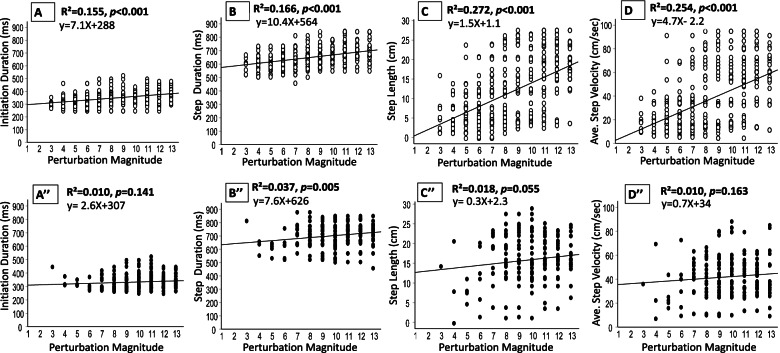
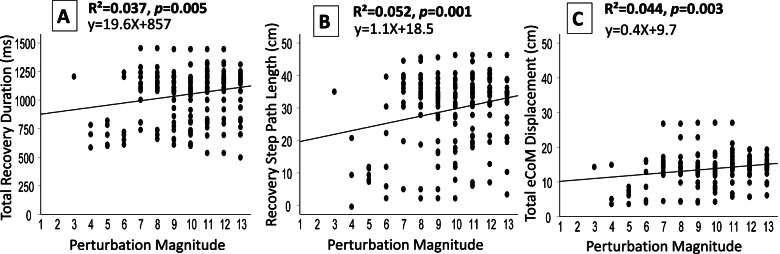
Kinematic patterns and strategies of the first recovery step in the single-step trials were significantly dependent on the perturbation magnitude. It took a small, yet significantly longer time to initiate a recovery step and a significantly longer time to complete the recovery step as the magnitude increased. However, the first recovery step in the multiple-step trials showed no significant differences between different perturbation magnitudes; while, in total balance recovery of these trials, we observed a small, yet significant difference as the magnitude increased.
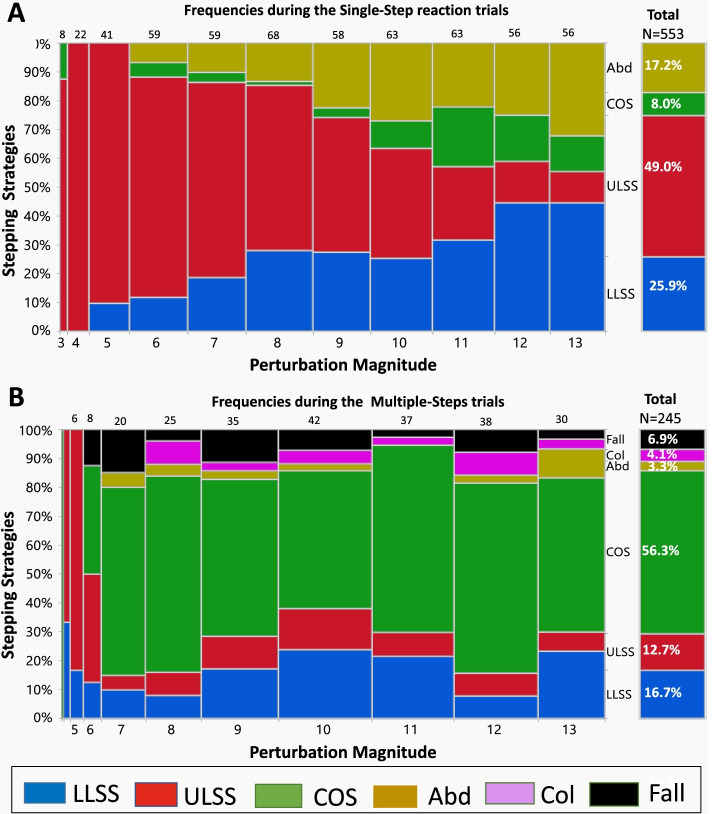
At relatively low perturbation magnitudes, i.e., single-step trials, older adults selected different first stepping strategies and kinematics as perturbation magnitudes increased, suggesting that this population activated pre-planned programs based on the perturbation magnitude. However, in the first recovery step of the multiple-step trials, i.e., high perturbation magnitudes, similar kinematic movement patterns were used at different magnitudes, suggesting a more rigid, automatic behavior, while the extra-steps were scaled to the perturbation magnitude. This suggest that older adults activate pre-planned programs based on the magnitude of the perturbation, even before the first step is completed..
无法从意外的横向失去平衡中恢复过来,可能与跌倒问题特别相关。
我们旨在探索在需要单步恢复跌倒的单步试验和需要多步恢复跌倒的多步试验中,是否会出现不同的运动模式和策略。此外,在多步试验中,我们检查了需要额外步骤来恢复平衡的平衡恢复运动模式。
84 名老年人(79.3±5.2 岁)在站立时接受了未宣布的右侧/左侧扰动,这些扰动逐渐增加以触发恢复跨步反应。我们对所有单步和多步试验中每个参与者的第一恢复步的运动学进行了分析,并对多步试验中的总平衡恢复进行了分析。
单步试验中第一恢复步的运动模式和策略与扰动幅度显著相关。随着幅度的增加,启动恢复步所需的时间明显更长,完成恢复步所需的时间也明显更长。然而,多步试验中的第一恢复步在不同的扰动幅度之间没有显著差异;然而,在这些试验的总平衡恢复中,我们观察到随着幅度的增加,存在一个小但显著的差异。
在相对较低的扰动幅度下,即单步试验中,老年人随着扰动幅度的增加选择了不同的第一步策略和运动学,这表明该人群根据扰动幅度激活了预先计划的程序。然而,在多步试验的第一恢复步中,即高扰动幅度下,在不同的幅度下使用了相似的运动模式,这表明行为更加刚性和自动,而额外的步骤则与扰动幅度相适应。这表明老年人根据扰动的幅度激活预先计划的程序,甚至在第一步完成之前。