Schwartz Movement Analysis & Rehabilitation Laboratory, Department of Physical Therapy, Faculty of Health Sciences, Recanati School for Community Health Professions, Ben-Gurion University of the Negev, P.O.B. 653, 84105, Beer-Sheva, Israel.
Department of Emergency Medicine, Recanati School for Community Health Professions, Ben-Gurion University of the Negev, Ben-Gurion University, Beer-Sheva, Israel.
BMC Geriatr. 2023 Oct 13;23(1):656. doi: 10.1186/s12877-023-04356-5.
'Reactive balance training' (RBT) was developed to improve balance reactions to unexpected losses of balance. Although this training method is effective, its practical usage in the field of physical-therapy in Israel and world-wide is still unclear.
This study aimed to evaluate the extent of RBT use in physical-therapy clinics in Israel, to identify the significant barriers to/facilitators for implementing RBT in clinical practice among physical therapists, and to determine which aspects of RBT most interest physical therapists in Israel.
Physical therapists in Israel completed a survey using a questionnaire regarding their knowledge and use of RBT in their clinical practices. We compared the specific use of RBT among users; non-users; and open-to-use physical therapists. The odds ratios of the facilitators and barriers were calculated using univariate and multivariate logistic regression models.
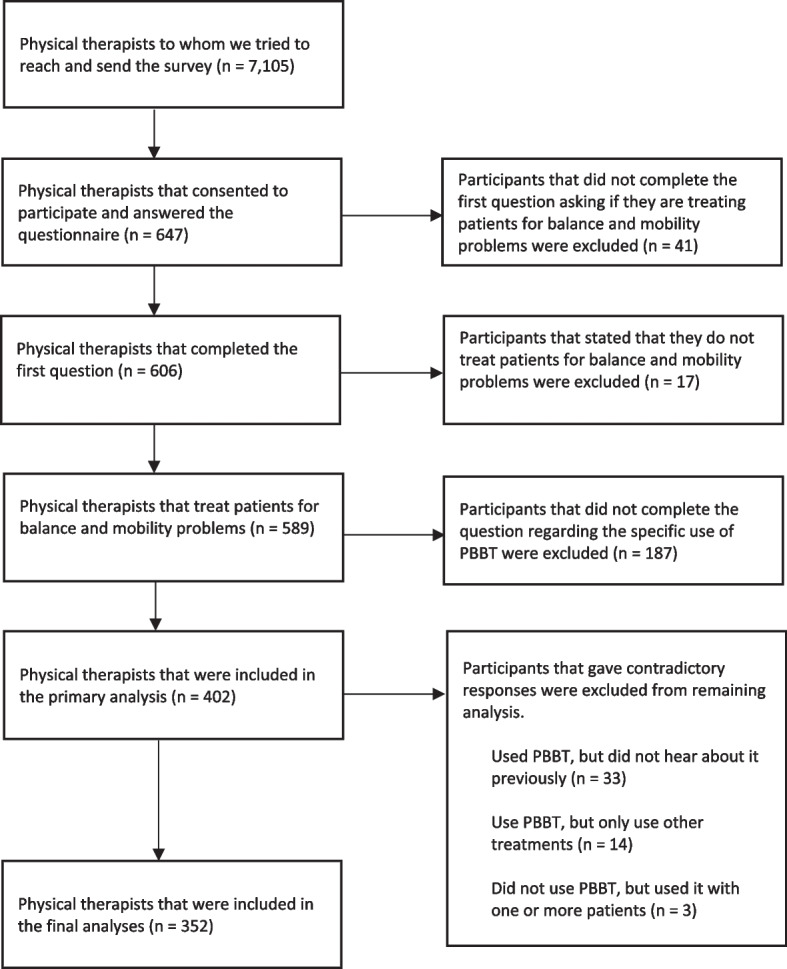
Four-hundred and two physical therapists responded to a yes/no question regarding their use of RBT. Three-quarters (75.4%) of physical therapists reported using RBT in their practices. The most prevalent barrier cited was insufficient space for setting up equipment and most prevalent facilitator was having a colleague who uses RBT. Most of the respondents wanted to learn more about RBT, and most of the non-users wanted to expand their knowledge and mastery of RBT principles.
There are misconceptions and insufficient knowledge about RBT among physical therapists in Israel, indicating that they may falsely believe that RBT requires large and expensive equipment, suggesting they categorize RBT as external perturbation training only. Reliable information may help to improve general knowledge regarding RBT, and to facilitate the more widespread implementation of RBT as an effective fall-prevention intervention method.
“反应性平衡训练”(RBT)是为了提高对意外失去平衡的平衡反应而开发的。尽管这种训练方法很有效,但在以色列和世界范围内的物理治疗领域的实际应用仍不清楚。
本研究旨在评估 RBT 在以色列物理治疗诊所中的使用程度,确定物理治疗师在临床实践中实施 RBT 的主要障碍/促进因素,并确定 RBT 中最能引起以色列物理治疗师兴趣的方面。
以色列的物理治疗师使用问卷完成了一项关于他们在临床实践中对 RBT 的了解和使用的调查。我们比较了使用者;非使用者;和愿意使用 RBT 的物理治疗师之间 RBT 的具体使用情况。使用单变量和多变量逻辑回归模型计算促进因素和障碍的优势比。
402 名物理治疗师对他们在实践中是否使用 RBT 回答了是/否的问题。四分之三(75.4%)的物理治疗师报告在他们的实践中使用 RBT。引用最多的障碍是设置设备的空间不足,最常见的促进因素是有同事使用 RBT。大多数受访者希望更多地了解 RBT,大多数非使用者希望扩展他们对 RBT 原则的知识和掌握。
以色列的物理治疗师对 RBT 存在误解和知识不足,这表明他们可能错误地认为 RBT 需要大型和昂贵的设备,这表明他们将 RBT 仅归类为外部干扰训练。可靠的信息可能有助于提高对 RBT 的一般认识,并促进 RBT 作为一种有效的预防跌倒干预方法更广泛地实施。