Qiao Juanjuan, Lu Gengyu, Wu Gang, Liu Hui, Wang Wanli, Zhang Tianmao, Xie Guoyong, Qin Minjian
Department of Resources Science of Traditional Chinese Medicines, School of Traditional Chinese Pharmacy, China Pharmaceutical University, Nanjing, 211198, China.
The Teaching Experiments Center of Traditional Chinese Medicines, School of Traditional Chinese Pharmacy, China Pharmaceutical University, Nanjing, 211198, China.
Chin Med. 2022 May 6;17(1):54. doi: 10.1186/s13020-022-00614-7.
The processing of medicinal plant materials is one of the important factors influencing the components and biological activities of TCMs. Smilax glabra Roxb. is an herbal vine widely distributed in China, and its dried rhizome (Smilacis Glabrae Rhizoma, SGR) is often used in traditional medicines and functional foods. The processing methods of fresh cutting for SGR slices have been included in ancient Chinese herbal works, some local standards of TCMs, and the current Chinese Pharmacopoeia. Nevertheless, to date, the scientific basis for the processing of fresh medicinal materials for SGR slices has not been revealed.
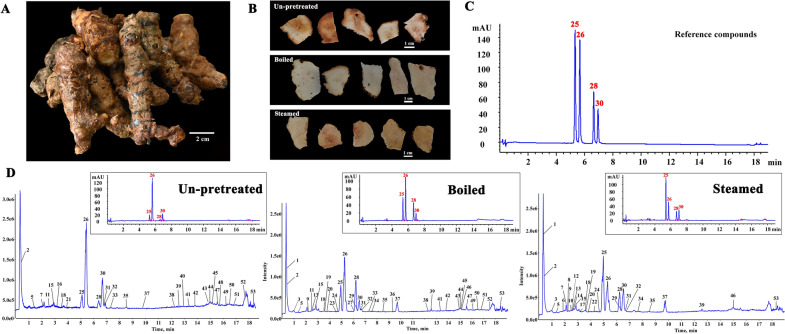
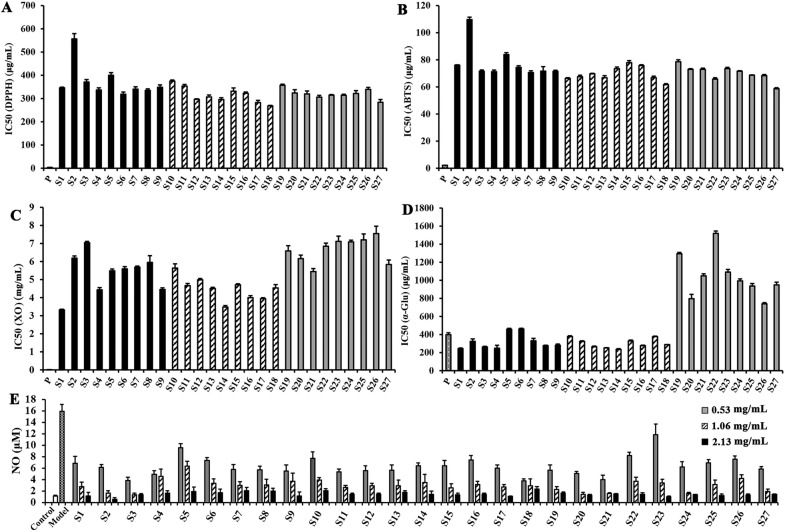
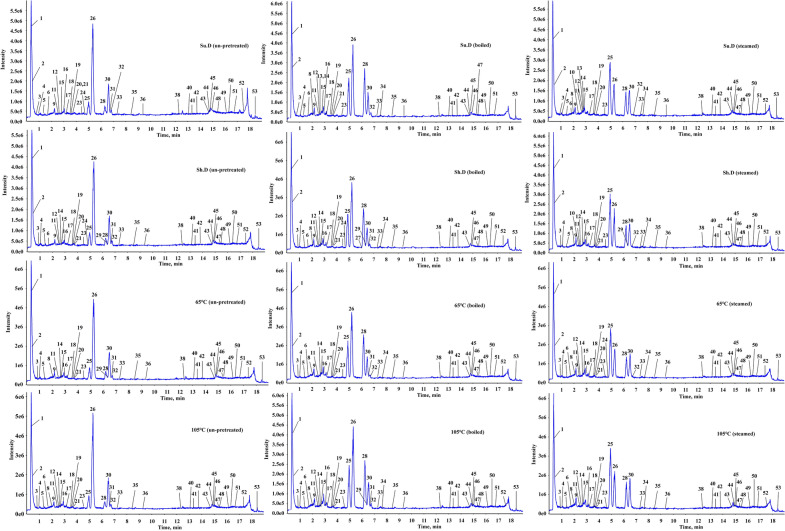
To optimize the processing method for preparing SGR slices from the fresh rhizomes, the chemical compositions of the un-pretreated and pretreated (boiling, steaming) samples before and after drying (sun-drying, shade-drying, oven-drying), and the contents of astilbin isomers in dried SGR were analyzed by UHPLC-Q-TOF-MS/MS and UHPLC-DAD methods, respectively. Then, the antioxidant, anti-inflammatory, xanthine oxidase and α-glucosidase inhibitory activities of the prepared SGR slices were investigated by biological assays.
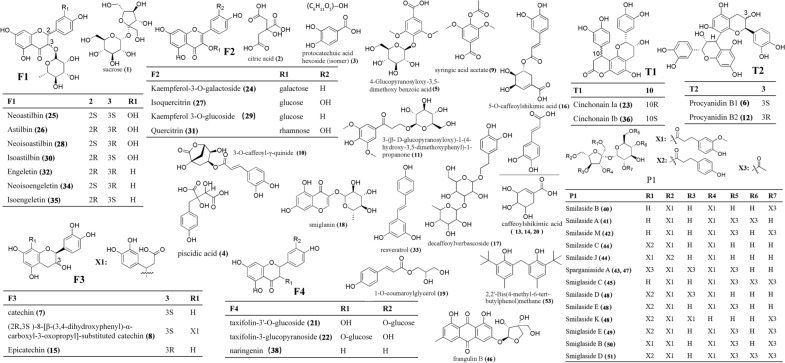
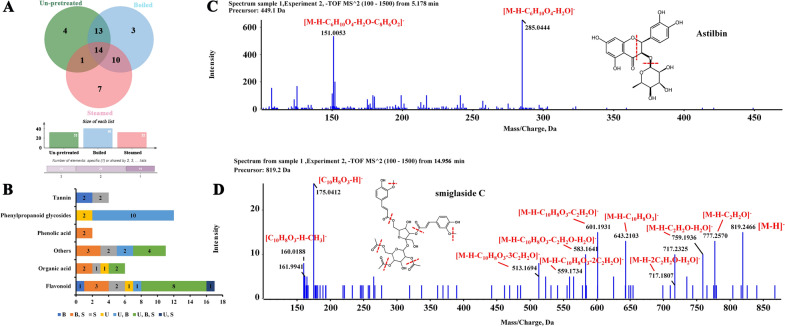
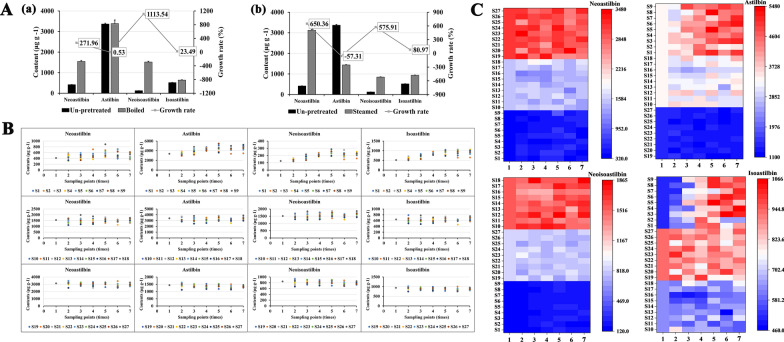
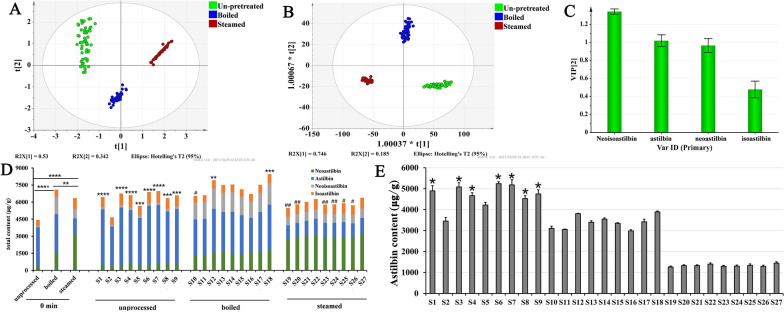
A total of fifty-two compounds were identified from the un-pretreated and pretreated samples and a total of forty-nine compounds were identified from the subsequently dried samples. After pretreated by boiling and steaming, the contents of neoastilbin, neoisoastilbin, and isoastilbin in the prepared samples all increased. As a quality marker of SGR, the content of astilbin was unchanged or decreased slightly compared with that in the un-pretreated samples. During the drying process, the contents of the four astilbin stereoisomers in the un-pretreated samples increased significantly, while those in the pretreated samples had a slight increase or decrease. The effects of different processing methods were sorted according to the bioactivities of the prepared SGR. As a result, SGR slices prepared with no pretreatment followed by a sun-drying process have a higher astilbin content, better bioactivities and more energy savings, representing the optimum processing method for SGR slices.
This study reveals the scientific basis for the processing of fresh medicinal materials for SGR slices. The results provide scientific information for the quality control of SGR and its rational applications in herbal medicines and functional foods.
药用植物材料的加工是影响中药成分和生物活性的重要因素之一。菝葜是一种广泛分布于中国的草本藤本植物,其干燥根茎(菝葜根茎,SGR)常用于传统药物和功能性食品。新鲜切割制备菝葜片的加工方法已被收录在中国古代本草著作、一些地方中药标准以及现行《中国药典》中。然而,迄今为止,新鲜药材制备菝葜片的科学依据尚未揭示。
为优化新鲜根茎制备菝葜片的加工方法,分别采用超高效液相色谱-四极杆-飞行时间串联质谱(UHPLC-Q-TOF-MS/MS)和超高效液相色谱-二极管阵列检测(UHPLC-DAD)方法分析了未经预处理和预处理(水煮、蒸制)的样品在干燥(晒干、阴干、烘干)前后的化学成分,以及干燥菝葜中落新妇苷异构体的含量。然后,通过生物学试验研究制备的菝葜片的抗氧化、抗炎、黄嘌呤氧化酶和α-葡萄糖苷酶抑制活性。
从未经预处理和预处理的样品中总共鉴定出52种化合物,从随后干燥的样品中总共鉴定出49种化合物。水煮和蒸制预处理后,制备样品中新落新妇苷、新异落新妇苷和异落新妇苷的含量均增加。作为菝葜的质量标志物,落新妇苷的含量与未经预处理的样品相比无变化或略有下降。在干燥过程中,未经预处理的样品中四种落新妇苷立体异构体的含量显著增加,而预处理样品中的含量略有增加或减少。根据制备的菝葜的生物活性对不同加工方法的效果进行排序。结果表明,未经预处理后晒干制备的菝葜片落新妇苷含量较高,生物活性较好,且更节能,代表了菝葜片的最佳加工方法。
本研究揭示了新鲜药材制备菝葜片的科学依据。研究结果为菝葜的质量控制及其在草药和功能性食品中的合理应用提供了科学信息。