Krabberød Anders K, Deutschmann Ina M, Bjorbækmo Marit F M, Balagué Vanessa, Giner Caterina R, Ferrera Isabel, Garcés Esther, Massana Ramon, Gasol Josep M, Logares Ramiro
Department of Biosciences, Section for Genetics and Evolutionary Biology (Evogene), University of Oslo, Blindernv. 31, 0316, Oslo, Norway.
Institute of Marine Sciences (ICM), CSIC, Passeig Marítim de la Barceloneta, 37-49, 08003, Barcelona, Spain.
Environ Microbiome. 2022 May 7;17(1):22. doi: 10.1186/s40793-022-00417-1.
Ocean microbes constitute ~ 70% of the marine biomass, are responsible for ~ 50% of the Earth's primary production and are crucial for global biogeochemical cycles. Marine microbiotas include core taxa that are usually key for ecosystem function. Despite their importance, core marine microbes are relatively unknown, which reflects the lack of consensus on how to identify them. So far, most core microbiotas have been defined based on species occurrence and abundance. Yet, species interactions are also important to identify core microbes, as communities include interacting species. Here, we investigate interconnected bacteria and small protists of the core pelagic microbiota populating a long-term marine-coastal observatory in the Mediterranean Sea over a decade.
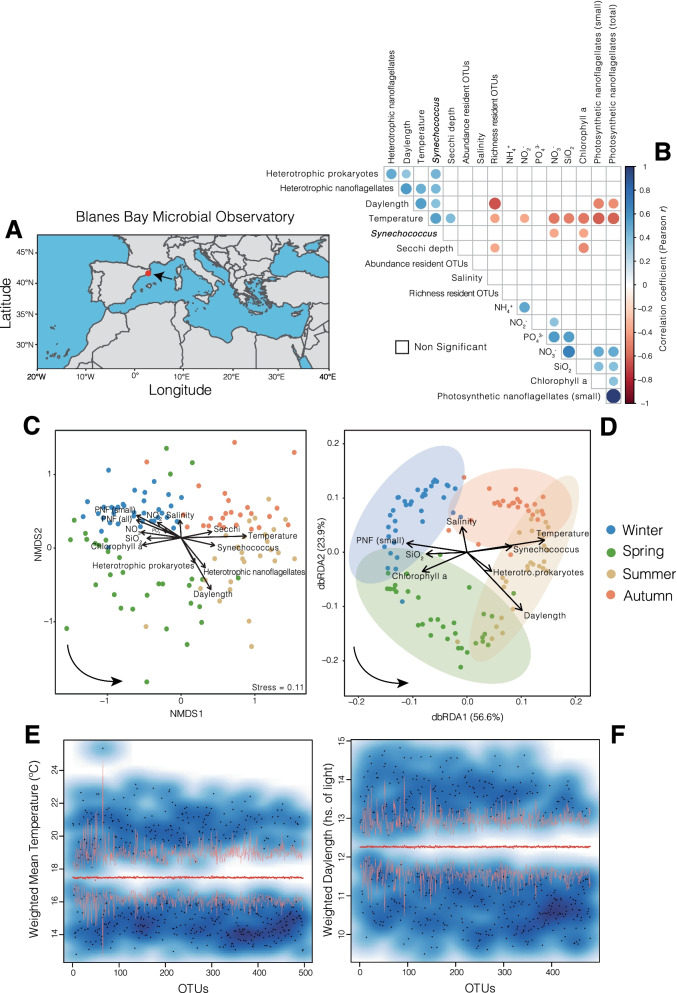
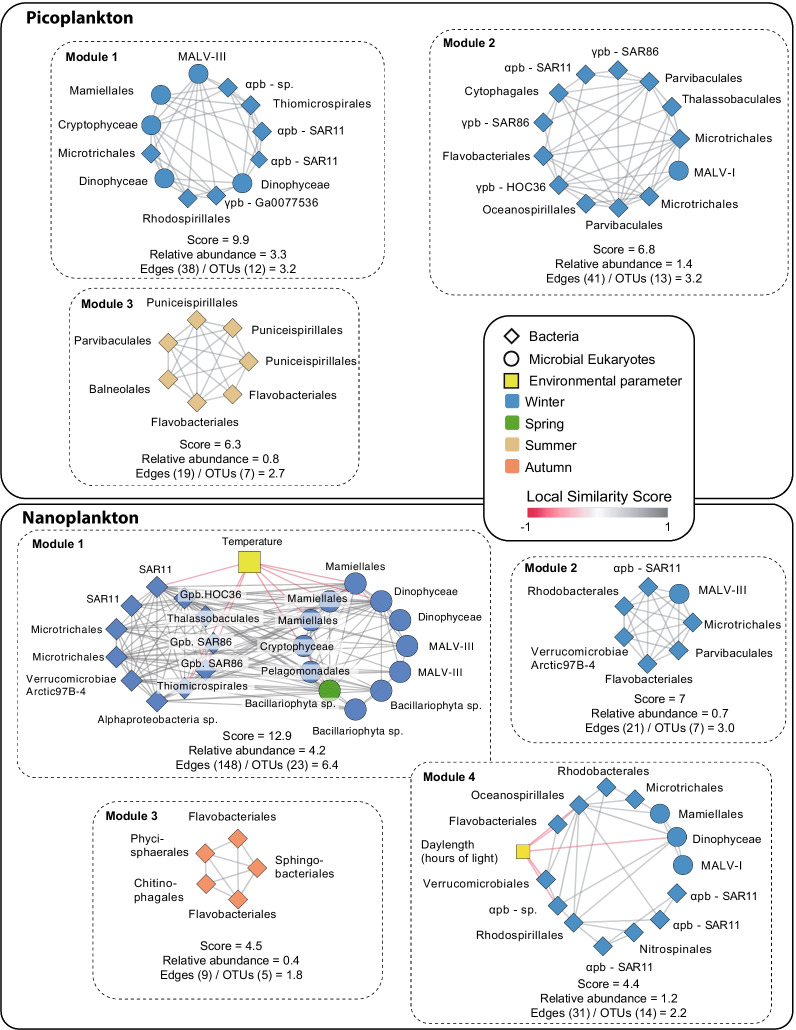
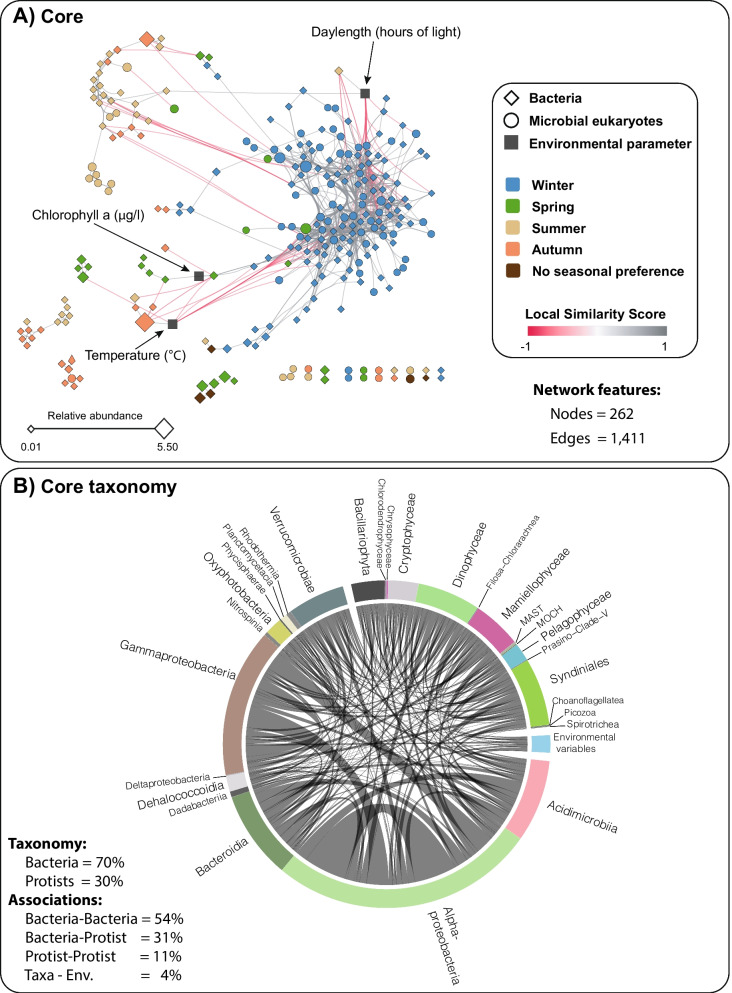
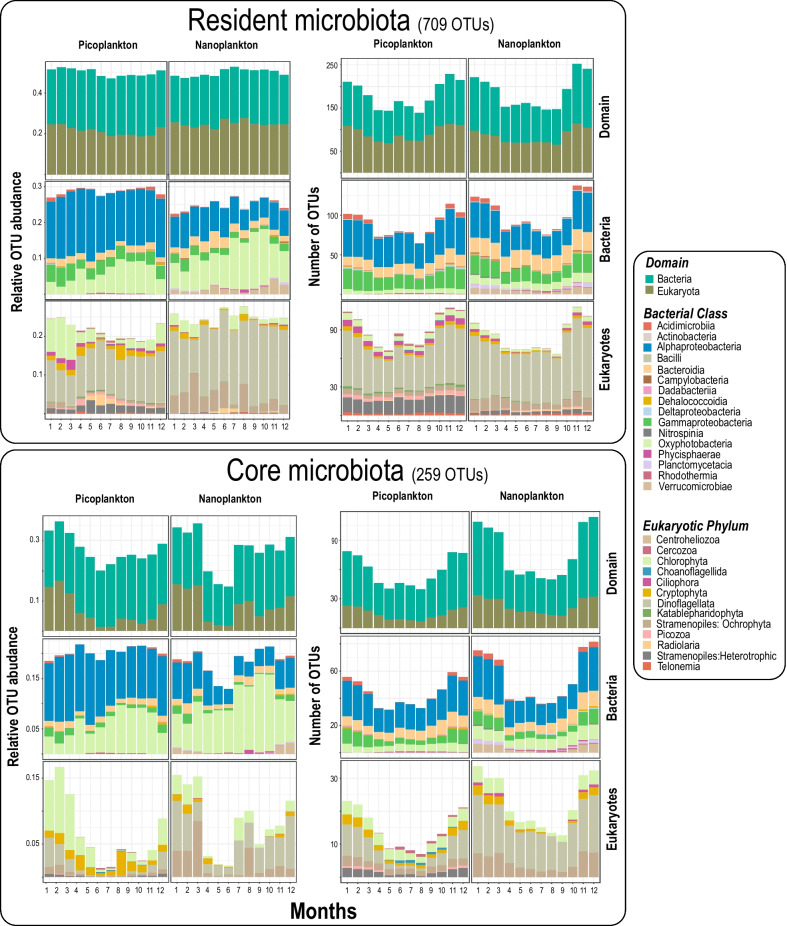
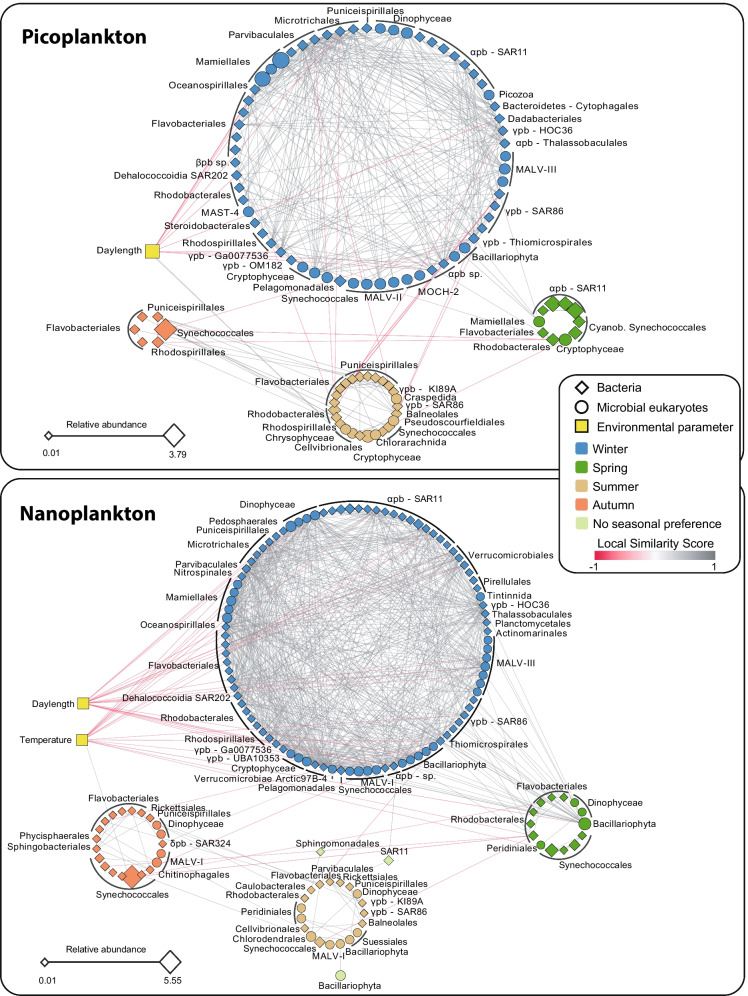
Core microbes were defined as those present in > 30% of the monthly samples over 10 years, with the strongest associations. The core microbiota included 259 Operational Taxonomic Units (OTUs) including 182 bacteria, 77 protists, and 1411 strong and mostly positive (~ 95%) associations. Core bacteria tended to be associated with other bacteria, while core protists tended to be associated with bacteria. The richness and abundance of core OTUs varied annually, decreasing in stratified warmers waters and increasing in colder mixed waters. Most core OTUs had a preference for one season, mostly winter, which featured subnetworks with the highest connectivity. Groups of highly associated taxa tended to include protists and bacteria with predominance in the same season, particularly winter. A group of 13 highly-connected hub-OTUs, with potentially important ecological roles dominated in winter and spring. Similarly, 18 connector OTUs with a low degree but high centrality were mostly associated with summer or autumn and may represent transitions between seasonal communities.
We found a relatively small and dynamic interconnected core microbiota in a model temperate marine-coastal site, with potential interactions being more deterministic in winter than in other seasons. These core microbes would be essential for the functioning of this ecosystem over the year. Other non-core taxa may also carry out important functions but would be redundant and non-essential. Our work contributes to the understanding of the dynamics and potential interactions of core microbes possibly sustaining ocean ecosystem function.
海洋微生物占海洋生物量的约70%,贡献了地球约50%的初级生产力,对全球生物地球化学循环至关重要。海洋微生物群落包括通常对生态系统功能起关键作用的核心分类群。尽管它们很重要,但核心海洋微生物相对鲜为人知,这反映出在如何识别它们方面缺乏共识。到目前为止,大多数核心微生物群落是根据物种的出现和丰度来定义的。然而,物种间相互作用对于识别核心微生物也很重要,因为群落包含相互作用的物种。在这里,我们对一个位于地中海的长期海洋 - 海岸观测站中,核心远洋微生物群落里相互关联的细菌和小型原生生物进行了长达十年的研究。
核心微生物被定义为在10年中超过30%的月度样本中出现且具有最强关联的微生物。核心微生物群落包括259个操作分类单元(OTU),其中有182个细菌、77个原生生物,以及1411个强且大多为正向(约95%)的关联。核心细菌倾向于与其他细菌相关联,而核心原生生物倾向于与细菌相关联。核心OTU的丰富度和丰度每年都有所变化,在分层的温暖水域中减少,在较冷的混合水域中增加。大多数核心OTU偏好一个季节,主要是冬季,冬季的子网具有最高的连通性。高度关联的分类群组往往包括在同一季节(尤其是冬季)占优势的原生生物和细菌。一组13个高度连通的中心OTU在冬季和春季占主导地位,它们可能具有重要的生态作用。同样,18个连接度低但中心性高的连接OTU大多与夏季或秋季相关联,可能代表季节性群落之间的过渡。
我们在一个典型的温带海洋 - 海岸站点发现了一个相对较小且动态的相互关联的核心微生物群落,其潜在相互作用在冬季比其他季节更具决定性。这些核心微生物对于该生态系统全年的功能至关重要。其他非核心分类群可能也执行重要功能,但可能是冗余且非必需的。我们的工作有助于理解可能维持海洋生态系统功能的核心微生物的动态变化和潜在相互作用。