Bagherifard Farnaz, Daneshmandi Hadi, Ziaei Mansour, Ghaem Haleh, Khoshbakht Ruhollah, Jaberi Omid, Choobineh Alireza
Department of Occupational Health Engineering, School of Health, Shiraz University of Medical Sciences, Shiraz, Iran.
Research Center for Health Sciences, Institute of Health, Shiraz University of Medical Sciences, PO Box: 71645-111, Shiraz, Iran.
BMC Sports Sci Med Rehabil. 2022 May 7;14(1):85. doi: 10.1186/s13102-022-00476-4.
Assessing physical workload is the most important step in deciding whether a workload is high and adopting appropriate control strategies to reduce physical workload. This study aimed to compare physical workload and Physical Work Capacity (PWC) among municipality cleaners in Shiraz to determine the number of workers needed to counterbalance physical workload.
The present cross-sectional study was performed on 97 municipality cleaners in Shiraz. In the first step, the participants' maximum aerobic capacity (VO-max) was estimated in the laboratory using an ergometer bicycle and the Young Men's Christian Association (YMCA) protocol, based on which the PWC was estimated. Secondly, energy expenditure and heart rate during work were measured using a POLAR400 device in an eight-hour shift. At the end of the work shift, the workers' perceived physical exertion was assessed using a Rating of Perceived Exertion 6-20 (RPE 6-20) Borg scale. In the final stage, the physical workload was assessed based on the results of the two steps.
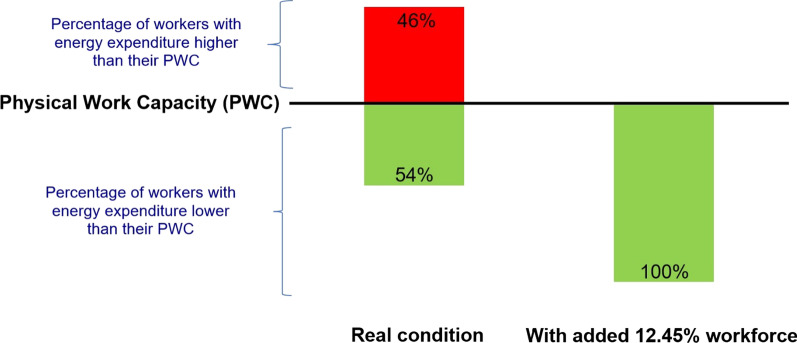
The mean VO-max of the cleaners and PWC were estimated to be 2.6 ± 0.66 l min and 4.3 ± 1.088 kcal min, respectively. The average energy consumed during work was 4.122 ± 1.016 kcal min. The overall results of this study showed that physical workload was greater than PWC in 46% of the municipality cleaners. In addition, it was found that 12.45% workforce was required to be added to the street cleaners of Shiraz municipality to reduce the physiological workload on the employed workforce.
With respect to the high level of physical activity in a significant proportion of the cleaners, measures such as increasing the workforce are suggested.
评估体力工作负荷是判定工作负荷是否过高以及采取适当控制策略以降低体力工作负荷的最重要步骤。本研究旨在比较设拉子市市政清洁工的体力工作负荷和体力工作能力(PWC),以确定抵消体力工作负荷所需的工人数。
本横断面研究对设拉子市的97名市政清洁工进行。第一步,在实验室使用测力计自行车和基督教青年会(YMCA)方案估算参与者的最大有氧能力(VO-max),并据此估算PWC。其次,在八小时轮班期间使用POLAR400设备测量工作期间的能量消耗和心率。在轮班结束时,使用6-20级自觉用力程度(RPE 6-20)博格量表评估工人的自觉体力消耗。在最后阶段,根据两个步骤的结果评估体力工作负荷。
清洁工的平均VO-max和PWC估计分别为2.6±0.66升/分钟和4.3±1.088千卡/分钟。工作期间的平均能量消耗为4.122±1.016千卡/分钟。本研究的总体结果表明,46%的市政清洁工的体力工作负荷大于PWC。此外,发现需要在设拉子市的街道清洁工中增加12.45%的劳动力,以减轻在职劳动力的生理工作负荷。
鉴于相当一部分清洁工的体力活动水平较高,建议采取增加劳动力等措施。