Brighenti-Zogg Stefanie, Mundwiler Jonas, Schüpbach Ulla, Dieterle Thomas, Wolfer David Paul, Leuppi Jörg Daniel, Miedinger David
University Clinic of Internal Medicine, Cantonal Hospital Baselland, Liestal, Switzerland.
Department of Health Sciences and Technology, ETH Zurich, Zurich, Switzerland.
PLoS One. 2016 May 2;11(5):e0154073. doi: 10.1371/journal.pone.0154073. eCollection 2016.
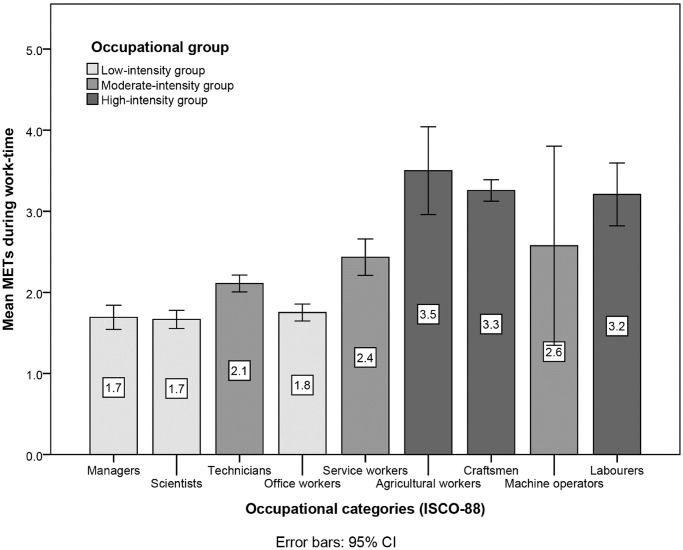
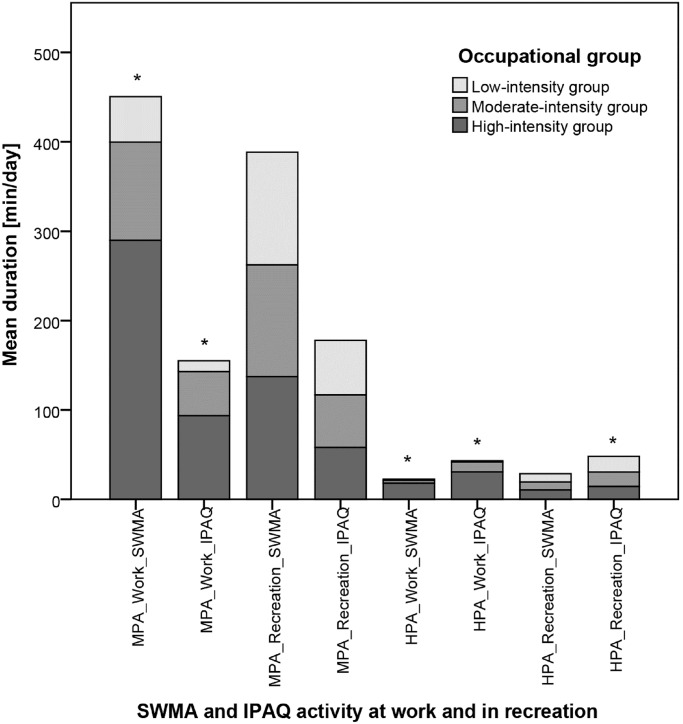
This study aimed to determine physical performance criteria of different occupational groups by investigating physical activity and energy expenditure in healthy Swiss employees in real-life workplaces on workdays and non-working days in relation to their aerobic capacity (VO2max). In this cross-sectional study, 337 healthy and full-time employed adults were recruited. Participants were classified (nine categories) according to the International Standard Classification of Occupations 1988 and merged into three groups with low-, moderate- and high-intensity occupational activity. Daily steps, energy expenditure, metabolic equivalents and activity at different intensities were measured using the SenseWear Mini armband on seven consecutive days (23 hours/day). VO2max was determined by the 20-meter shuttle run test. Data of 303 subjects were considered for analysis (63% male, mean age: 33 yrs, SD 12), 101 from the low-, 102 from the moderate- and 100 from the high-intensity group. At work, the high-intensity group showed higher energy expenditure, metabolic equivalents, steps and activity at all intensities than the other groups (p<0.001). There were no significant differences in physical activity between the occupational groups on non-working days. VO2max did not differ across groups when stratified for gender. The upper workload limit was 21%, 29% and 44% of VO2max in the low-, moderate- and high-intensity group, respectively. Men had a lower limit than women due to their higher VO2max (26% vs. 37%), when all groups were combined. While this study did confirm that the average workload limit is one third of VO2max, it showed that the average is misrepresenting the actual physical work demands of specific occupational groups, and that it does not account for gender-related differences in relative workload. Therefore, clinical practice needs to consider these differences with regard to a safe return to work, particularly for the high-intensity group.
本研究旨在通过调查瑞士健康员工在工作日和非工作日的实际工作场所中的身体活动和能量消耗,并将其与有氧能力(最大摄氧量,VO2max)相关联,来确定不同职业群体的身体表现标准。在这项横断面研究中,招募了337名健康的全职成年员工。参与者根据1988年《国际职业标准分类》进行分类(九类),并合并为低、中、高强度职业活动的三组。连续七天(每天23小时)使用SenseWear Mini臂带测量每日步数、能量消耗、代谢当量以及不同强度的活动。通过20米往返跑测试确定VO2max。对303名受试者的数据进行分析(63%为男性,平均年龄:33岁,标准差12),其中低强度组101人,中等强度组102人,高强度组100人。在工作时,高强度组在所有强度下的能量消耗、代谢当量、步数和活动均高于其他组(p<0.001)。非工作日各职业群体之间的身体活动没有显著差异。按性别分层时,各组的VO2max没有差异。低、中、高强度组的工作负荷上限分别为VO2max的21%、29%和44%。当所有组合并时,由于男性的VO2max较高,其工作负荷下限低于女性(26%对37%)。虽然本研究确实证实平均工作负荷上限是VO2max的三分之一,但它表明该平均值不能代表特定职业群体的实际体力工作需求,并且没有考虑到相对工作负荷的性别差异。因此,临床实践在考虑安全复工时需要考虑这些差异,特别是对于高强度组。