Reproductive Medical Center of Second Affiliated Hospital of Nanjing Medical University, Nanjing, China.
State Key Laboratory of Reproductive Medicine, Second Affiliated Hospital of Nanjing Medical University, Nanjing Medical University, Nanjing, China.
Hum Reprod. 2022 May 30;37(6):1229-1243. doi: 10.1093/humrep/deac089.
Are taurine and its transporter TAUT associated with spermiogenesis and early embryo development?
Morphologically abnormal spermatozoa increased after local functional interference by intratesticular injection, and taurine depletion significantly reduced the normal embryo numbers in vivo and blastocyst formation rate in vitro.
Taurine is one of the most abundant amino acids in the male reproductive system and it has been demonstrated that taurine can efficiently improve spermatogenic function in rat models of testicular injury. However, limited information is known about the role of taurine and its transporter TAUT in spermatogenesis and early embryo development.
STUDY DESIGN, SIZE, DURATION: Clinical characteristics from 110 couples who have experienced recurrent pregnancy loss (RPL) were collected from December 2014 to March 2018. According to whether a fetal heartbeat was seen in the previous pregnancy under ultrasonic monitoring, patients with RPL were divided into two groups: an RPL without heartbeat (pregnancy with no fetal heartbeat, ROH) group, and an RPL with heartbeat (one or more pregnancies with fetal heartbeat, RWH) group. Semen samples (21 ROH and 20 RWH) were finally used for metabolomic analysis. Furthermore, semen samples were obtained from 30 patients with teratozoospermia (normal sperm morphology <4%) seeking evaluation for infertility and 25 age-matched control subjects with normal semen quality for western blotting. Animal experiments were performed in CD-1/ICR mice.
PARTICIPANTS/MATERIALS, SETTING, METHODS: Metabolomics was performed to determine the metabolic changes between the ROH and RWH groups. Sperm proteins from patients with teratozoospermia and healthy controls were extracted for detecting TAUT expression using western blot analysis. Immunofluorescence was used to characterize the localization of TAUT in the testis and ejaculated spermatozoa. Functional analysis in mice was performed by intratesticular injection of siRNAs or antagonist (β-alanine) and 5% β-alanine was provided in drinking water to 3-week-old male mice for 5 weeks with the aim of depleting taurine. Murine epididymal spermatozoa were stained with hematoxylin and eosin for morphological assessment. IVF and mating tests were performed in mice for assessing fertility.
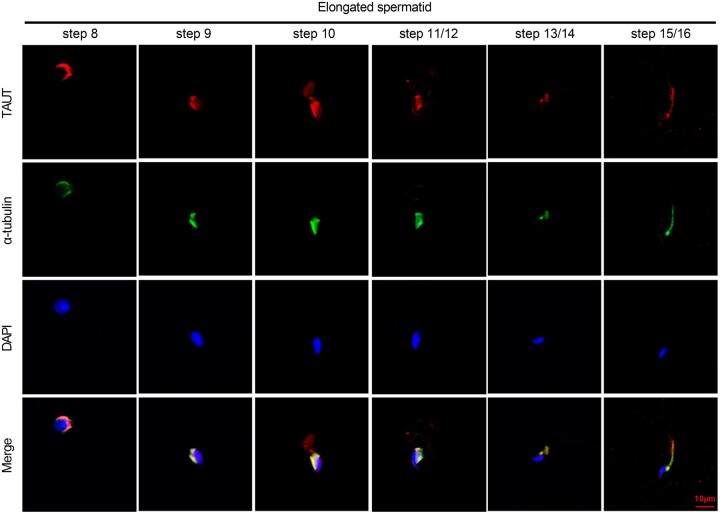
Metabolomic analysis demonstrated that the taurine content was lower in spermatozoa but higher in seminal plasma from the ROH than the RWH group. TAUT expression was lower in spermatozoa from patients with teratozoospermia than controls. Immunofluorescence showed that TAUT was localized to the manchette in mouse elongated spermatids functional analysis showed that morphologically abnormal spermatozoa increased after interference, and this defect increased after supplementation with 5% β-alanine but was improved by 5% taurine supplementation. Supplementation with 5% β-alanine significantly reduced the normal embryo number in the mouse uterus as well as blastocyst formation rate in vitro.
N/A.
LIMITATIONS, REASONS FOR CAUTION: The sample size was low and larger cohorts are needed to confirm the positive effect of taurine on human sperm quality. A comprehensive safety examination should be performed to evaluate whether taurine is a possible treatment for teratozoospermia. Furthermore, the specific molecular mechanism of TAUT involvement in spermiogenesis remains to be clarified.
The study provides new insights into the role of taurine and its transporter TAUT in male reproduction and embryo development. The results also indicate that TAUT is a promising molecular candidate for the assessment of sperm quality, which may contribute to the diagnosis and treatment for teratozoospermia.
STUDY FUNDING/COMPETING INTEREST(S): This work was supported by grants from the National Natural Science Foundation of China (no. 81774075, 31900605, 81971451), Jiangsu Science and Technology Program Grant (BK20190654) and Maternal and child health scientific research of Jiangsu Province (F202121). The authors declare no competing financial interests.
牛磺酸及其转运体 TAUT 是否与精子发生和早期胚胎发育有关?
局部功能干扰通过睾丸内注射后,形态异常的精子数量增加,牛磺酸耗竭显著降低了体内正常胚胎数量和体外囊胚形成率。
牛磺酸是雄性生殖系统中最丰富的氨基酸之一,已证明牛磺酸可以有效地改善睾丸损伤大鼠模型的生精功能。然而,关于牛磺酸及其转运体 TAUT 在精子发生和早期胚胎发育中的作用,知之甚少。
研究设计、规模、持续时间:从 2014 年 12 月至 2018 年 3 月,收集了 110 对经历反复妊娠丢失(RPL)的夫妇的临床特征。根据超声监测前一次妊娠是否有胎心,将 RPL 患者分为两组:无胎心 RPL(无胎心妊娠,ROH)组和有胎心 RPL(一个或多个有胎心妊娠,RWH)组。最终对 21 例 ROH 和 20 例 RWH 的精液样本进行代谢组学分析。此外,从 30 例特发性少精子症患者(正常精子形态<4%)和 25 名年龄匹配的正常精液质量对照者中获得精液样本,用于 Western blot。在 CD-1/ICR 小鼠中进行动物实验。
参与者/材料、设置、方法:代谢组学用于确定 ROH 和 RWH 组之间的代谢变化。使用 Western blot 分析提取特发性少精子症患者和健康对照者的精子蛋白,检测 TAUT 的表达。免疫荧光用于表征 TAUT 在睾丸和射出精子中的定位。通过睾丸内注射 siRNA 或拮抗剂(β-丙氨酸)对小鼠进行功能分析,并在 3 周龄雄性小鼠饮用水中提供 5%β-丙氨酸,持续 5 周,以耗尽牛磺酸。用苏木精和伊红对小鼠附睾精子进行染色,进行形态评估。在小鼠中进行 IVF 和交配试验,评估生育能力。
代谢组学分析表明,ROH 组精子中的牛磺酸含量较低,但精浆中的牛磺酸含量较高。特发性少精子症患者的精子中 TAUT 表达较低。免疫荧光显示 TAUT 定位于小鼠伸长精子的顶体帽中。功能分析表明,形态异常的精子数量在干扰后增加,这种缺陷在补充 5%β-丙氨酸后增加,但补充 5%牛磺酸后得到改善。补充 5%β-丙氨酸显著降低了小鼠子宫内的正常胚胎数量以及体外囊胚形成率。
无。
限制、谨慎的原因:样本量低,需要更大的队列来确认牛磺酸对人类精子质量的积极影响。应进行全面的安全检查,以评估牛磺酸是否是治疗特发性少精子症的一种可能方法。此外,TAUT 参与精子发生的具体分子机制仍需阐明。
该研究为牛磺酸及其转运体 TAUT 在男性生殖和胚胎发育中的作用提供了新的见解。研究结果还表明,TAUT 是评估精子质量的有前途的分子候选者,这可能有助于特发性少精子症的诊断和治疗。
研究基金/利益冲突:本工作得到国家自然科学基金(No. 81774075、31900605、81971451)、江苏省科技计划项目(BK20190654)和江苏省妇幼健康科学研究项目(F202121)的资助。作者没有申报任何竞争利益。