School of Pharmaceutical Sciences, Guangzhou University of Chinese Medicine, Guangzhou, China.
The First Affiliated Hospital of Guangzhou University of Chinese Medicine, Guangzhou University of Chinese Medicine, Guangzhou, China.
Cell Mol Gastroenterol Hepatol. 2022;14(2):271-293. doi: 10.1016/j.jcmgh.2022.04.011. Epub 2022 May 6.
BACKGROUND & AIMS: Excessive acetaminophen (APAP) intake causes oxidative stress and inflammation, leading to fatal hepatotoxicity; however, the mechanism remains unclear. This study aims to explore the protective effects and detailed mechanisms of sirtuin 6 (SIRT6) in the defense against APAP-induced hepatotoxicity.
Hepatocyte-specific SIRT6 knockout mice, farnesoid X receptor (FXR) knockout mice, and mice with genetic or pharmacological activation of SIRT6 were subjected to APAP to evaluate the critical role of SIRT6 in the pathogenesis of acute liver injury. RNA sequences were used to investigate molecular mechanisms underlying this process.
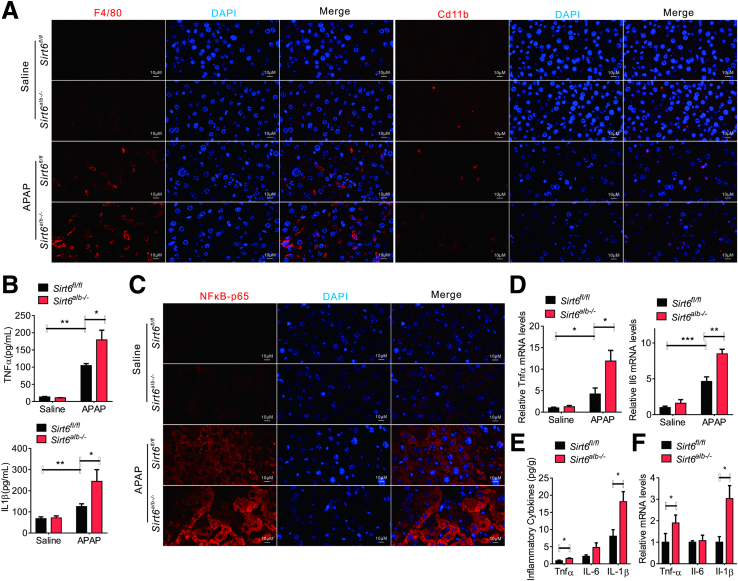
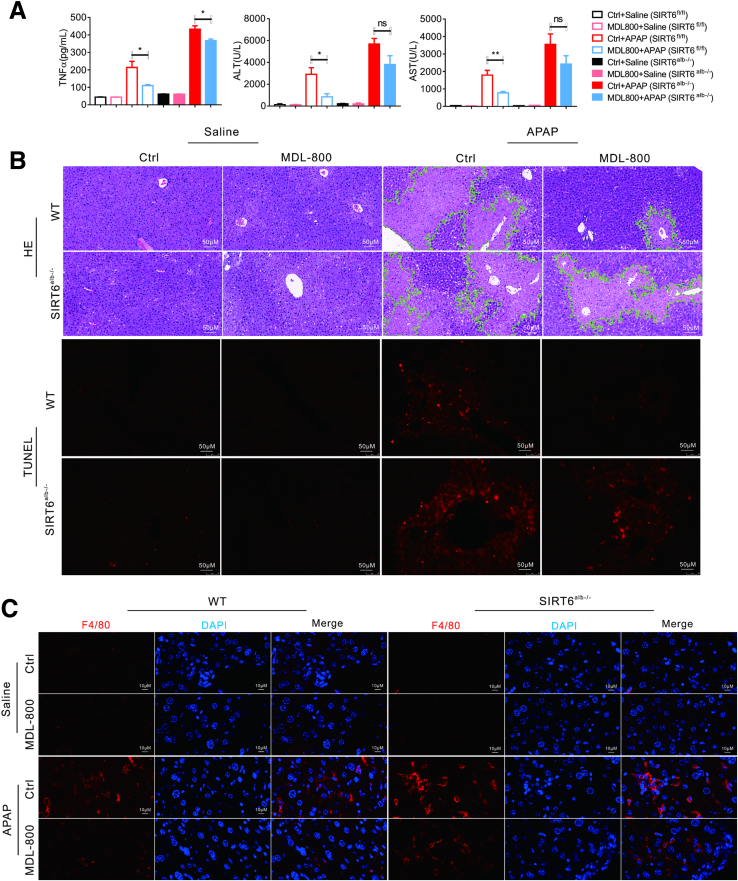
Hepatic SIRT6 expression was substantially reduced in the patients and mice with acute liver injury. The deletion of SIRT6 in mice and mice primary hepatocytes led to high N-acetyl-p-benzo-quinoneimine and low glutathione levels in the liver, thereby enhancing APAP overdose-induced liver injury, manifested as increased hepatic centrilobular necrosis, oxidative stress, and inflammation. Conversely, overexpression or pharmacological activation of SIRT6 enhanced glutathione and decreased N-acetyl-p-benzo-quinoneimine, thus alleviating APAP-induced hepatotoxicity via normalization of liver damage, inflammatory infiltration, and oxidative stress. Our molecular analysis revealed that FXR is regulated by SIRT6, which is associated with the pathological progression of ALI. Mechanistically, SIRT6 deacetylates FXR and elevates FXR transcriptional activity. FXR ablation in mice and mice primary hepatocytes prominently blunted SIRT6 overexpression and activation-mediated ameliorative effects. Conversely, pharmacological activation of FXR mitigated APAP-induced hepatotoxicity in SIRT6 knockout mice.
Our current study suggests that SIRT6 plays a crucial role in APAP-induced hepatotoxicity, and pharmacological activation of SIRT6 may represent a novel therapeutic strategy for APAP overdose-induced liver injury.
过量摄入对乙酰氨基酚(APAP)会导致氧化应激和炎症,从而引发致命的肝毒性;然而,其具体机制尚不清楚。本研究旨在探讨 SIRT6 在防御 APAP 诱导的肝毒性中的保护作用及其详细机制。
采用肝特异性 SIRT6 敲除小鼠、法尼醇 X 受体(FXR)敲除小鼠以及通过基因或药理学方法激活 SIRT6 的小鼠进行 APAP 处理,以评估 SIRT6 在急性肝损伤发病机制中的关键作用。利用 RNA 序列分析来研究这一过程中的分子机制。
急性肝损伤患者和小鼠的肝 SIRT6 表达明显降低。在小鼠和小鼠原代肝细胞中敲除 SIRT6 会导致肝脏中 N-乙酰-p-苯醌亚胺和谷胱甘肽水平升高,从而加剧 APAP 过量诱导的肝损伤,表现为肝中央小叶坏死、氧化应激和炎症增加。相反,SIRT6 的过表达或药理学激活增强了谷胱甘肽并降低了 N-乙酰-p-苯醌亚胺,从而通过肝损伤、炎症浸润和氧化应激的正常化来减轻 APAP 诱导的肝毒性。我们的分子分析表明,FXR 受 SIRT6 调节,与 ALI 的病理进展有关。在机制上,SIRT6 去乙酰化 FXR 并提高 FXR 的转录活性。在小鼠和小鼠原代肝细胞中敲除 FXR 会明显减弱 SIRT6 过表达和激活介导的改善作用。相反,FXR 的药理学激活减轻了 SIRT6 敲除小鼠的 APAP 诱导的肝毒性。
本研究表明,SIRT6 在 APAP 诱导的肝毒性中发挥关键作用,激活 SIRT6 可能成为治疗 APAP 过量诱导的肝损伤的新策略。