Laboratory of Automation and Robotics-LARA, University of Brasilia, Brasilia, Brazil.
Graduate Program in Biomedical Engineering, PPGEB, University of Brasilia, Brasilia, Brazil.
J Neuroeng Rehabil. 2022 May 8;19(1):45. doi: 10.1186/s12984-022-01014-6.
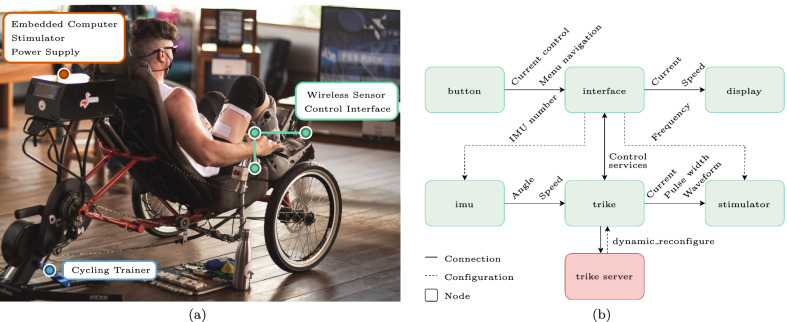
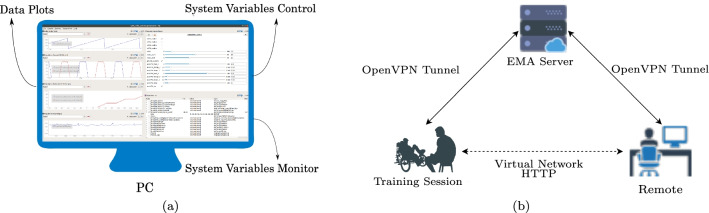
In this work, we share the enhancements made in our system to take part in the CYBATHLON 2020 Global Edition Functional Electrical Stimulation (FES) Bike Race. Among the main improvements, firstly an overhaul, an overhaul of the system and user interface developed with User-centered design principles with remote access to enable telerehabilitation. Secondly, the implementation and experimental comparison between the traditional single electrode stimulation (SES) and spatially distributed sequential stimulation (SDSS) applied for FES Cycling.
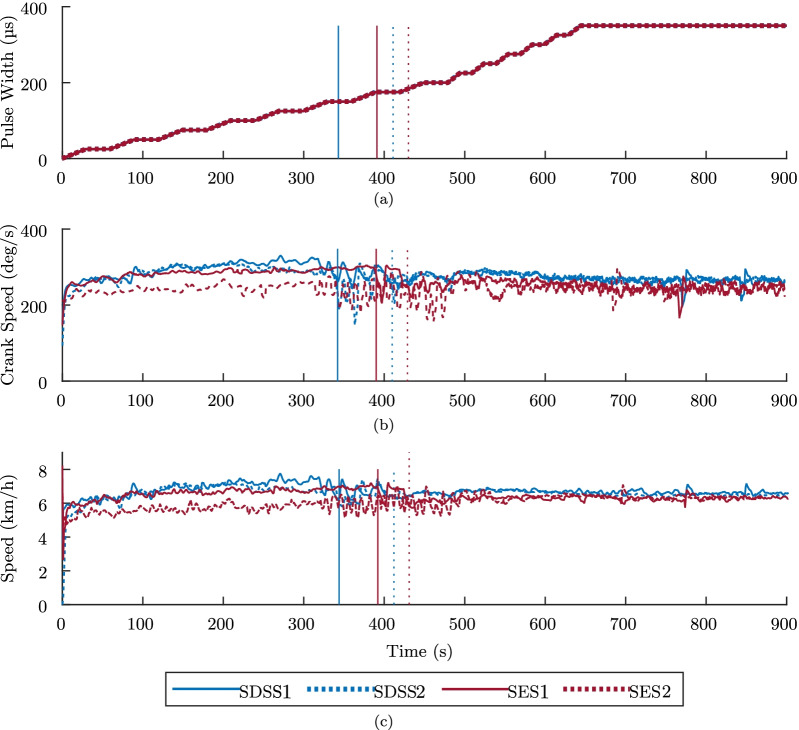
We report on the main aspects of the developed system. To evaluate the user perception of the system, we applied a System Usability Scale (SUS) questionnaire. In comparing SDSS and SES, we collected data from one subject in four sessions, each simulating one race in the CYBATHLON format.
User perception measured with SUS indicates a positive outcome in the developed system. The SDSS trials were superior in absolute and average values to SES regarding total distance covered and velocity. We successfully competed in the CYBATHLON 2020 Global Edition, finishing in 6th position in the FES Bike Race category.
The CYBATHLON format induced us to put the end-user in the center of our system design principle, which was well perceived. However, further improvements are required if the intention is to progress to a commercial product. FES Cycling performance in SDSS trials was superior when compared to SES trials, indicating that this technique may enable faster and possibly longer FES cycling sessions for individuals with paraplegia. More extensive studies are required to assess these aspects.
在这项工作中,我们分享了我们的系统在参加 2020 年 CYBATHLON 全球版功能性电刺激(FES)自行车赛方面的改进。其中主要的改进包括:首先,对我们采用以用户为中心的设计原则开发的系统和用户界面进行全面检修,并实现远程访问以支持远程康复;其次,实施并比较传统的单电极刺激(SES)和用于 FES 自行车的空间分布顺序刺激(SDSS)。
我们报告了开发系统的主要方面。为了评估系统的用户感知,我们应用了系统可用性量表(SUS)问卷。在比较 SDSS 和 SES 时,我们在四个会话中从一个主题收集数据,每个会话模拟一次 CYBATHLON 格式的比赛。
SUS 测量的用户感知表明,开发系统的结果是积极的。在总距离和速度方面,SDSS 试验的绝对和平均值均优于 SES。我们成功参加了 2020 年 CYBATHLON 全球版比赛,在 FES 自行车赛中获得第 6 名。
CYBATHLON 格式促使我们将最终用户置于系统设计原则的中心,这一原则得到了很好的认可。然而,如果我们的意图是将其推向商业化产品,还需要进一步改进。与 SES 试验相比,SDSS 试验中的 FES 自行车性能更好,这表明该技术可能为截瘫患者实现更快且可能更长时间的 FES 自行车运动。需要进行更广泛的研究来评估这些方面。