Ahd Khedher, Dhibi Sabah, Akermi Sarra, Bouzenna Hafsia, Samout Noura, Elfeki Abdelfattah, Hfaiedh Najla
Unity of Macromolecular Biochemistry and Genetics Faculty of Sciences Sidi Ahmed Zarrouk 2112 Gafsa Tunisia
Laboratory of Environmental Physiopathology, Valorization of Bioactive Molecules and Mathematical Modeling, Faculty of Sciences of Sfax Road Soukra km 3.5, PB no 1171-3000 Sfax Tunisia.
RSC Adv. 2019 Sep 17;9(50):29120-29130. doi: 10.1039/c9ra03136g. eCollection 2019 Sep 13.
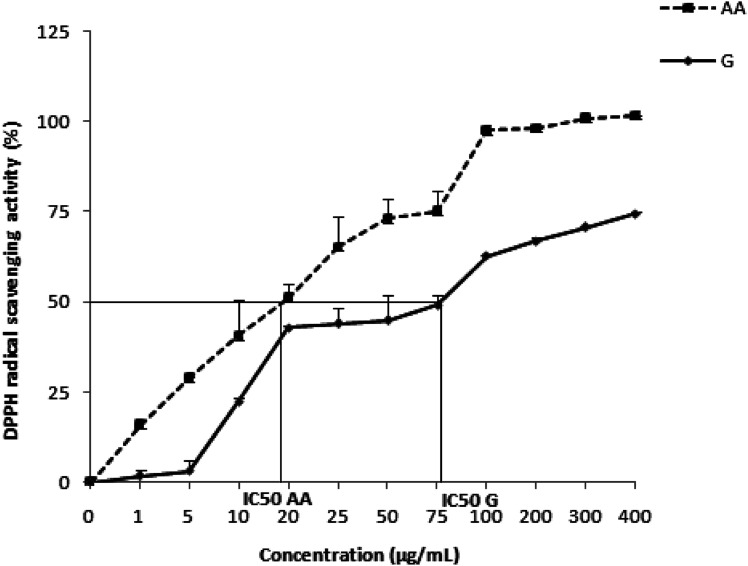
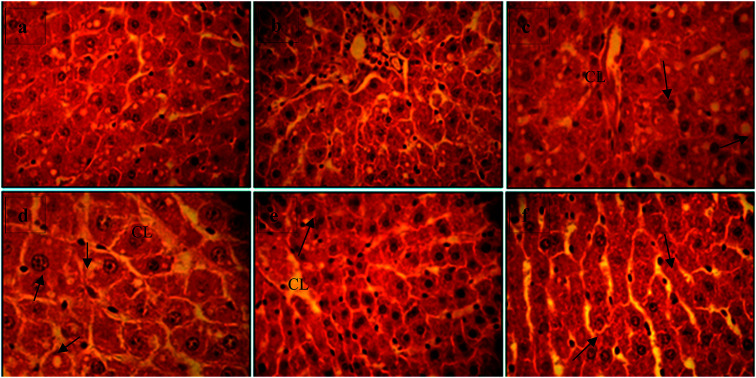
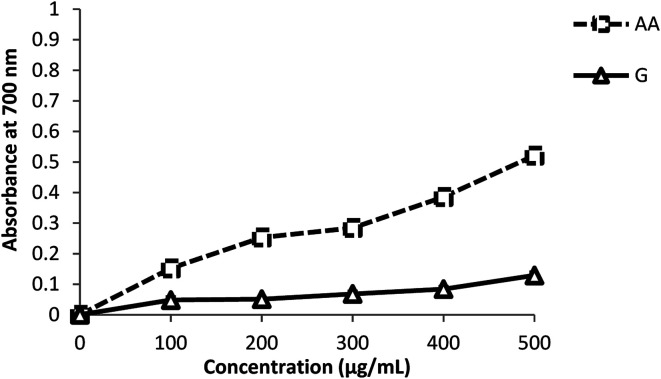
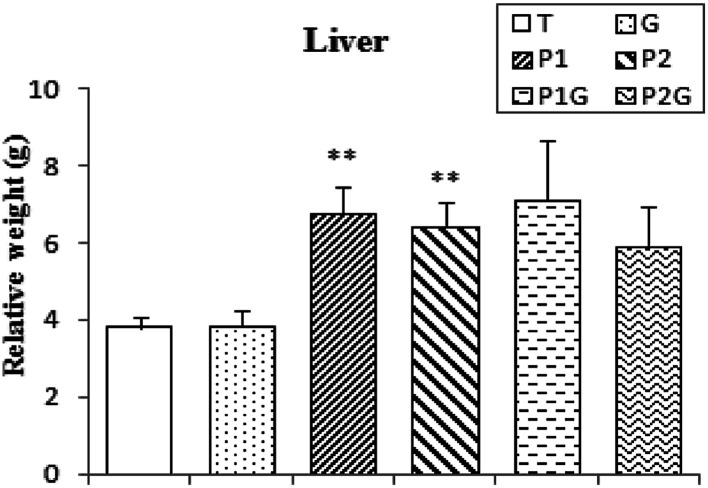
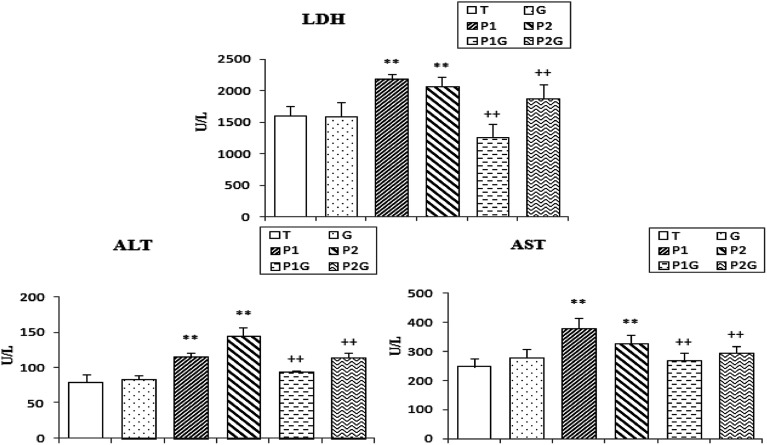
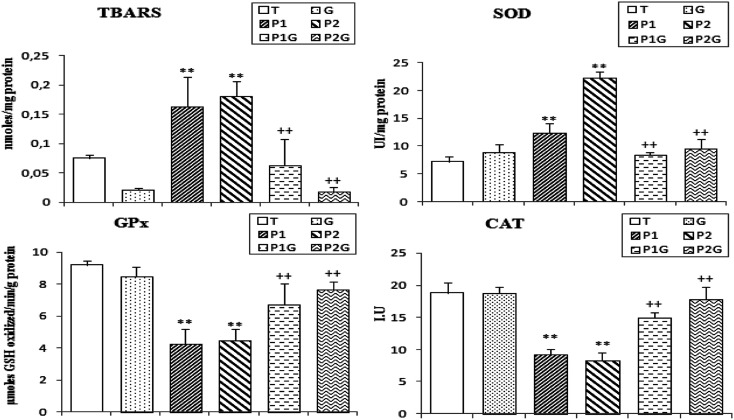
After absorption by the organism, polychlorinated biphenyls (PCBs) cross cellular membranes and pass into blood vessels and the lymphatic system. It is generally in the liver, adipose tissues, brain and skin that we find the strongest concentrations of PCBs. Herbal medicine remains as a discipline intended to treat and to prevent certain functional disorders and/or pathologies caused by oxidative stress, which can be induced by pesticides, medicines or pollutants. The objective of this study is to verify the toxic and oxidative effects of PCBs and to investigate the protective effect of ginger () in the liver of male rats of the "Wistar" strain. These rats are divided into 6 groups: a control group (T), two groups treated with PCB at two different concentrations (P and P), a group treated with ginger extract (G), a group pretreated with ginger extract and then injected with the first concentration of PCBs (PG), and a group pretreated with ginger and then injected with the second concentration of PCBs (PG). The results showed that the administration of PCBs led to an increase in the relative weight of the liver, and a significant increase in all of the hepatic biomarker levels (glucose, cholesterol, triglycerides, AST, ALT, and LDH) in the serum. Furthermore, an increase in the rate of lipid peroxidation and a decrease in the antioxidant enzyme activities (catalase, superoxide dismutase and glutathione peroxidase) were observed under the influence of PCBs in the liver. The histological test showed that the PCBs induced hepatocyte vacuolization, prominent and peripheralized nuclei, hepatocellular hypertrophy and turgor of the vein in the centriacinar regions. Pretreatment with ginger extract restored all of the biochemical and oxidative parameters to the normal values and reduced the injuries caused by the PCBs. In conclusion, in our experimental conditions, ginger effectively protects the liver against the hepatotoxic effects induced by PCBs.
多氯联苯(PCBs)被生物体吸收后,会穿过细胞膜,进入血管和淋巴系统。我们通常在肝脏、脂肪组织、大脑和皮肤中发现浓度最高的多氯联苯。草药仍然是一门旨在治疗和预防由氧化应激引起的某些功能障碍和/或病症的学科,氧化应激可由农药、药物或污染物诱发。本研究的目的是验证多氯联苯的毒性和氧化作用,并研究生姜()对“Wistar”品系雄性大鼠肝脏的保护作用。这些大鼠被分为6组:对照组(T)、两组用两种不同浓度的多氯联苯处理的组(P和P)、一组用生姜提取物处理的组(G)、一组先用生姜提取物预处理然后注射第一种浓度多氯联苯的组(PG),以及一组先用生姜预处理然后注射第二种浓度多氯联苯的组(PG)。结果表明,多氯联苯的给药导致肝脏相对重量增加,血清中所有肝脏生物标志物水平(葡萄糖、胆固醇、甘油三酯、AST、ALT和LDH)显著升高。此外,在多氯联苯的影响下,肝脏中脂质过氧化率增加,抗氧化酶活性(过氧化氢酶、超氧化物歧化酶和谷胱甘肽过氧化物酶)降低。组织学检查表明,多氯联苯诱导肝细胞空泡化、细胞核突出并边缘化、肝细胞肥大以及中央腺泡区域静脉肿胀。生姜提取物预处理可使所有生化和氧化参数恢复到正常值,并减少多氯联苯造成的损伤。总之,在我们的实验条件下,生姜能有效保护肝脏免受多氯联苯诱导的肝毒性作用。