Sung Kuo-Tzu, Chandramouli Chanchal, Lo Chi-In, Tsai Jui-Peng, Lai Yau-Huei, Hsiao Chih-Chung, Tsai Shin-Yi, Yun Chun-Ho, Hung Ta-Chuan, Kuo Jen-Yuan, Lin Jiun-Lu, Hou Charles Jia-Yin, Chen Ying-Ju, Su Cheng-Huang, Hung Chung-Lieh, Bulwer Bernard E, Yeh Hung-I, Lam Carolyn S P
Division of Cardiology, Department of Internal Medicine, MacKay Memorial Hospital, Taipei, Taiwan.
Department of Medicine, Mackay Medical College, New Taipei City, Taiwan.
Front Cardiovasc Med. 2022 Apr 21;9:804336. doi: 10.3389/fcvm.2022.804336. eCollection 2022.
Despite known sex differences in cardiac structure and function, little is known about how menopause and estrogen associate with atrioventricular mechanics and outcomes.
To study how, sex differences, loss of estrogen in menopause and duration of menopause, relate to atrioventricular mechanics and outcomes.
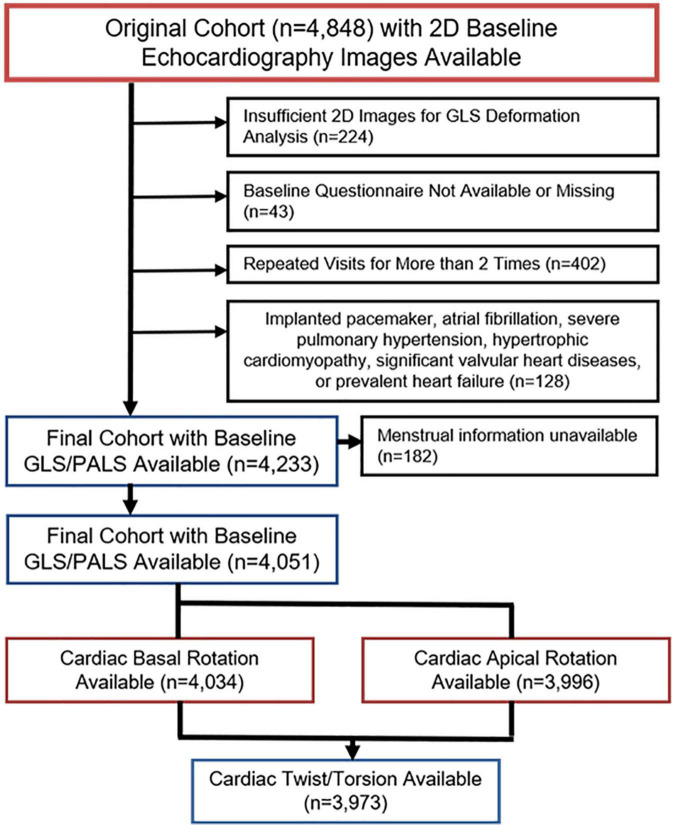
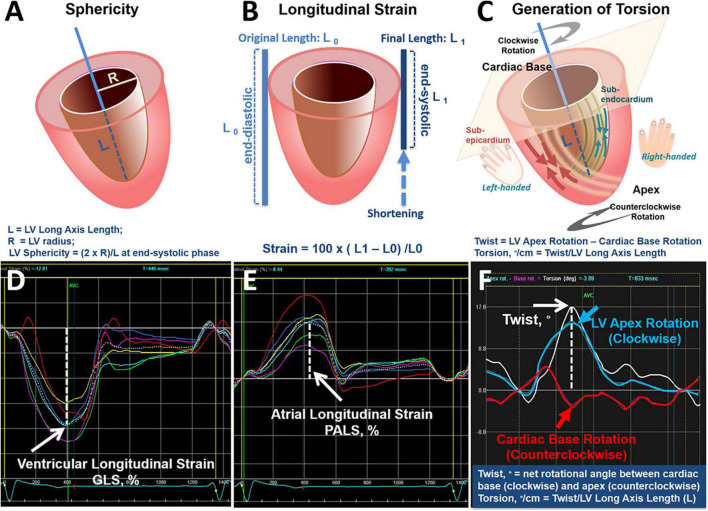
Among 4051 asymptomatic adults (49.8 ± 10.8 years, 35%women), left ventricular (LV) and left atrial (LA) mechanics were assessed using speckle-tracking.
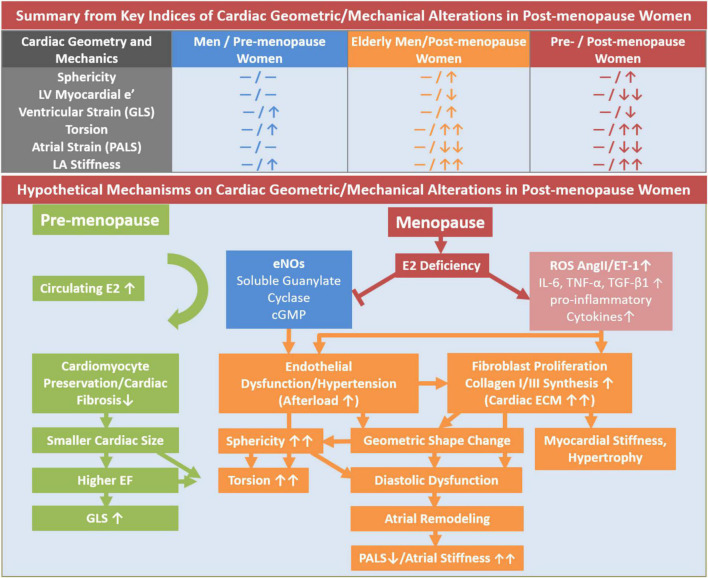
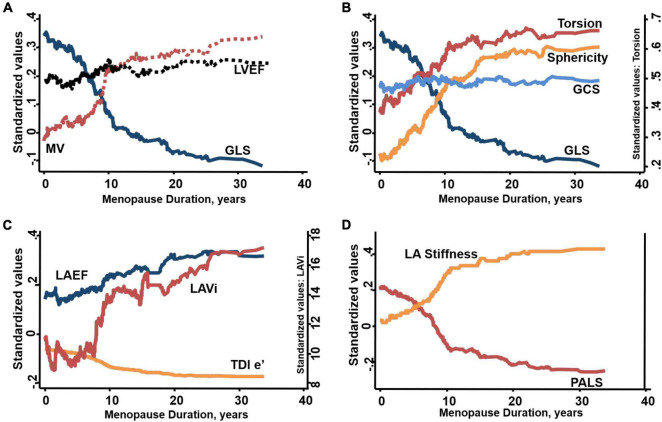
Post-menopausal (vs. pre-menopausal) women had similar LV ejection fraction but reduced GLS, reduced PALS, increased LA stiffness, higher LV sphericity and LV torsion (all < 0.001). Multivariable analysis showed menopause to be associated with greater LV sphericity (0.02, 95%CI 0.01, 0.03), higher indexed LV mass (LVMi), lower mitral e', lower LV GLS (0.37, 95%CI 0.04-0.70), higher LV torsion, larger LA volume, worse PALS (∼2.4-fold) and greater LA stiffness (0.028, 95%CI 0.01-0.05). Increasing years of menopause was associated with further reduction in GLS, markedly worse LA mechanics despite greater LV sphericity and higher torsion. Lower estradiol levels correlated with more impaired LV diastolic function, impaired LV GLS, greater LA stiffness, and increased LV sphericity and LV torsion (all < 0.05). Approximately 5.5% (37/669) of post-menopausal women incident HF over 2.9 years of follow-up. Greater LV sphericity [adjusted hazard ratio (aHR) 1.04, 95%CI 1.00-1.07], impaired GLS (aHR 0.87, 95%CI 0.78-0.97), reduced peak left atrial longitudinal strain (PALS, aHR 0.94, 95%CI 0.90-0.99) and higher LA stiffness (aHR 10.5, 95%CI 1.69-64.6) were independently associated with the primary outcome of HF hospitalizations in post-menopause. Both PALS < 23% (aHR:1.32, 95%CI 1.01-3.49) and GLS < 16% (aHR:5.80, 95%CI 1.79-18.8) remained prognostic for the incidence of HF in post-menopausal women in dichotomous analyses, even after adjusting for confounders. Results were consistent with composite outcomes of HF hospitalizations and 1-year all-cause mortality as well.
Menopause was associated with greater LV/LA remodeling and reduced LV longitudinal and LA function in women. The cardiac functional deficit with menopause and lower estradiol levels, along with their independent prognostic value post-menopause, may elucidate sex differences in heart failure further.
尽管已知心脏结构和功能存在性别差异,但关于绝经和雌激素如何与房室力学及预后相关的了解甚少。
研究性别差异、绝经后雌激素丧失及绝经持续时间如何与房室力学及预后相关。
在4051名无症状成年人(49.8±10.8岁,35%为女性)中,使用斑点追踪技术评估左心室(LV)和左心房(LA)力学。
绝经后(与绝经前相比)女性左心室射血分数相似,但整体纵向应变(GLS)降低、左心房峰值纵向应变(PALS)降低、左心房僵硬度增加、左心室球形度增加和左心室扭转增加(均P<0.001)。多变量分析显示,绝经与更大的左心室球形度(β=0.02,95%置信区间0.01,0.03)、更高的左心室质量指数(LVMi)、更低的二尖瓣E峰流速(e')、更低的左心室GLS(β=0.37,95%置信区间0.04 - 0.70)、更高的左心室扭转、更大的左心房容积、更差的PALS(约2.4倍)和更大的左心房僵硬度(β=0.028,95%置信区间0.01 - 0.05)相关。绝经年限增加与GLS进一步降低相关,尽管左心室球形度更大和扭转更高,但左心房力学明显更差。更低的雌二醇水平与左心室舒张功能受损、左心室GLS受损、更大的左心房僵硬度以及左心室球形度和左心室扭转增加相关(均P<0.05)。在2.9年的随访中,约5.5%(37/669)的绝经后女性发生心力衰竭。更大的左心室球形度[调整后风险比(aHR)1.04,95%置信区间1.00 - 1.07]、受损的GLS(aHR 0.87,95%置信区间0.78 - 0.97)、降低的左心房峰值纵向应变(PALS,aHR 0.94,95%置信区间0.90 - 0.99)和更高的左心房僵硬度(aHR 10.5,95%置信区间1.69 - 64.6)与绝经后心力衰竭住院的主要结局独立相关。在二分法分析中,即使在调整混杂因素后,PALS<23%(aHR:1.32,95%置信区间1.01 - 3.49)和GLS<16%(aHR:5.80,95%置信区间1.79 - 18.8)对绝经后女性心力衰竭的发生率仍具有预后价值。结果在心力衰竭住院和1年全因死亡率的综合结局中也一致。
绝经与女性更大的左心室/左心房重塑以及左心室纵向和左心房功能降低相关。绝经和更低雌二醇水平导致的心脏功能缺陷及其在绝经后的独立预后价值,可能进一步阐明心力衰竭中的性别差异。