Barraza Fiorella, Moore Rebekah E T, Rehkämper Mark, Schreck Eva, Lefeuvre Grégoire, Kreissig Katharina, Coles Barry J, Maurice Laurence
Géosciences Environnement Toulouse (GET), Observatoire Midi-Pyrénées, CNRS, IRD, Université de Toulouse 14 avenue E. Belin F-31400 Toulouse France
Department of Earth Science & Engineering, Imperial College London London SW7 2AZ UK
RSC Adv. 2019 Oct 23;9(58):34011-34022. doi: 10.1039/c9ra05516a. eCollection 2019 Oct 18.
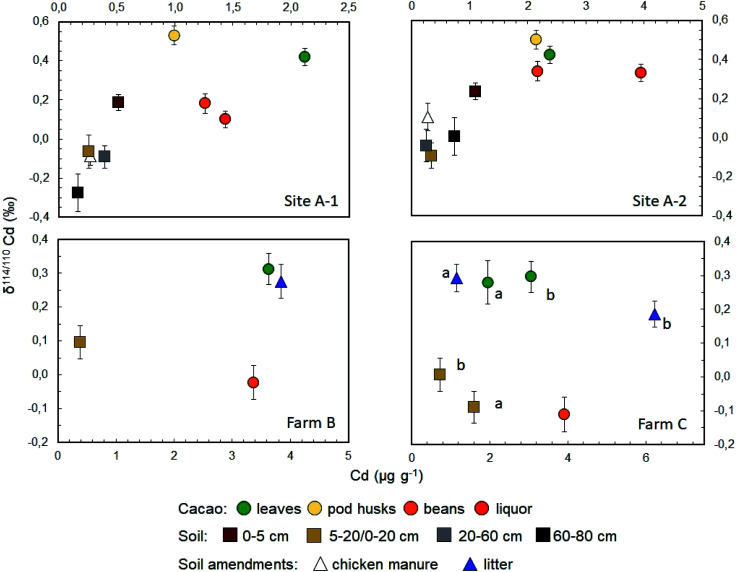
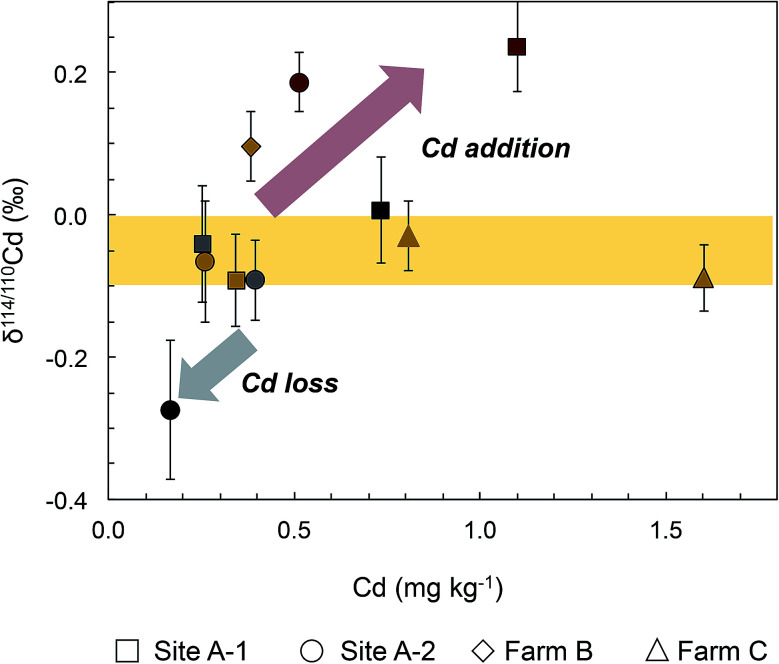
The often high Cd concentrations of cacao beans are a serious concern for producers in Latin America due to the implementation of stricter Cd limits for cocoa products by the European Union in 2019. This is the first investigation to employ coupled Cd isotope and concentration measurements to study soil - cacao systems. Analyses were carried out for 29 samples of soils, soil amendments and cacao tree organs from organic farms in Ecuador that harvest three distinct cacao cultivars. The majority of soils from 0-80 cm depth have very similar δCd of about -0.1‰ to 0‰. Two 0-5 cm topsoils, however, have high Cd concentrations coupled with heavy Cd isotope compositions of δCd ≈ 0.2%, possibly indicating Cd additions from the tree litter used as organic fertilizer. Whilst cacao leaves, pods and beans are ubiquitously enriched in Cd relative to soils there are distinct Cd isotope signatures. The leaves and pods are isotopically heavier than the soils, with similar ΔCd values of 0.22 ± 0.07‰ to 0.41 ± 0.09‰. In contrast, the data reveal differences in ΔCd that may be linked to distinct cacao cultivars. In detail, ΔCd values of -0.34‰ to -0.40‰ were obtained for Nacional cacao from two farms, whilst CCN-51 hybrid cacao from a third farm showed no fractionation within error (-0.08 ± 0.13‰). As such, further work to investigate whether Cd isotopes are indeed useful for tracing sources of Cd enrichments in soils and to inform genetic efforts to reduce the Cd burden of cocoa is indicated.
由于欧盟于2019年对可可制品实施了更严格的镉限量标准,拉丁美洲的可可豆镉含量常常较高,这成为了生产者们严重关切的问题。这是首次运用镉同位素与浓度耦合测量来研究土壤 - 可可系统的调查。对来自厄瓜多尔有机农场的29个土壤、土壤改良剂和可可树器官样本进行了分析,这些农场收获三种不同的可可品种。0至80厘米深度的大多数土壤具有非常相似的δCd,约为 -0.1‰至0‰。然而,有两个0至5厘米的表层土壤镉浓度较高,且镉同位素组成较重,δCd≈0.2%,这可能表明用作有机肥料的树木凋落物添加了镉。虽然相对于土壤,可可叶、豆荚和豆子普遍富含镉,但存在明显的镉同位素特征。叶子和豆荚的同位素比土壤重,ΔCd值相似,为0.22±0.07‰至0.41±0.09‰。相比之下,数据揭示了ΔCd的差异,这可能与不同的可可品种有关。具体而言,来自两个农场的Nacional可可的ΔCd值为 -0.34‰至 -0.40‰,而来自第三个农场的CCN - 51杂交可可在误差范围内没有分馏(-0.08±0.13‰)。因此,表明需要进一步开展工作,以研究镉同位素是否确实有助于追踪土壤中镉富集的来源,并为减少可可镉含量的遗传研究提供信息。