Chen Qingqing, Crooks Andrew
Department of Geography, University at Buffalo, Buffalo, NY, USA.
Int J Appl Earth Obs Geoinf. 2022 Jun;110:102783. doi: 10.1016/j.jag.2022.102783. Epub 2022 May 5.
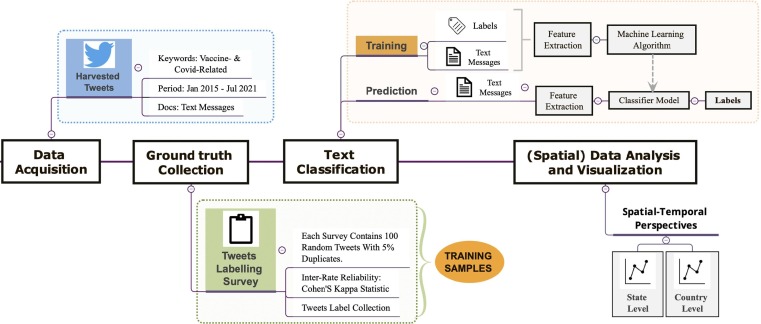
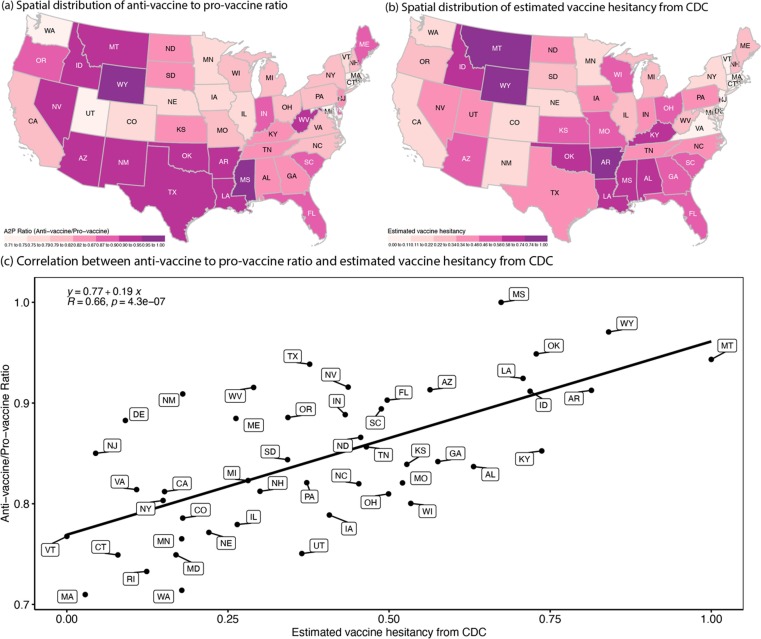
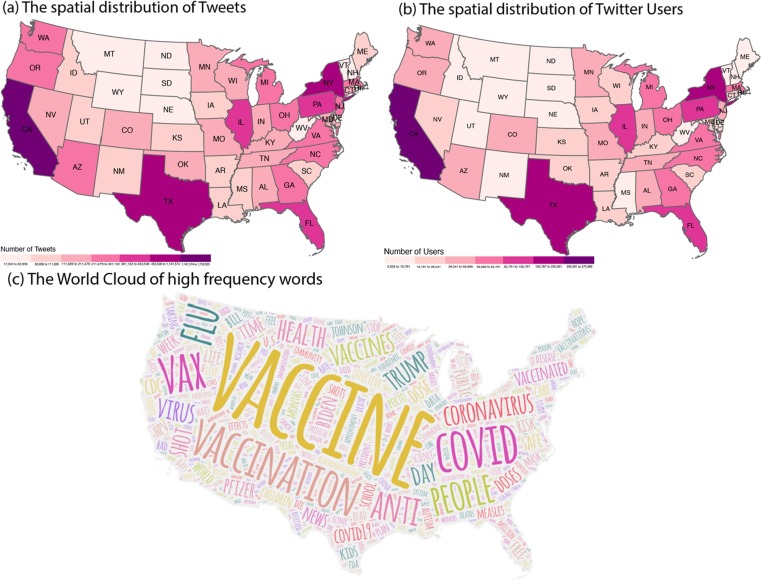
The COVID-19 virus has caused and continues to cause unprecedented impacts on the life trajectories of millions of people globally. Recently, to combat the transmission of the virus, vaccination campaigns around the world have become prevalent. However, while many see such campaigns as positive (e.g., protecting lives), others see them as negative (e.g., the side effects that are not fully understood scientifically), resulting in diverse sentiments towards vaccination campaigns. In addition, the diverse sentiments have seldom been systematically quantified let alone their dynamic changes over space and time. To shed light on this issue, we propose an approach to analyze vaccine sentiments in space and time by using supervised machine learning combined with word embedding techniques. Taking the United States as a test case, we utilize a Twitter dataset (approximately 11.7 million tweets) from January 2015 to July 2021 and measure and map vaccine sentiments (Pro-vaccine, Anti-vaccine, and Neutral) across the nation. In doing so, we can capture the heterogeneous public opinions within social media discussions regarding vaccination among states. Results show how positive sentiment in social media has a strong correlation with the actual vaccinated population. Furthermore, we introduce a simple ratio between Anti and Pro-vaccine as a proxy to quantify vaccine hesitancy and show how our results align with other traditional survey approaches. The proposed approach illustrates the potential to monitor the dynamics of vaccine opinion distribution online, which we hope, can be helpful to explain vaccination rates for the ongoing COVID-19 pandemic.
新冠病毒已经并将继续对全球数百万人的生活轨迹造成前所未有的影响。最近,为了抗击病毒传播,全球范围内的疫苗接种活动盛行。然而,尽管许多人认为此类活动是积极的(例如,拯救生命),但也有人认为它们是消极的(例如,科学上尚未完全了解的副作用),这导致了人们对疫苗接种活动的不同看法。此外,这些不同看法很少得到系统量化,更不用说它们在空间和时间上的动态变化了。为了阐明这个问题,我们提出了一种方法,通过使用监督机器学习结合词嵌入技术来分析疫苗看法在空间和时间上的情况。以美国为例,我们利用了2015年1月至2021年7月的推特数据集(约1170万条推文),并测量和绘制了全国范围内的疫苗看法(支持疫苗、反对疫苗和中立)。这样做,我们可以捕捉社交媒体讨论中各州关于疫苗接种的不同公众意见。结果表明社交媒体中的积极情绪与实际接种人群之间存在很强的相关性。此外,我们引入了一个简单的反疫苗与支持疫苗的比例作为代理来量化疫苗犹豫,并展示我们的结果如何与其他传统调查方法一致。所提出的方法说明了在线监测疫苗意见分布动态的潜力,我们希望这有助于解释当前新冠疫情的疫苗接种率。