Ge Yong, Zhang Wen-Bin, Liu Haiyan, Ruktanonchai Corrine W, Hu Maogui, Wu Xilin, Song Yongze, Ruktanonchai Nick W, Yan Wei, Cleary Eimear, Feng Luzhao, Li Zhongjie, Yang Weizhong, Liu Mengxiao, Tatem Andrew J, Wang Jin-Feng, Lai Shengjie
State Key Laboratory of Resources and Environmental Information System, Institute of Geographic Sciences and Natural Resources Research, Chinese Academy of Sciences, Beijing, China.
College of Resources and Environment, University of Academy of Sciences, Beijing, China.
Int J Appl Earth Obs Geoinf. 2022 Feb;106:102649. doi: 10.1016/j.jag.2021.102649.
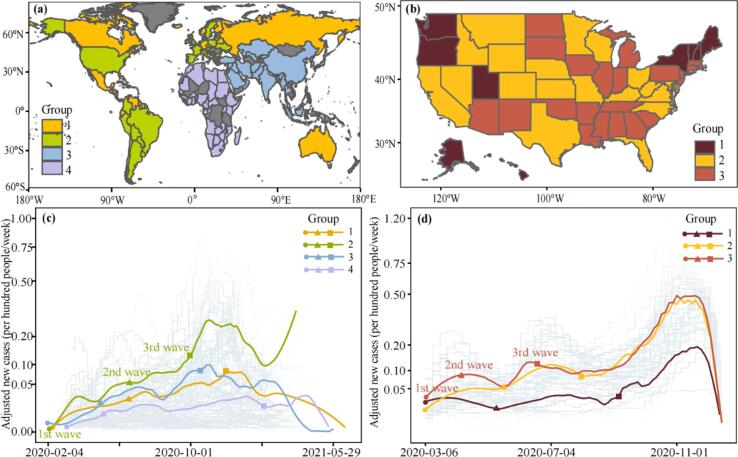
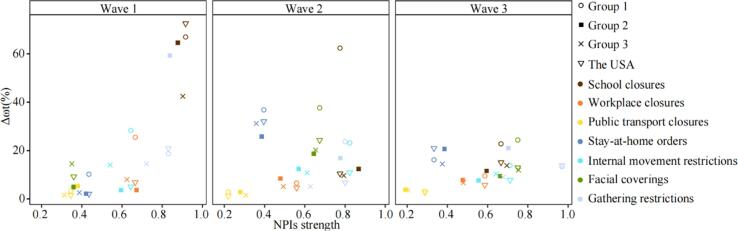
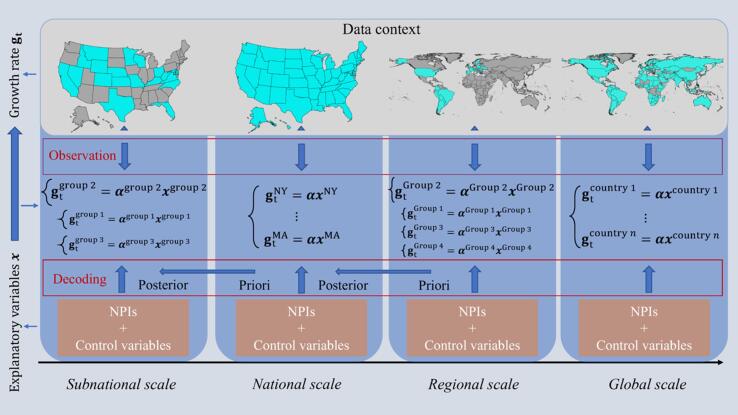
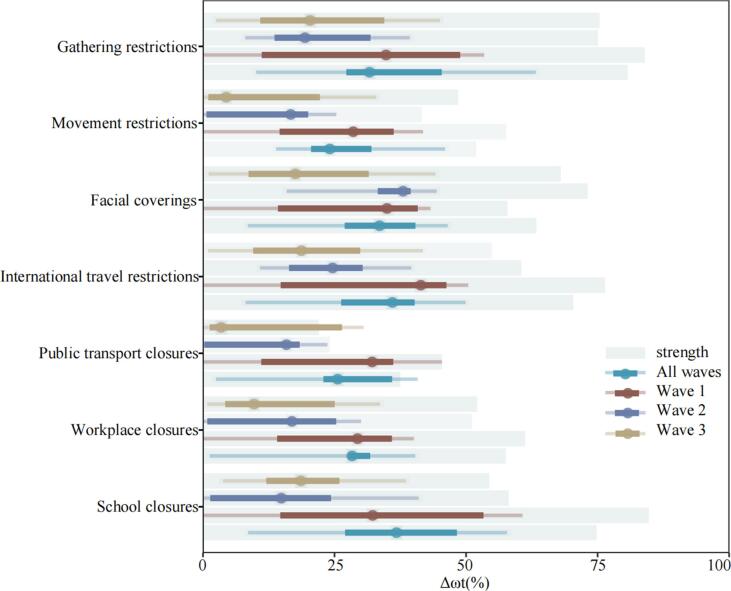
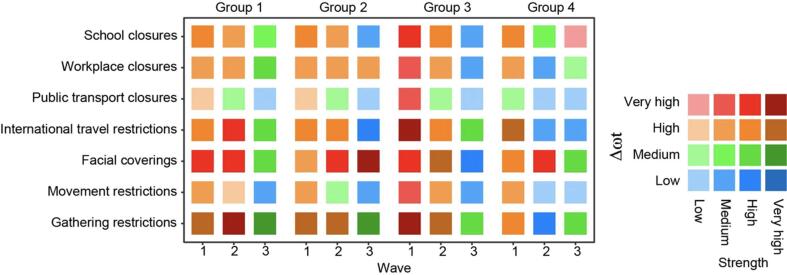
Governments worldwide have rapidly deployed non-pharmaceutical interventions (NPIs) to mitigate the COVID-19 pandemic. However, the effect of these individual NPI measures across space and time has yet to be sufficiently assessed, especially with the increase of policy fatigue and the urge for NPI relaxation in the vaccination era. Using the decay ratio in the suppression of COVID-19 infections and multi-source big data, we investigated the changing performance of different NPIs across waves from global and regional levels (in 133 countries) to national and subnational (in the United States of America [USA]) scales before the implementation of mass vaccination. The synergistic effectiveness of all NPIs for reducing COVID-19 infections declined along waves, from 95.4% in the first wave to 56.0% in the third wave recently at the global level and similarly from 83.3% to 58.7% at the USA national level, while it had fluctuating performance across waves on regional and subnational scales. Regardless of geographical scale, gathering restrictions and facial coverings played significant roles in epidemic mitigation before the vaccine rollout. Our findings have important implications for continued tailoring and implementation of NPI strategies, together with vaccination, to mitigate future COVID-19 waves, caused by new variants, and other emerging respiratory infectious diseases.
世界各国政府迅速部署了非药物干预措施(NPIs)以缓解新冠疫情。然而,这些单独的非药物干预措施在不同时空的效果尚未得到充分评估,尤其是在疫苗接种时代政策疲劳加剧以及放松非药物干预措施的呼声不断的情况下。利用新冠病毒感染抑制中的衰减率和多源大数据,我们在大规模疫苗接种实施之前,研究了从全球和区域层面(133个国家)到国家和次国家层面(美国)不同波次中不同非药物干预措施的变化效果。在全球层面,所有非药物干预措施减少新冠病毒感染的协同效果随着波次下降,从第一波的95.4%降至最近第三波的56.0%,在美国国家层面也类似,从83.3%降至58.7%,而在区域和次国家层面其效果在不同波次中有所波动。无论地理规模如何,在疫苗推出之前,集会限制和面部遮盖在疫情缓解中发挥了重要作用。我们的研究结果对于持续调整和实施非药物干预措施策略以及疫苗接种以缓解未来由新变种引起的新冠疫情浪潮和其他新兴呼吸道传染病具有重要意义。