
多孔碳/醌衍生物杂化材料的孔结构和尺寸对其电化学电容器性能影响的研究。
Study of the pore structure and size effects on the electrochemical capacitor behaviors of porous carbon/quinone derivative hybrids.
作者信息
Itoi Hiroyuki, Tazawa Shuka, Hasegawa Hideyuki, Tanabe Yuichiro, Iwata Hiroyuki, Ohzawa Yoshimi
机构信息
Department of Applied Chemistry, Aichi Institute of Technology Yachigusa 1247, Yakusa-cho Toyota 470-0392 Japan
Department of Electrical and Electronics Engineering, Aichi Institute of Technology Yachigusa 1247, Yakusa-cho Toyota 470-0392 Japan.
出版信息
RSC Adv. 2019 Sep 2;9(47):27602-27614. doi: 10.1039/c9ra05225a. eCollection 2019 Aug 29.
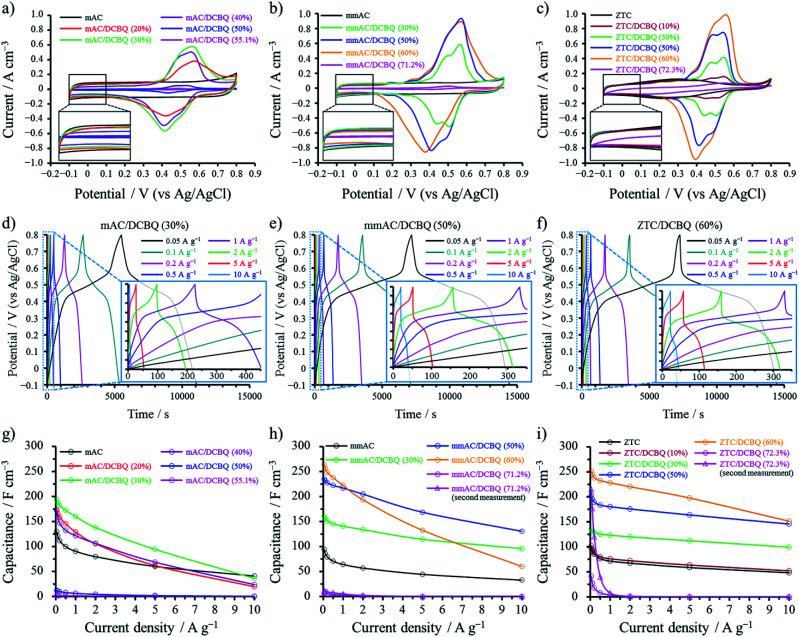
We demonstrate the hybridization of a redox-active quinone derivative, 2,5-dichloro-1,4-benzoquinone (DCBQ), and porous carbons with different pore structures for aqueous electrochemical capacitor electrodes. The hybridization is performed in the gas phase, which enables accurate porous carbon/DCBQ weight ratios. This method is advantageous over conventional liquid phase adsorption, in terms of facile optimization of the porous carbon/DCBQ weight ratio to obtain high-performance aqueous electrochemical capacitor electrodes, dependent on the kind of porous carbons; moreover, complete adsorption in the liquid phase cannot be achieved by the conventional liquid phase adsorption method. Their electrochemical capacitor performances are evaluated using an aqueous 1 M HSO electrolyte, and the adsorbed DCBQ undergoes redox reactions inducing pseudocapacitance within the pores of porous carbons. To study the effect of the pore size on the electrochemical capacitor behavior, two kinds of activated carbon (AC) with different pore sizes are examined: the microporous AC and the AC with both micro- and mesopores. Additionally, we examine ordered microporous carbon with a uniform pore size of 1.2 nm and a three-dimensionally (3D) ordered and mutually connected pore structure. The results reveal that mesopores facilitate proton conduction inside the DCBQ-constrained carbon pores, whereas the 3D-ordered and mutually connected micropores balance high volumetric capacitance enhancement with excellent rate capability. Such high proton conduction inside such constrained spaces can be explained only by the Grotthuss mechanism.
我们展示了一种氧化还原活性醌衍生物2,5 - 二氯 - 1,4 - 苯醌(DCBQ)与具有不同孔结构的多孔碳用于水性电化学电容器电极的杂化。杂化在气相中进行,这使得能够精确控制多孔碳/DCBQ的重量比。与传统的液相吸附相比,这种方法具有优势,它能够根据多孔碳的种类轻松优化多孔碳/DCBQ的重量比,从而获得高性能的水性电化学电容器电极;此外,传统的液相吸附方法无法实现完全吸附。使用1 M HSO水性电解质评估了它们的电化学电容器性能,吸附的DCBQ发生氧化还原反应,在多孔碳的孔内诱导赝电容。为了研究孔径对电化学电容器行为的影响,考察了两种不同孔径的活性炭(AC):微孔AC和同时具有微孔和介孔的AC。此外,我们还研究了孔径均匀为1.2 nm且具有三维(3D)有序且相互连接的孔结构的有序微孔碳。结果表明,介孔促进了DCBQ受限碳孔内的质子传导,而3D有序且相互连接的微孔在高体积电容增强与优异的倍率性能之间取得了平衡。这种受限空间内如此高的质子传导只能用Grotthuss机制来解释。


 Zotero 插件