Lin Hsiu-Fen, Postmus Judy L, Hu Hongwei, Stylianou Amanda M
School of Social Work, Arizona State University, 411 N. Central Ave. Suite 800, Phoenix, AZ 85004 USA.
School of Social Work, University of Maryland, College Park, MD USA.
J Fam Econ Issues. 2023;44(2):434-446. doi: 10.1007/s10834-022-09847-y. Epub 2022 May 4.
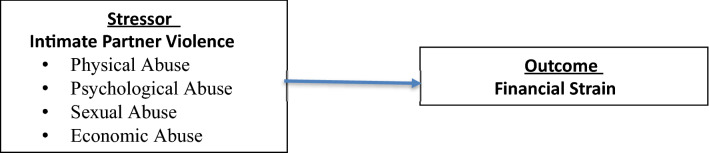
Financial strain is one hardship faced by female survivors of intimate partner violence (IPV) that is often overlooked. This paper examined the relationships between multiple forms of abuse-with a focus on economic abuse-and financial strain. Guided by stress process model, this study tested two hypotheses: (1) economic abuse is associated with financial strain more than other types of IPV; and (2) decreased economic abuse relates to financial strain over time. The study sample consists of 229 female IPV survivors who participated in a longitudinal, randomized controlled study evaluating an economic empowerment curriculum. Results from regression models suggest that physical abuse and economic abuse were significantly and positively associated with the magnitude of financial strain. Oaxaca-Blinder decomposition was used to partition the mean differences of financial strain over time that was mainly attributed to the decrease in economic and physical abuse (78%). Particularly, the decrease of economic abuse contributed to over half (58%) of the decrease in financial strain over time. Advocates should assess survivors' risk of economic abuse, evaluate financial strain, and utilize financial safety planning skills to help survivors build economic security and independence. In addition, policy makers should address issues concerning economic security among female IPV survivors.
经济压力是亲密伴侣暴力(IPV)女性幸存者面临的一种常常被忽视的困境。本文研究了多种形式的虐待之间的关系——重点关注经济虐待——以及经济压力。在压力过程模型的指导下,本研究检验了两个假设:(1)经济虐待比其他类型的亲密伴侣暴力与经济压力的关联更大;(2)随着时间的推移,经济虐待的减少与经济压力相关。研究样本包括229名参与一项评估经济赋权课程的纵向随机对照研究的亲密伴侣暴力女性幸存者。回归模型的结果表明,身体虐待和经济虐待与经济压力的程度显著正相关。采用瓦哈卡-布林德分解法(Oaxaca-Blinder decomposition)来划分经济压力随时间的平均差异,这主要归因于经济和身体虐待的减少(78%)。特别是,经济虐待的减少占经济压力随时间减少的一半以上(58%)。倡导者应评估幸存者遭受经济虐待的风险,评估经济压力,并运用财务安全规划技能来帮助幸存者建立经济保障和独立性。此外,政策制定者应解决亲密伴侣暴力女性幸存者的经济安全问题。