Rončević Sanda, Nemet Ivan, Ferri Tea Zubin, Matković-Čalogović Dubravka
Department of Chemistry, Faculty of Science, University of Zagreb Horvatovac 102a 10000 Zagreb Croatia
METRIS Materials' Research Centre Zagrebačka 30 52100 Pula Croatia.
RSC Adv. 2019 Oct 1;9(53):31043-31051. doi: 10.1039/c9ra04831f. eCollection 2019 Sep 26.
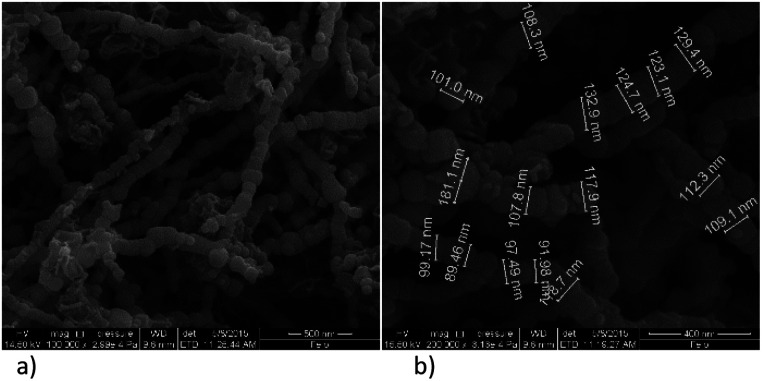
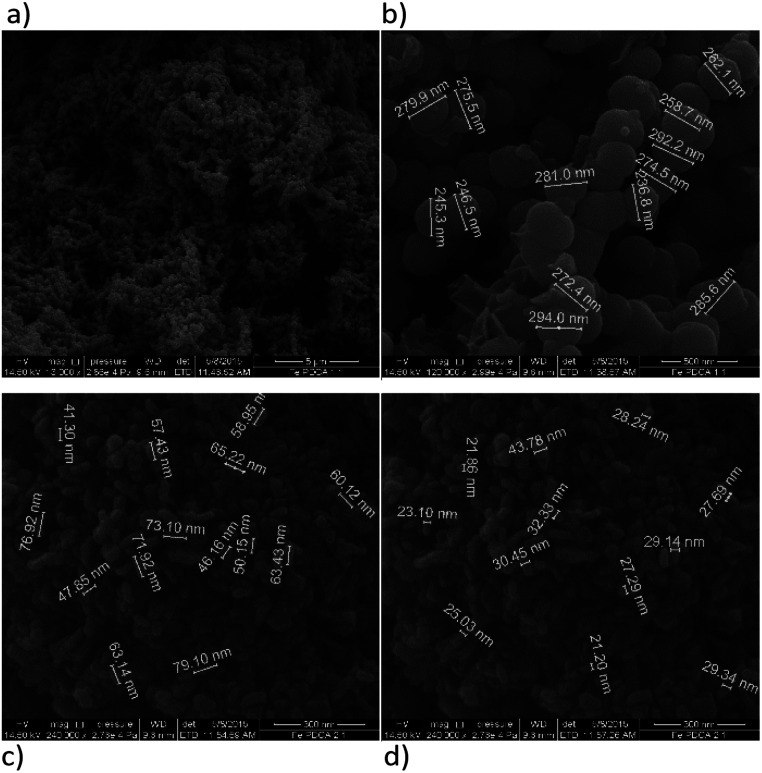
The simultaneous adsorption of metal ions on bare and functionalized zero-valent iron nanoparticles (nZVI) from aqueous solution was tested using inductively coupled plasma optical emission spectrometry (ICP-OES). The nanomaterials were synthetized using borohydride reduction of iron salt followed by addition of EDTA and pyridine-2,6-dicarboxylic acid (dipicolinic acid, PDCA) in different molar ratios. Functionalized materials were characterized by FT-IR, XRD and SEM-EDS methods. The ligand attachment on the particles was confirmed by FT-IR spectroscopy. The formation of a magnetite and feroxyhyte shell on the core of functionalized nanoparticles was confirmed by the XRD study. Transformation of chain-like structures into clusters of nanospheres with smaller diameter size was observed from SEM study of EDTA-nVZI particles. The average diameter of bare nZVI particles comprised 115 nm, while EDTA functionalization resulted in an average diameter of 22 and 35 nm. The PDCA-nZVI particles obtained with the molar ratio of Fe : PDCA = 1 : 1 retain the chain-like structure with enlargement of the average particle diameter to 267 nm. SEM study of PDCA-nZVI particles that were produced using the ratio Fe : PDCA = 2 : 1 have demonstrated the unique property of elongation into ellipsoidal forms of reduced dimensions ( = 61 nm; = 28 nm). The simultaneous metal ion removal from aqueous solution was the most efficient in the case of bare nZVI particles (91-97%). EDTA functionalization was found to be highly selective for Cu and Cr removal (95%), while PDCA functionalization shows selective adsorption of Cu, Cr and V in an aqueous medium (93%). Iron nanoparticles functionalized with PDCA in both of the used ratios showed more efficient metal ion adsorption in the case when smaller ellipsoidal particles were formed.
采用电感耦合等离子体发射光谱法(ICP-OES)测试了金属离子在裸露的和功能化的零价铁纳米颗粒(nZVI)上从水溶液中的同步吸附情况。通过硼氢化钠还原铁盐,随后以不同摩尔比添加乙二胺四乙酸(EDTA)和吡啶-2,6-二羧酸(二吡啶甲酸,PDCA)来合成纳米材料。通过傅里叶变换红外光谱(FT-IR)、X射线衍射(XRD)和扫描电子显微镜-能谱分析(SEM-EDS)方法对功能化材料进行了表征。通过FT-IR光谱证实了颗粒上配体的附着。XRD研究证实了在功能化纳米颗粒的核心上形成了磁铁矿和纤铁矿壳。从对EDTA-nVZI颗粒的SEM研究中观察到链状结构转变为直径较小的纳米球簇。裸露的nZVI颗粒的平均直径为115 nm,而EDTA功能化导致平均直径为22和35 nm。铁与PDCA摩尔比为1∶1时得到的PDCA-nZVI颗粒保留了链状结构,平均粒径增大到267 nm。对铁与PDCA摩尔比为2∶1时制备的PDCA-nZVI颗粒的SEM研究表明,其具有独特的伸长为尺寸减小的椭圆形的特性(长径 = 61 nm;短径 = 28 nm)。在裸露的nZVI颗粒的情况下,从水溶液中同步去除金属离子的效率最高(91 - 97%)。发现EDTA功能化对铜和铬的去除具有高度选择性(95%),而PDCA功能化在水介质中显示出对铜、铬和钒的选择性吸附(93%)。在形成较小椭圆形颗粒的情况下,两种使用比例的PDCA功能化的铁纳米颗粒均显示出更高效的金属离子吸附。