College of Medicine, University of Sharjah, Sharjah, United Arab Emirates.
Sharjah Institute for Medical Research, University of Sharjah, Sharjah, United Arab Emirates.
Front Immunol. 2022 Apr 20;13:865845. doi: 10.3389/fimmu.2022.865845. eCollection 2022.
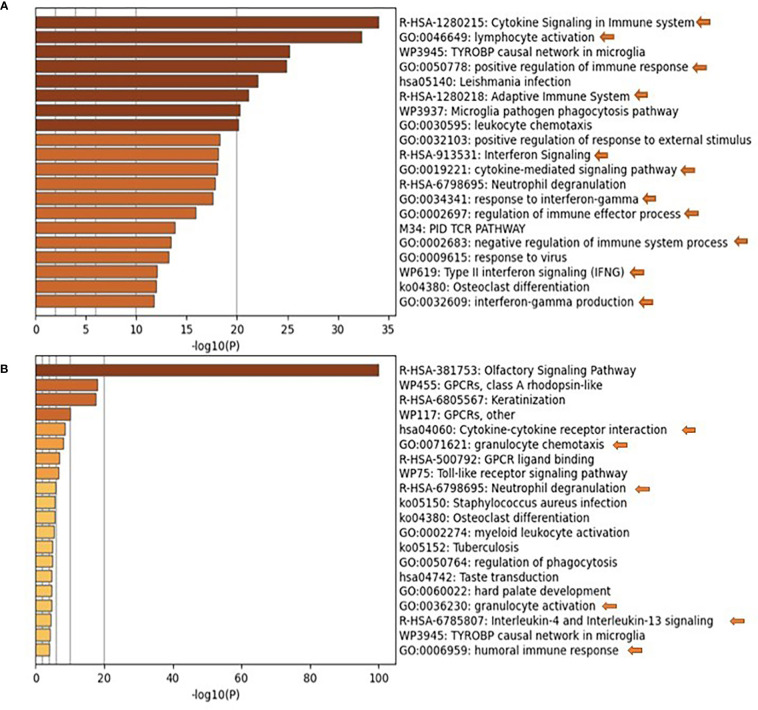
Since its emergence as a pandemic in March 2020, coronavirus disease (COVID-19) outcome has been explored several predictive models, using specific clinical or biochemical parameters. In the current study, we developed an integrative non-linear predictive model of COVID-19 outcome, using clinical, biochemical, immunological, and radiological data of patients with different disease severities. Initially, the immunological signature of the disease was investigated through transcriptomics analysis of nasopharyngeal swab samples of patients with different COVID-19 severity versus control subjects (exploratory cohort, n=61), identifying significant differential expression of several cytokines. Accordingly, 24 cytokines were validated using a multiplex assay in the serum of COVID-19 patients and control subjects (validation cohort, n=77). Predictors of severity were Interleukin (IL)-10, Programmed Death-Ligand-1 (PDL-1), Tumor necrosis factors-α, absolute neutrophil count, C-reactive protein, lactate dehydrogenase, blood urea nitrogen, and ferritin; with high predictive efficacy (AUC=0.93 and 0.98 using ROC analysis of the predictive capacity of cytokines and biochemical markers, respectively). Increased IL-6 and granzyme B were found to predict liver injury in COVID-19 patients, whereas interferon-gamma (IFN-γ), IL-1 receptor-a (IL-1Ra) and PD-L1 were predictors of remarkable radiological findings. The model revealed consistent elevation of IL-15 and IL-10 in severe cases. Combining basic biochemical and radiological investigations with a limited number of curated cytokines will likely attain accurate predictive value in COVID-19. The model-derived cytokines highlight critical pathways in the pathophysiology of the COVID-19 with insight towards potential therapeutic targets. Our modeling methodology can be implemented using new datasets to identify key players and predict outcomes in new variants of COVID-19.
自 2020 年 3 月作为大流行出现以来,已经使用特定的临床或生化参数探索了几种冠状病毒病 (COVID-19) 结果预测模型。在本研究中,我们使用不同疾病严重程度的患者的临床、生化、免疫和影像学数据,开发了一种 COVID-19 结果的综合非线性预测模型。最初,通过对不同 COVID-19 严重程度的患者与对照者的鼻咽拭子样本进行转录组学分析,研究了疾病的免疫学特征(探索性队列,n=61),确定了几种细胞因子的显著差异表达。因此,使用 COVID-19 患者和对照者的血清中的多重测定法验证了 24 种细胞因子(验证队列,n=77)。严重程度的预测因子为白细胞介素 (IL)-10、程序性死亡配体-1 (PDL-1)、肿瘤坏死因子-α、绝对中性粒细胞计数、C 反应蛋白、乳酸脱氢酶、血尿素氮和铁蛋白;细胞因子和生化标志物的预测能力的 ROC 分析分别为 0.93 和 0.98,具有较高的预测效果。发现白细胞介素 6 和颗粒酶 B 可预测 COVID-19 患者的肝损伤,而干扰素-γ (IFN-γ)、白细胞介素 1 受体-a (IL-1Ra) 和 PDL-1 是明显影像学发现的预测因子。该模型显示严重病例中白细胞介素 15 和白细胞介素 10 持续升高。将基本生化和影像学检查与少数精选细胞因子结合使用,可能会在 COVID-19 中获得准确的预测价值。该模型衍生的细胞因子突出了 COVID-19 病理生理学中的关键途径,并为潜在的治疗靶点提供了见解。我们的建模方法可以使用新数据集来实施,以识别 COVID-19 新变体中的关键参与者并预测结果。