Infectious Disease Biology, Institute of Life Sciences, Bhubaneswar, India.
Infectious Disease Biology, Regional Center for Biotechnology, Faridabad, India.
Front Cell Infect Microbiol. 2021 Dec 21;11:725035. doi: 10.3389/fcimb.2021.725035. eCollection 2021.
The current global pandemic of coronavirus disease 2019 (COVID-19), caused by severe acute respiratory syndrome coronavirus 2 (SARS-CoV-2), led to the investigation with clinical, biochemical, immunological, and genomic characterization from patients to understand the pathophysiology of viral infection.
Samples were collected from six asymptomatic and six symptomatic SARS-CoV-2-confirmed hospitalized patients in Bhubaneswar, Odisha, India. Clinical details, biochemical parameters, and treatment regimen were collected from a hospital; viral load was determined by RT-PCR; and the levels of cytokines and circulating antibodies in plasma were assessed by Bio-Plex and isotyping, respectively. In addition, whole-genome sequencing of viral strains and mutational analysis were carried out.
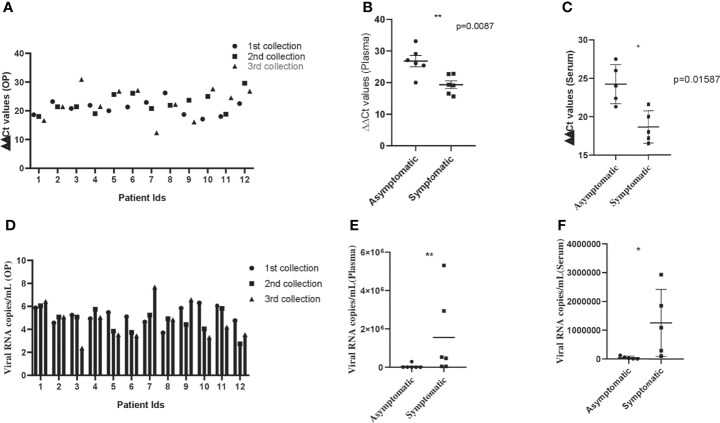
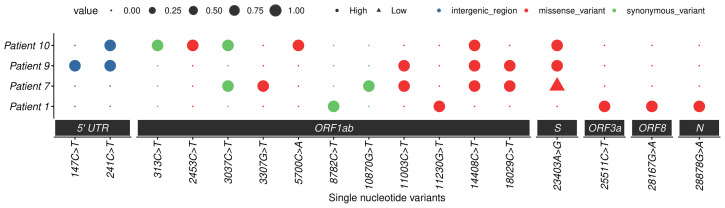
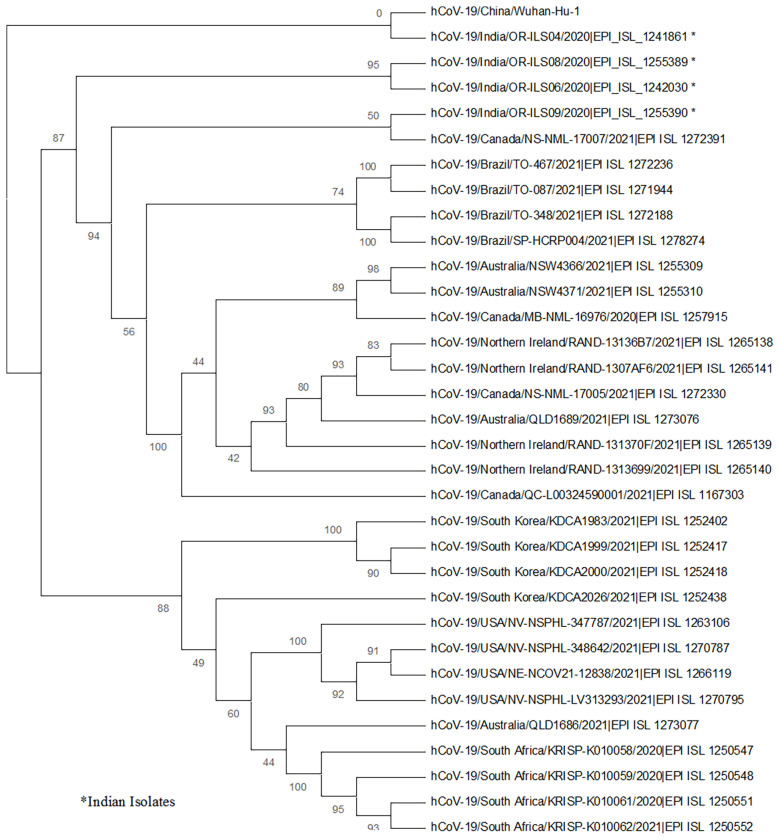
Analysis of the biochemical parameters highlighted the increased levels of C-reactive protein (CRP), lactate dehydrogenase (LDH), serum SGPT, serum SGOT, and ferritin in symptomatic patients. Symptomatic patients were mostly with one or more comorbidities, especially type 2 diabetes (66.6%). The virological estimation revealed that there was no significant difference in viral load of oropharyngeal (OP) samples between the two groups. On the other hand, viral load was higher in plasma and serum samples of symptomatic patients, and they develop sufficient amounts of antibodies (IgG, IgM, and IgA). The levels of seven cytokines (IL-6, IL-1α, IP-10, IL-8, IL-10, IFN-α2, IL-15) were found to be highly elevated in symptomatic patients, while three cytokines (soluble CD40L, GRO, and MDC) were remarkably higher in asymptomatic patients. The whole-genome sequence analysis revealed that the current isolates were clustered with 19B, 20A, and 20B clades; however, 11 additional changes in Orf1ab, spike, Orf3a, Orf8, and nucleocapsid proteins were acquired. The D614G mutation in spike protein is linked with higher virus replication efficiency and severe SARS-CoV-2 infection as three patients had higher viral load, and among them, two patients with this mutation passed away.
This is the first comprehensive study of SARS-CoV-2 patients from India. This will contribute to a better understanding of the pathophysiology of SARS-CoV-2 infection and thereby advance the implementation of effective disease control strategies.
由严重急性呼吸系统综合征冠状病毒 2(SARS-CoV-2)引起的 2019 年冠状病毒病(COVID-19)目前在全球流行,这导致了对患者进行临床、生化、免疫学和基因组特征的调查,以了解病毒感染的病理生理学。
从印度奥里萨邦布巴内斯瓦尔的 6 名无症状和 6 名确诊 SARS-CoV-2 住院患者中采集样本。从医院收集临床详细信息、生化参数和治疗方案;通过 RT-PCR 确定病毒载量;通过 Bio-Plex 和分型分别评估血浆中细胞因子和循环抗体的水平。此外,还进行了病毒株的全基因组测序和突变分析。
生化参数分析突出显示,在有症状的患者中,C 反应蛋白(CRP)、乳酸脱氢酶(LDH)、血清 SGPT、血清 SGOT 和铁蛋白水平升高。有症状的患者大多有一个或多个合并症,尤其是 2 型糖尿病(66.6%)。病毒学评估表明,两组之间口咽(OP)样本的病毒载量没有显著差异。另一方面,症状患者的血浆和血清样本中的病毒载量更高,并且产生了足够数量的抗体(IgG、IgM 和 IgA)。在有症状的患者中发现七种细胞因子(IL-6、IL-1α、IP-10、IL-8、IL-10、IFN-α2、IL-15)的水平显著升高,而在无症状患者中,三种细胞因子(可溶性 CD40L、GRO 和 MDC)明显升高。全基因组序列分析显示,目前的分离株与 19B、20A 和 20B 进化枝聚类;然而,在 Orf1ab、刺突、Orf3a、Orf8 和核衣壳蛋白中获得了 11 个额外的变化。刺突蛋白中的 D614G 突变与更高的病毒复制效率和严重的 SARS-CoV-2 感染相关,因为三名患者的病毒载量更高,其中两名携带这种突变的患者死亡。
这是印度首例对 SARS-CoV-2 患者的综合研究。这将有助于更好地了解 SARS-CoV-2 感染的病理生理学,从而推进实施有效的疾病控制策略。