Huang Junchao, Lin Jialiang, Li Congbin, Tang Bo, Xiao Haijun
Department of Orthopedics, Anhui University of Science and Technology Affiliated Shanghai Fengxian Hospital, Shanghai 201400, China.
Department of Orthopedics, Shanghai Fengxian District Central Hospital, Shanghai 201400, China.
Stem Cells Int. 2022 Apr 28;2022:1560943. doi: 10.1155/2022/1560943. eCollection 2022.
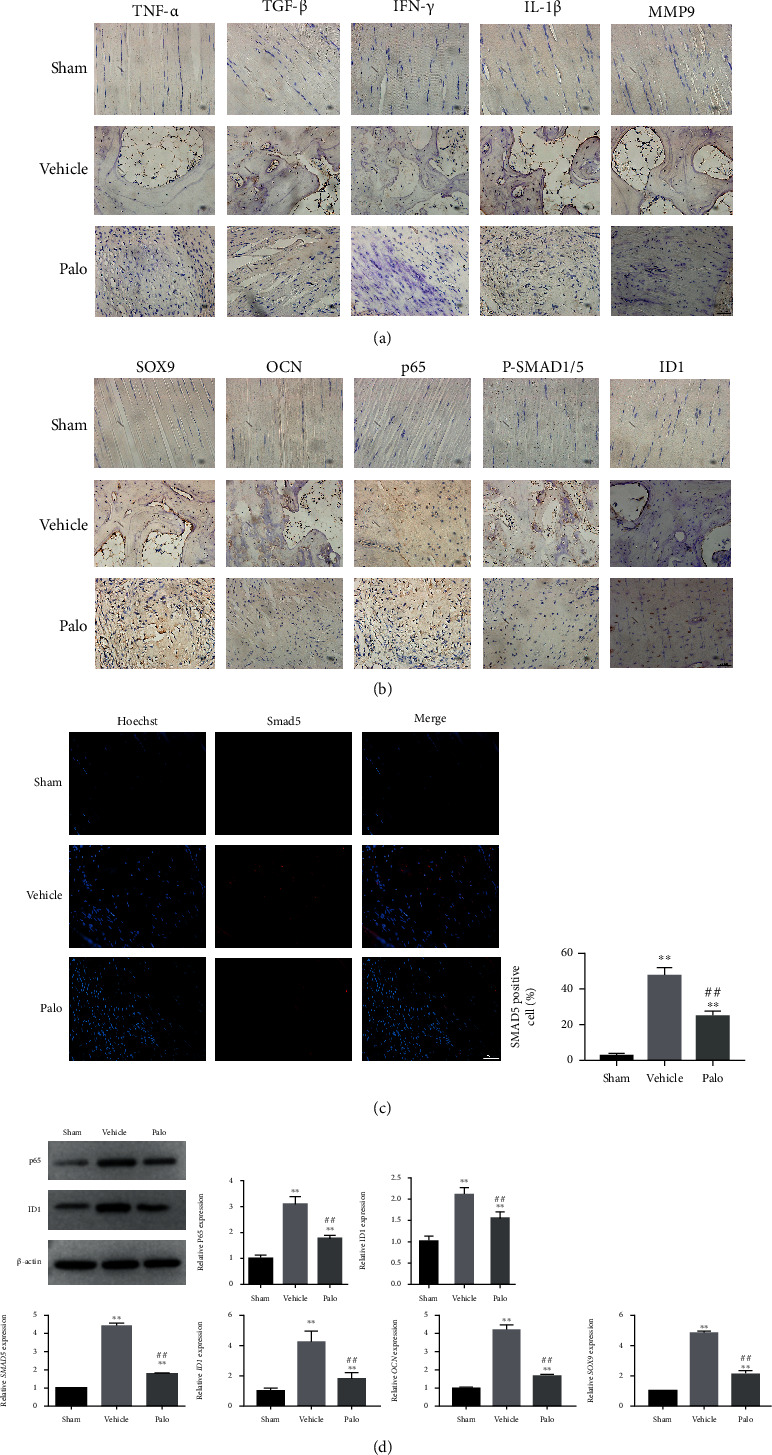
Heterotopic ossification (HO) is defined as the formation of bone tissues outside the bones, such as in the muscles. Currently, the mechanism of HO is still unclear. Tendon stem cells (TSCs) play important roles in the occurrence and development of HO. The inflammatory microenvironment dominated by macrophages also plays an important role in the course of HO. The commonly used clinical treatment methods, such as nonsteroidal anti-inflammatory drugs and radiotherapy, have relatively large side effects, and more efficient treatment methods are needed in clinical practice. Under physiological conditions, retinoic acid receptor (RAR) signal transduction pathway inhibits osteogenic progenitor cell aggregation and chondrocyte differentiation. We focus on palovarotene, a retinoic acid -receptor activator, showing an inhibitory effect on HO mice, but the specific mechanism is still unclear. This study was aimed at exploring the specific molecular mechanism of palovarotene by blocking osteogenic differentiation and HO formation of TSCs in vitro and in vivo in an inflammatory microenvironment. We constructed a coculture model of TCSs and polarized macrophages, as well as overexpression and knockdown models of the Smad signaling pathway of TCSs. In addition, a rat model of HO, which was constructed by Achilles tendon resection, was also established. These models explored the role of inflammatory microenvironment and Smad signaling pathways in the osteogenic differentiation of TSCs which lead to HO, as well as the reversal role played by palovarotene in this process. Our results suggest that, under the stimulation of inflammatory microenvironment and trauma, the injured site was in an inflammatory state, and macrophages were highly concentrated in the injured site. The expression of osteogenic and inflammation-related proteins, as well as Smad proteins, was upregulated. Osteogenic differentiation was performed in TCSs. We also found that TCSs activated Smad and NF-B signaling pathways, which initiated the formation of HO. Palovarotene inhibited the aggregation of osteogenic progenitor cells and macrophages and attenuated HO by blocking Smad and NF-B signaling pathways. Therefore, palovarotene may be a novel HO inhibitor, while other drugs or antibodies targeting Smad and NF-B signaling pathways may also prevent or treat HO. The expressions of Smad5, Id1, P65, and other proteins may predict HO formation.
异位骨化(HO)被定义为在骨骼之外如肌肉中形成骨组织。目前,HO的机制仍不清楚。肌腱干细胞(TSCs)在HO的发生和发展中起重要作用。以巨噬细胞为主导的炎性微环境在HO过程中也起重要作用。常用的临床治疗方法,如非甾体抗炎药和放疗,副作用相对较大,临床实践中需要更有效的治疗方法。在生理条件下,视黄酸受体(RAR)信号转导通路抑制成骨祖细胞聚集和软骨细胞分化。我们聚焦于帕罗维罗汀,一种视黄酸受体激活剂,其对HO小鼠显示出抑制作用,但具体机制仍不清楚。本研究旨在通过在体外和体内炎性微环境中阻断TSCs的成骨分化和HO形成来探索帕罗维罗汀的具体分子机制。我们构建了TCSs与极化巨噬细胞的共培养模型,以及TCSs的Smad信号通路的过表达和敲低模型。此外,还建立了通过跟腱切除构建的HO大鼠模型。这些模型探索了炎性微环境和Smad信号通路在导致HO的TSCs成骨分化中的作用,以及帕罗维罗汀在此过程中所起的逆转作用。我们的结果表明,在炎性微环境和创伤刺激下,损伤部位处于炎症状态,巨噬细胞高度集中在损伤部位。成骨和炎症相关蛋白以及Smad蛋白的表达上调。TSCs中进行了成骨分化。我们还发现TSCs激活了Smad和NF-κB信号通路,从而启动了HO的形成。帕罗维罗汀通过阻断Smad和NF-κB信号通路抑制成骨祖细胞和巨噬细胞的聚集并减轻HO。因此,帕罗维罗汀可能是一种新型的HO抑制剂,而其他靶向Smad和NF-κB信号通路的药物或抗体也可能预防或治疗HO。Smad5、Id1、P65等蛋白的表达可能预测HO的形成。