Turner Matthew, Mutter Shaun T, Kennedy-Britten Oliver D, Platts James A
School of Chemistry, Cardiff University Park Place, Cardiff CF10 3AT UK
RSC Adv. 2019 Oct 30;9(60):35089-35097. doi: 10.1039/c9ra04637b. eCollection 2019 Oct 28.
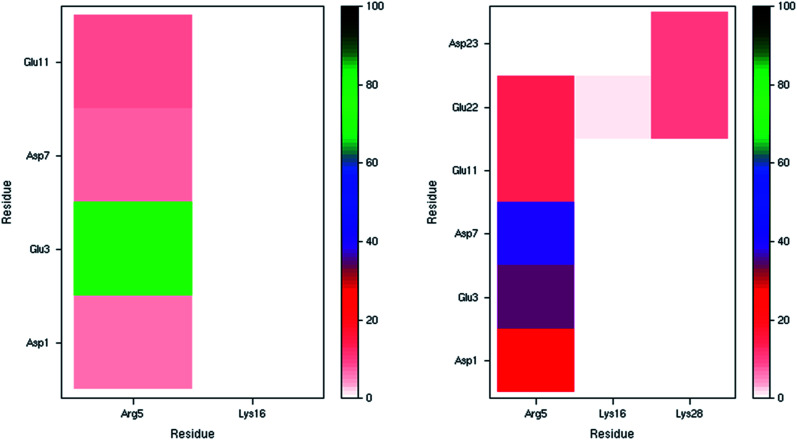
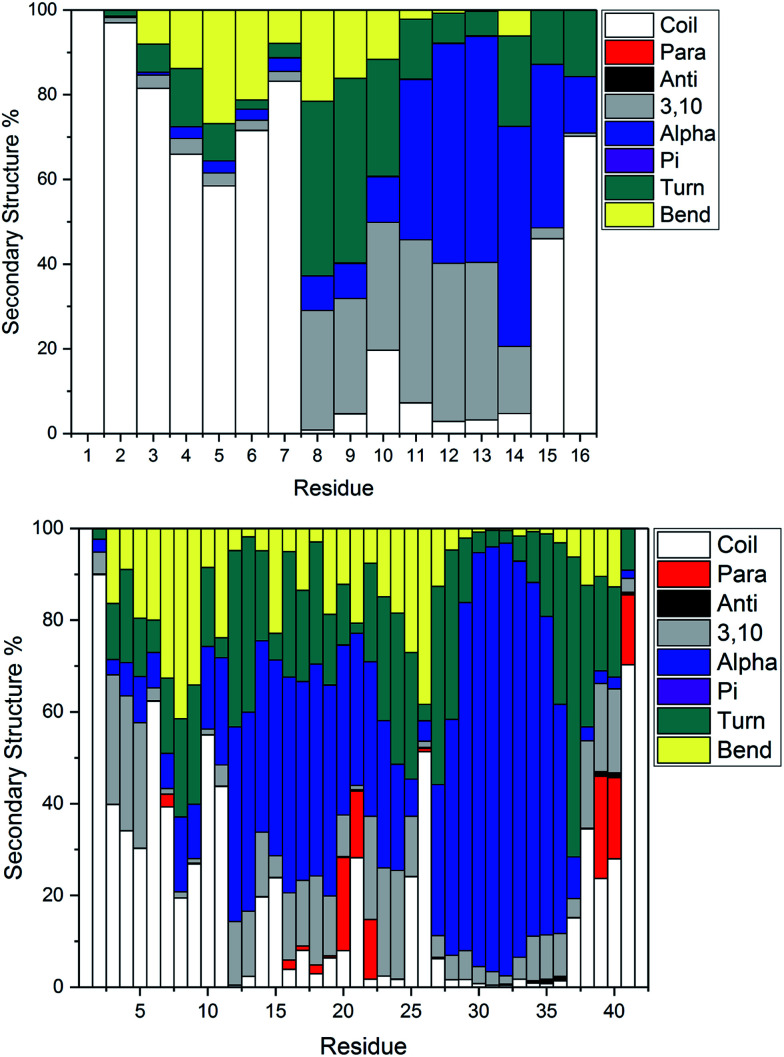
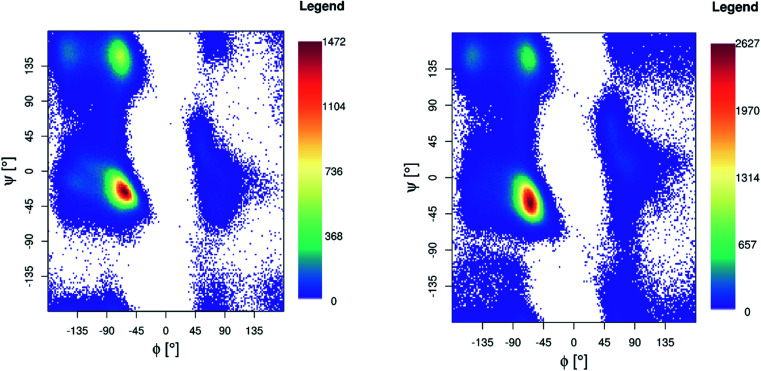
We report replica exchange molecular dynamics (REMD) simulations of the complex formed between amyloid-β peptides and platinum bound to a phenanthroline ligand, Pt(phen). After construction of an AMBER-style forcefield for the Pt complex, REMD simulation employing temperatures between 270 and 615 K was used to provide thorough sampling of the conformational freedom available to the peptide. We find that the full length peptide Aβ42, in particular, frequently adopts a compact conformation with a large proportion of α- and 3,10-helix content, with smaller amounts of β-strand in the C-terminal region of the peptide. Helical structures are more prevalent than in the metal-free peptide, while turn and strand conformations are markedly less common. Non-covalent interactions, including salt-bridges, hydrogen bonds, and π-stacking between aromatic residues and the phenanthroline ligand, are common, and markedly different from those seen in the amyloid-β peptides alone.
我们报告了淀粉样β肽与结合菲咯啉配体(Pt(phen))的铂形成的复合物的副本交换分子动力学(REMD)模拟。在构建了铂复合物的AMBER风格力场后,采用270至615 K温度的REMD模拟用于全面采样肽可利用的构象自由度。我们发现,特别是全长肽Aβ42,经常采用紧凑构象,其中α-螺旋和3,10-螺旋含量占很大比例,而肽的C端区域β-链含量较少。螺旋结构比无金属肽中更普遍,而转角和链构象明显较少见。包括盐桥、氢键以及芳香族残基与菲咯啉配体之间的π堆积在内的非共价相互作用很常见,且与单独的淀粉样β肽中所见的相互作用明显不同。