Dubay Megan M, Johnston Nikki, Wronkiewicz Mark, Lee Jake, Lindensmith Christian A, Nadeau Jay L
Department of Physics, Portland State University, Portland, OR, United States.
Jet Propulsion Laboratory, California Institute of Technology, Pasadena, CA, United States.
Front Microbiol. 2022 Apr 21;13:836808. doi: 10.3389/fmicb.2022.836808. eCollection 2022.
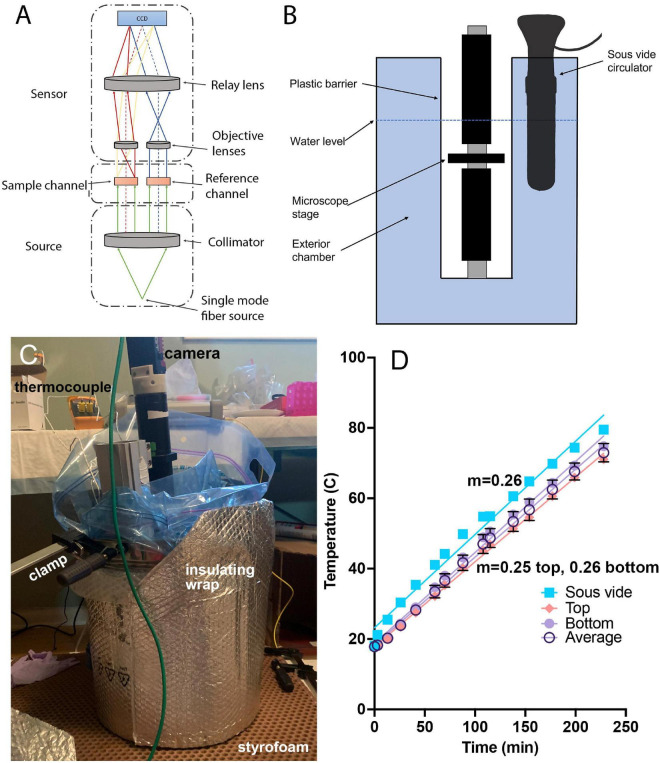
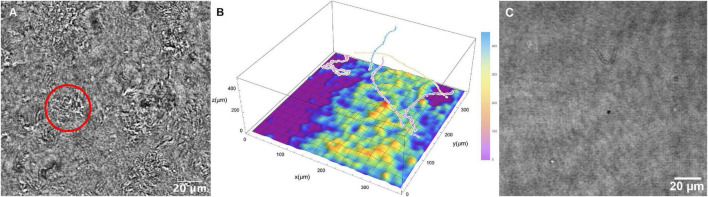
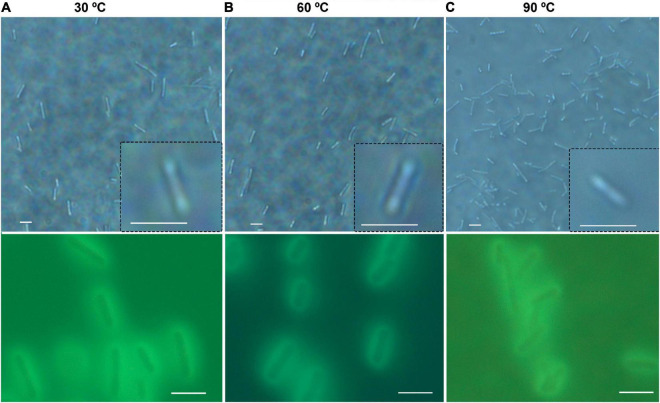
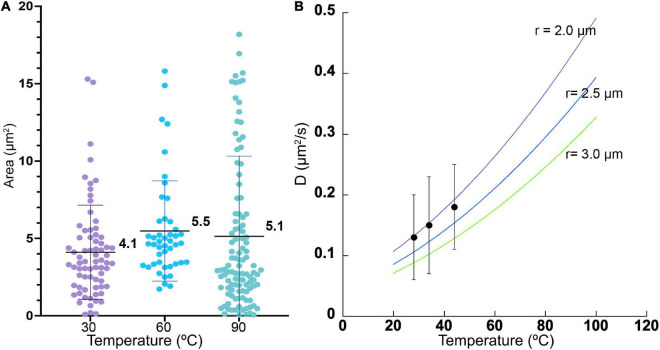
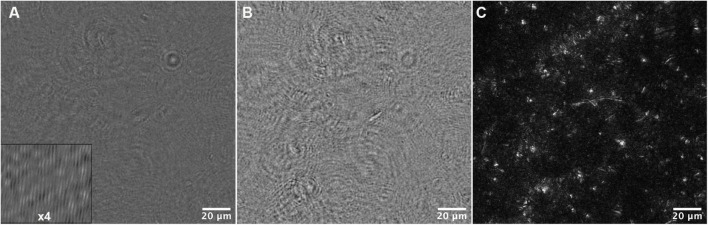
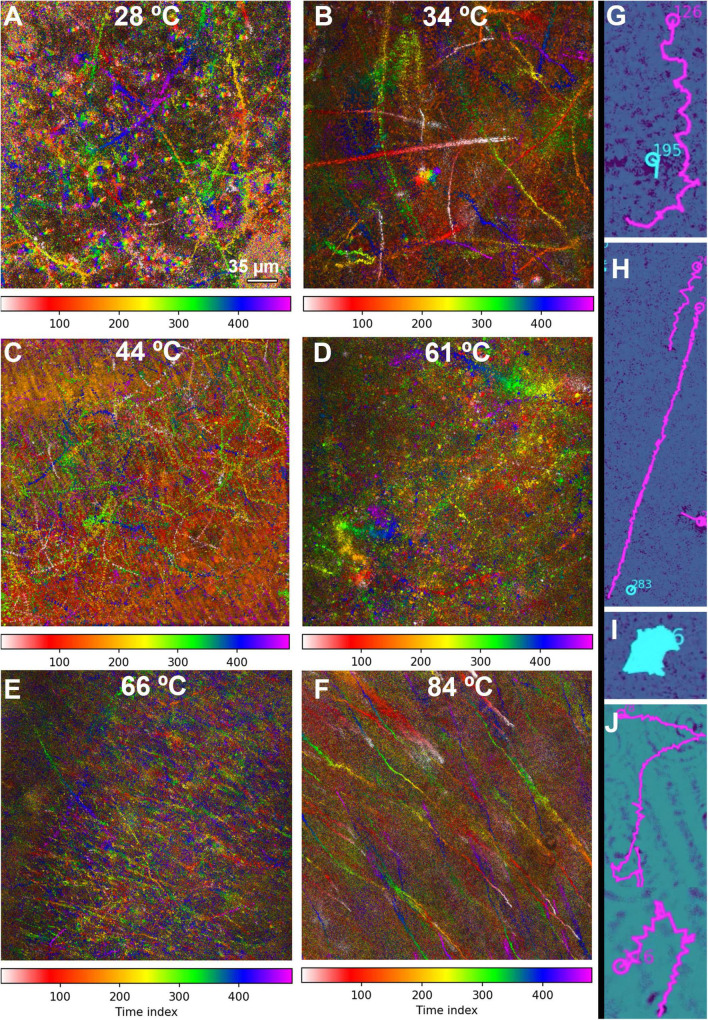
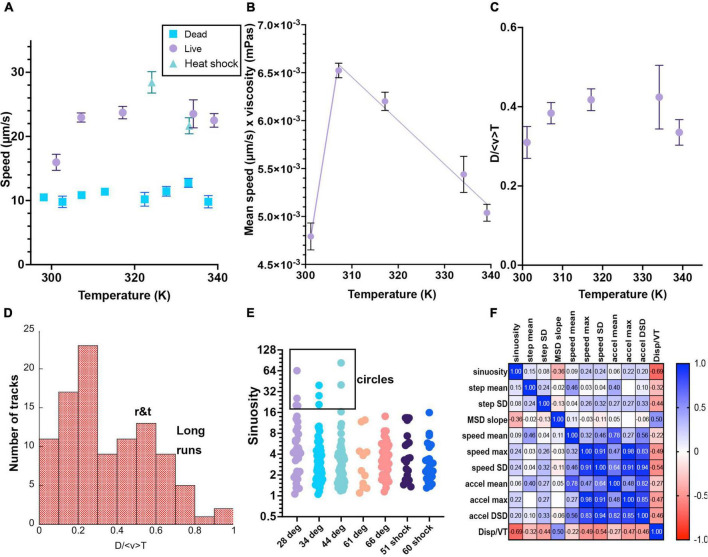
We describe a system for high-temperature investigations of bacterial motility using a digital holographic microscope completely submerged in heated water. Temperatures above 90°C could be achieved, with a constant 5°C offset between the sample temperature and the surrounding water bath. Using this system, we observed active motility in up to 66°C. As temperatures rose, most cells became immobilized on the surface, but a fraction of cells remained highly motile at distances of >100 μm above the surface. Suspended non-motile cells showed Brownian motion that scaled consistently with temperature and viscosity. A novel open-source automated tracking package was used to obtain 2D tracks of motile cells and quantify motility parameters, showing that swimming speed increased with temperature until ∼40°C, then plateaued. These findings are consistent with the observed heterogeneity of populations, and represent the highest reported temperature for swimming in this species. This technique is a simple, low-cost method for quantifying motility at high temperatures and could be useful for investigation of many different cell types, including thermophilic archaea.
我们描述了一种使用完全浸没在热水中的数字全息显微镜对细菌运动性进行高温研究的系统。该系统能够实现90°C以上的温度,样品温度与周围水浴之间存在恒定的5°C偏差。使用该系统,我们观察到在高达66°C时仍存在活跃的运动性。随着温度升高,大多数细胞固定在表面,但仍有一部分细胞在距离表面>100μm处保持高度运动性。悬浮的非运动细胞表现出与温度和粘度一致的布朗运动。使用一种新型的开源自动跟踪软件包来获取运动细胞的二维轨迹并量化运动参数,结果表明游泳速度随温度升高直至约40°C,然后趋于平稳。这些发现与观察到的群体异质性一致,并且代表了该物种游泳所报道的最高温度。该技术是一种简单、低成本的高温下量化运动性的方法,可用于研究包括嗜热古菌在内的许多不同细胞类型。