• 文献检索
  • 文档翻译
  • 深度研究
  • 学术资讯
  • Suppr Zotero 插件Zotero 插件
  • 邀请有礼
  • 套餐&价格
  • 历史记录
应用&插件
Suppr Zotero 插件Zotero 插件浏览器插件Mac 客户端Windows 客户端微信小程序
定价
高级版会员购买积分包购买API积分包
服务
文献检索文档翻译深度研究API 文档MCP 服务
关于我们
关于 Suppr公司介绍联系我们用户协议隐私条款
关注我们

Suppr 超能文献

核心技术专利:CN118964589B侵权必究
粤ICP备2023148730 号-1Suppr @ 2026

文献检索

告别复杂PubMed语法,用中文像聊天一样搜索,搜遍4000万医学文献。AI智能推荐,让科研检索更轻松。

立即免费搜索

文件翻译

保留排版,准确专业,支持PDF/Word/PPT等文件格式,支持 12+语言互译。

免费翻译文档

深度研究

AI帮你快速写综述,25分钟生成高质量综述,智能提取关键信息,辅助科研写作。

立即免费体验

微米尺度游泳生物库(BOSO-Micro)。

The bank of swimming organisms at the micron scale (BOSO-Micro).

机构信息

Department of Applied Mathematics and Theoretical Physics, University of Cambridge, Cambridge, United Kingdom.

Faculty of Physics, University of Warsaw, Warsaw, Poland.

出版信息

PLoS One. 2021 Jun 10;16(6):e0252291. doi: 10.1371/journal.pone.0252291. eCollection 2021.

DOI:10.1371/journal.pone.0252291
PMID:34111118
原文链接:https://pmc.ncbi.nlm.nih.gov/articles/PMC8191957/
Abstract

Unicellular microscopic organisms living in aqueous environments outnumber all other creatures on Earth. A large proportion of them are able to self-propel in fluids with a vast diversity of swimming gaits and motility patterns. In this paper we present a biophysical survey of the available experimental data produced to date on the characteristics of motile behaviour in unicellular microswimmers. We assemble from the available literature empirical data on the motility of four broad categories of organisms: bacteria (and archaea), flagellated eukaryotes, spermatozoa and ciliates. Whenever possible, we gather the following biological, morphological, kinematic and dynamical parameters: species, geometry and size of the organisms, swimming speeds, actuation frequencies, actuation amplitudes, number of flagella and properties of the surrounding fluid. We then organise the data using the established fluid mechanics principles for propulsion at low Reynolds number. Specifically, we use theoretical biophysical models for the locomotion of cells within the same taxonomic groups of organisms as a means of rationalising the raw material we have assembled, while demonstrating the variability for organisms of different species within the same group. The material gathered in our work is an attempt to summarise the available experimental data in the field, providing a convenient and practical reference point for future studies.

摘要

生活在水相环境中的单细胞微生物在地球上的数量超过了所有其他生物。它们中的很大一部分能够在具有各种游动步态和运动模式的液体中自主推进。在本文中,我们对迄今为止关于单细胞微游泳生物运动特性的可用实验数据进行了生物物理调查。我们从现有文献中收集了四类生物体的运动的经验数据:细菌(和古细菌)、鞭毛真核生物、精子和纤毛。只要有可能,我们就会收集以下生物学、形态学、运动学和动力学参数:物种、生物体的形状和大小、游动速度、驱动频率、驱动幅度、鞭毛数量以及周围流体的特性。然后,我们使用已建立的低雷诺数推进流体力学原理对数据进行组织。具体来说,我们使用相同分类群的生物的理论生物物理模型来合理化我们所收集的原始材料,同时展示同一组内不同物种的生物体的可变性。我们收集的材料旨在总结该领域的现有实验数据,为未来的研究提供方便实用的参考点。
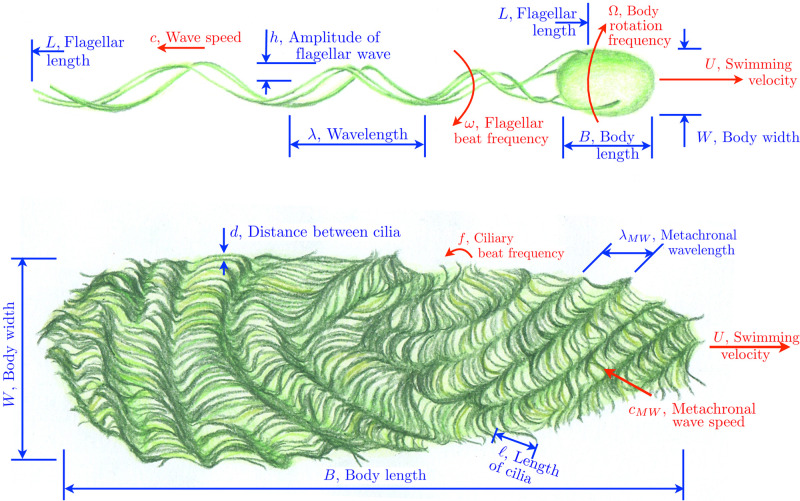
https://cdn.ncbi.nlm.nih.gov/pmc/blobs/3950/8191957/f10104392d1b/pone.0252291.g023.jpg
https://cdn.ncbi.nlm.nih.gov/pmc/blobs/3950/8191957/2a43048dda37/pone.0252291.g001.jpg
https://cdn.ncbi.nlm.nih.gov/pmc/blobs/3950/8191957/2fbc64140fd1/pone.0252291.g002.jpg
https://cdn.ncbi.nlm.nih.gov/pmc/blobs/3950/8191957/fd59edffb0ce/pone.0252291.g003.jpg
https://cdn.ncbi.nlm.nih.gov/pmc/blobs/3950/8191957/1bc7a7b02d44/pone.0252291.g004.jpg
https://cdn.ncbi.nlm.nih.gov/pmc/blobs/3950/8191957/27fc360fa7cd/pone.0252291.g005.jpg
https://cdn.ncbi.nlm.nih.gov/pmc/blobs/3950/8191957/cd57a5b61131/pone.0252291.g006.jpg
https://cdn.ncbi.nlm.nih.gov/pmc/blobs/3950/8191957/f21efaf064cd/pone.0252291.g007.jpg
https://cdn.ncbi.nlm.nih.gov/pmc/blobs/3950/8191957/ad187e405ee9/pone.0252291.g008.jpg
https://cdn.ncbi.nlm.nih.gov/pmc/blobs/3950/8191957/b16ef1da7213/pone.0252291.g009.jpg
https://cdn.ncbi.nlm.nih.gov/pmc/blobs/3950/8191957/dd3d9b03fab9/pone.0252291.g010.jpg
https://cdn.ncbi.nlm.nih.gov/pmc/blobs/3950/8191957/14d516ca5dcb/pone.0252291.g011.jpg
https://cdn.ncbi.nlm.nih.gov/pmc/blobs/3950/8191957/f7e746843414/pone.0252291.g012.jpg
https://cdn.ncbi.nlm.nih.gov/pmc/blobs/3950/8191957/07ec3b8e0758/pone.0252291.g013.jpg
https://cdn.ncbi.nlm.nih.gov/pmc/blobs/3950/8191957/57441ff64a0e/pone.0252291.g014.jpg
https://cdn.ncbi.nlm.nih.gov/pmc/blobs/3950/8191957/3b7a8a7683b2/pone.0252291.g015.jpg
https://cdn.ncbi.nlm.nih.gov/pmc/blobs/3950/8191957/82b4f3e9d356/pone.0252291.g016.jpg
https://cdn.ncbi.nlm.nih.gov/pmc/blobs/3950/8191957/c7da5fe926e2/pone.0252291.g017.jpg
https://cdn.ncbi.nlm.nih.gov/pmc/blobs/3950/8191957/9dfaf8ba3d93/pone.0252291.g018.jpg
https://cdn.ncbi.nlm.nih.gov/pmc/blobs/3950/8191957/d0bb3a53ab41/pone.0252291.g019.jpg
https://cdn.ncbi.nlm.nih.gov/pmc/blobs/3950/8191957/148d66a89836/pone.0252291.g020.jpg
https://cdn.ncbi.nlm.nih.gov/pmc/blobs/3950/8191957/b03411968031/pone.0252291.g021.jpg
https://cdn.ncbi.nlm.nih.gov/pmc/blobs/3950/8191957/78b64c4235ae/pone.0252291.g022.jpg
https://cdn.ncbi.nlm.nih.gov/pmc/blobs/3950/8191957/f10104392d1b/pone.0252291.g023.jpg
https://cdn.ncbi.nlm.nih.gov/pmc/blobs/3950/8191957/2a43048dda37/pone.0252291.g001.jpg
https://cdn.ncbi.nlm.nih.gov/pmc/blobs/3950/8191957/2fbc64140fd1/pone.0252291.g002.jpg
https://cdn.ncbi.nlm.nih.gov/pmc/blobs/3950/8191957/fd59edffb0ce/pone.0252291.g003.jpg
https://cdn.ncbi.nlm.nih.gov/pmc/blobs/3950/8191957/1bc7a7b02d44/pone.0252291.g004.jpg
https://cdn.ncbi.nlm.nih.gov/pmc/blobs/3950/8191957/27fc360fa7cd/pone.0252291.g005.jpg
https://cdn.ncbi.nlm.nih.gov/pmc/blobs/3950/8191957/cd57a5b61131/pone.0252291.g006.jpg
https://cdn.ncbi.nlm.nih.gov/pmc/blobs/3950/8191957/f21efaf064cd/pone.0252291.g007.jpg
https://cdn.ncbi.nlm.nih.gov/pmc/blobs/3950/8191957/ad187e405ee9/pone.0252291.g008.jpg
https://cdn.ncbi.nlm.nih.gov/pmc/blobs/3950/8191957/b16ef1da7213/pone.0252291.g009.jpg
https://cdn.ncbi.nlm.nih.gov/pmc/blobs/3950/8191957/dd3d9b03fab9/pone.0252291.g010.jpg
https://cdn.ncbi.nlm.nih.gov/pmc/blobs/3950/8191957/14d516ca5dcb/pone.0252291.g011.jpg
https://cdn.ncbi.nlm.nih.gov/pmc/blobs/3950/8191957/f7e746843414/pone.0252291.g012.jpg
https://cdn.ncbi.nlm.nih.gov/pmc/blobs/3950/8191957/07ec3b8e0758/pone.0252291.g013.jpg
https://cdn.ncbi.nlm.nih.gov/pmc/blobs/3950/8191957/57441ff64a0e/pone.0252291.g014.jpg
https://cdn.ncbi.nlm.nih.gov/pmc/blobs/3950/8191957/3b7a8a7683b2/pone.0252291.g015.jpg
https://cdn.ncbi.nlm.nih.gov/pmc/blobs/3950/8191957/82b4f3e9d356/pone.0252291.g016.jpg
https://cdn.ncbi.nlm.nih.gov/pmc/blobs/3950/8191957/c7da5fe926e2/pone.0252291.g017.jpg
https://cdn.ncbi.nlm.nih.gov/pmc/blobs/3950/8191957/9dfaf8ba3d93/pone.0252291.g018.jpg
https://cdn.ncbi.nlm.nih.gov/pmc/blobs/3950/8191957/d0bb3a53ab41/pone.0252291.g019.jpg
https://cdn.ncbi.nlm.nih.gov/pmc/blobs/3950/8191957/148d66a89836/pone.0252291.g020.jpg
https://cdn.ncbi.nlm.nih.gov/pmc/blobs/3950/8191957/b03411968031/pone.0252291.g021.jpg
https://cdn.ncbi.nlm.nih.gov/pmc/blobs/3950/8191957/78b64c4235ae/pone.0252291.g022.jpg
https://cdn.ncbi.nlm.nih.gov/pmc/blobs/3950/8191957/f10104392d1b/pone.0252291.g023.jpg

相似文献

1
The bank of swimming organisms at the micron scale (BOSO-Micro).微米尺度游泳生物库(BOSO-Micro)。
PLoS One. 2021 Jun 10;16(6):e0252291. doi: 10.1371/journal.pone.0252291. eCollection 2021.
2
Quiet swimming at low Reynolds number.低雷诺数下的安静游动。
Phys Rev E Stat Nonlin Soft Matter Phys. 2015 Apr;91(4):042712. doi: 10.1103/PhysRevE.91.042712. Epub 2015 Apr 24.
3
Asymmetry and stability of shape kinematics in microswimmers' motion.微泳者运动中形状运动学的非对称性和稳定性。
Phys Rev Lett. 2012 Jun 22;108(25):258101. doi: 10.1103/PhysRevLett.108.258101. Epub 2012 Jun 18.
4
Swimming by reciprocal motion at low Reynolds number.在低雷诺数下通过往复运动游泳。
Nat Commun. 2014 Nov 4;5:5119. doi: 10.1038/ncomms6119.
5
Optimal feeding and swimming gaits of biflagellated organisms.双鞭毛生物的最佳进食和游动步态。
Proc Natl Acad Sci U S A. 2011 Jan 18;108(3):1001-6. doi: 10.1073/pnas.1011185108. Epub 2011 Jan 3.
6
A minimal robophysical model of quadriflagellate self-propulsion.四鞭毛自推进的最小机器人物理模型。
Bioinspir Biomim. 2021 Sep 1;16(6). doi: 10.1088/1748-3190/ac1b6e.
7
Coordination of eukaryotic cilia and flagella.真核纤毛和鞭毛的协调。
Essays Biochem. 2018 Dec 7;62(6):829-838. doi: 10.1042/EBC20180029.
8
Nonlinear instability in flagellar dynamics: a novel modulation mechanism in sperm migration?鞭毛动力学中的非线性不稳定性:精子迁移的一种新的调制机制?
J R Soc Interface. 2010 Dec 6;7(53):1689-97. doi: 10.1098/rsif.2010.0136. Epub 2010 May 12.
9
Flow disturbances generated by feeding and swimming zooplankton.摄食和游动浮游动物产生的流动干扰。
Proc Natl Acad Sci U S A. 2014 Aug 12;111(32):11738-43. doi: 10.1073/pnas.1405260111. Epub 2014 Jul 28.
10
Maximum relative speeds of living organisms: Why do bacteria perform as fast as ostriches?生物的最大相对速度:为什么细菌的速度与鸵鸟一样快?
Phys Biol. 2016 Nov 15;13(6):066006. doi: 10.1088/1478-3975/13/6/066006.

引用本文的文献

1
Designing optimal elastic filaments for viscous propulsion.设计用于粘性推进的最佳弹性细丝。
Soft Matter. 2025 May 7;21(18):3503-3514. doi: 10.1039/d4sm01388c.
2
Costs and benefits of phytoplankton motility.浮游植物运动的成本与收益。
ArXiv. 2025 Mar 18:arXiv:2503.14625v1.
3
Functional morphology of gliding motility in benthic diatoms.底栖硅藻滑行运动的功能形态学

本文引用的文献

1
Structural Conservation and Adaptation of the Bacterial Flagella Motor.细菌鞭毛马达的结构保护与适应。
Biomolecules. 2020 Oct 29;10(11):1492. doi: 10.3390/biom10111492.
2
Axisymmetric spheroidal squirmers and self-diffusiophoretic particles.轴对称椭球形蠕动体和自扩散电泳粒子。
J Phys Condens Matter. 2020 Apr 17;32(16):164001. doi: 10.1088/1361-648X/ab5edd.
3
Swimming eukaryotic microorganisms exhibit a universal speed distribution.游泳真核微生物表现出普遍的速度分布。
Proc Natl Acad Sci U S A. 2025 Mar 25;122(12):e2426910122. doi: 10.1073/pnas.2426910122. Epub 2025 Mar 18.
4
Learning optimal integration of spatial and temporal information in noisy chemotaxis.学习在有噪声的趋化作用中空间和时间信息的最优整合。
PNAS Nexus. 2024 Jun 14;3(7):pgae235. doi: 10.1093/pnasnexus/pgae235. eCollection 2024 Jul.
5
Methods and Measures for Investigating Microscale Motility.微观尺度运动性研究的方法与措施
Integr Comp Biol. 2023 Dec 29;63(6):1485-1508. doi: 10.1093/icb/icad075.
6
Encounter rates prime interactions between microorganisms.相遇率引发微生物之间的相互作用。
Interface Focus. 2023 Feb 10;13(2):20220059. doi: 10.1098/rsfs.2022.0059. eCollection 2023 Apr 6.
7
Microswimmers in vortices: dynamics and trapping.微泳者在涡旋中:动力学与捕获。
Soft Matter. 2022 Dec 7;18(47):8931-8944. doi: 10.1039/d2sm00907b.
8
Predicting the locations of force-generating dyneins in beating cilia and flagella.预测驱动蛋白在摆动纤毛和鞭毛中产生力的位置。
Front Cell Dev Biol. 2022 Oct 11;10:995847. doi: 10.3389/fcell.2022.995847. eCollection 2022.
9
Separation of Heterotrophic Microalgae by Dielectrophoresis.通过介电泳法分离异养微藻
Front Bioeng Biotechnol. 2022 May 23;10:855035. doi: 10.3389/fbioe.2022.855035. eCollection 2022.
10
Quantification of Motility in at Temperatures Up to 84°C Using a Submersible Volumetric Microscope and Automated Tracking.使用潜水式体积显微镜和自动跟踪技术对高达84°C温度下的运动性进行定量分析。
Front Microbiol. 2022 Apr 21;13:836808. doi: 10.3389/fmicb.2022.836808. eCollection 2022.
Elife. 2019 Jul 16;8:e44907. doi: 10.7554/eLife.44907.
4
Computing the motor torque of Escherichia coli.计算大肠杆菌的电机扭矩。
Soft Matter. 2018 Jul 25;14(29):5955-5967. doi: 10.1039/c8sm00536b.
5
Ultrastructure of the spermatozoon of Megaselia scalaris Loew (Diptera:Brachycera:Cyclorrhapha:Phoridea:Phoridae).扁足蝇(双翅目:短角亚目:环裂亚目:蚤蝇科:扁足蝇科)精子的超微结构
J Morphol. 1989 Apr;200(1):47-61. doi: 10.1002/jmor.1052000107.
6
Movement of spermatozoa of Megaselia Scalaris (Diptera: Brachycera: Cyclorrhapha: Phoridae) in artificial and natural fluids.黑腹果蝇(双翅目:短角亚目:环裂亚目:蚤蝇科)精子在人工和天然液体中的运动。
J Morphol. 1991 Oct;210(1):85-99. doi: 10.1002/jmor.1052100108.
7
Kinematics of flagellar swimming in : Helical trajectories and flagellar shapes.鞭毛游动的运动学:螺旋轨迹和鞭毛形状。
Proc Natl Acad Sci U S A. 2017 Dec 12;114(50):13085-13090. doi: 10.1073/pnas.1708064114. Epub 2017 Nov 27.
8
SPERM CHEMOTAXIS IN OIKOPLEURA DIOICA FOL, 1872 (UROCHORDATA: LARVACEA).1872年尖笔帽海樽(UROCHORDATA: LARVACEA)中的精子趋化性
Biol Bull. 1983 Oct;165(2):419-428. doi: 10.2307/1541207.
9
Applying torque to the Escherichia coli flagellar motor using magnetic tweezers.利用磁镊对大肠杆菌鞭毛马达施加扭矩。
Sci Rep. 2017 Mar 7;7:43285. doi: 10.1038/srep43285.
10
Swimming and feeding of mixotrophic biflagellates.混合营养双鞭毛藻的游泳和摄食。
Sci Rep. 2017 Jan 5;7:39892. doi: 10.1038/srep39892.